
Rule 4 Deductions Explained: 2026 Table & Calculator
A Rule 4 deduction is money taken off your winnings (never your stake) when a horse is withdrawn after you placed your bet at a price. The amount depends on the withdrawn horse's odds at the time: from 5c per €1 of winnings for a 10/1-14/1 shot up to 90c per €1 for a very short-priced favourite. Horses longer than 14/1 trigger no deduction at all.
A horse is withdrawn, your bet wins, and the payout comes up short. That is Rule 4: a standard deduction every bookmaker applies when a runner comes out after you took a price. Here is exactly how much it takes, why, and how to check the sum yourself.
Nothing sours a winning bet like a payout that does not match the maths on the slip. You backed a horse at 4/1, staked €10, and the account shows €40 back instead of €50. In almost every case the missing money is a Rule 4 deduction, and it is neither an error nor the bookmaker chancing its arm: it is a standard, published scale that every licensed bookmaker applies the same way, triggered by one thing only - a horse coming out of the race after you took your price.
This guide covers what Rule 4 means, the full deductions table, the exact calculation with worked examples, how it treats each-way bets, starting price and ante-post wagers, and a calculator that does the sum for any bet.

What is a Rule 4 deduction in horse racing?
Rule 4 takes its name from Rule 4(c) of the Tattersalls Committee Rules on Betting, the long-standing framework that governs betting disputes in British racing and is applied in practice by bookmakers in Ireland and far beyond. It answers a fairness problem. When you take a price about a horse, that price reflects the whole field: your 4/1 means "4/1 against this horse beating these particular rivals". If one of those rivals - especially a fancied one - is withdrawn before the race, every remaining runner's chance improves, and the price you locked in is suddenly better than the true odds. Without a correction, punters would be paid at odds the market never really offered.
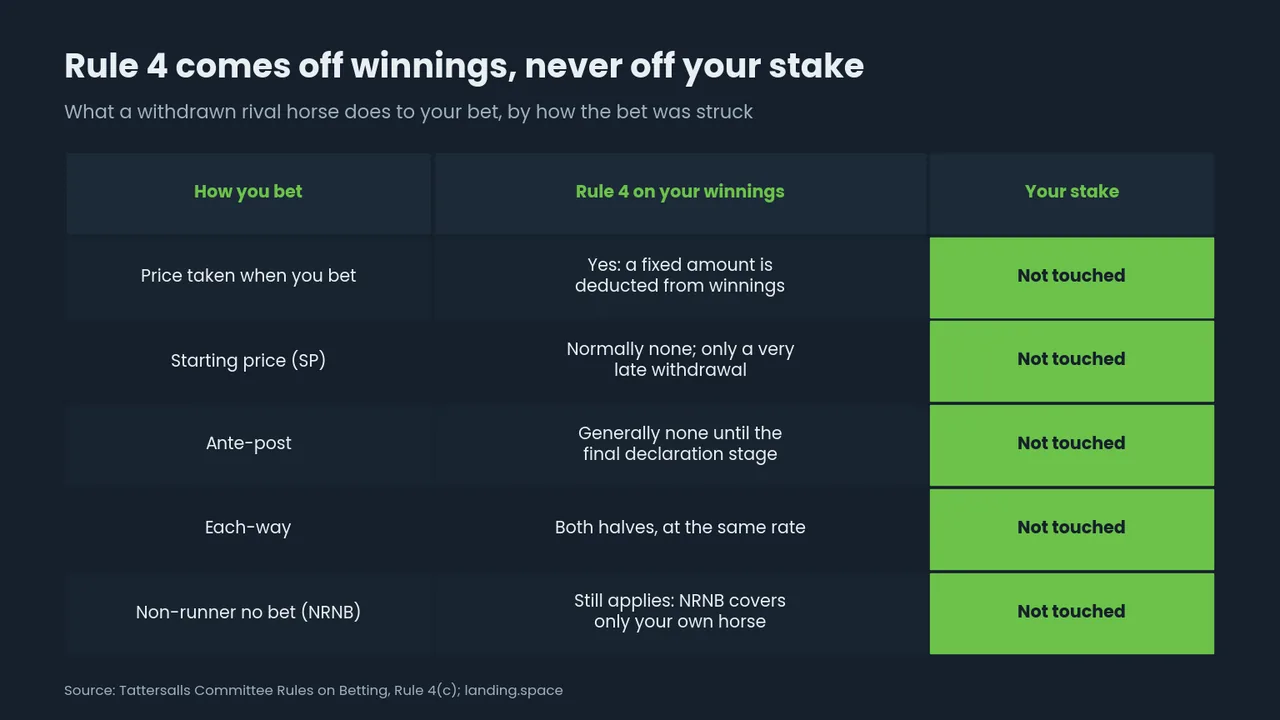
So instead of voiding bets or re-pricing them one by one, Rule 4 applies a standard deduction to winnings, scaled to how big the withdrawal was. A 12/1 outsider dropping out barely changes the race, so it costs you 5c in the euro. An even-money favourite dropping out transforms it, so it costs 45c. The deduction never touches your stake - a winning bet always returns the full stake plus the reduced winnings.
The Rule 4 deductions table
The deduction is set by the withdrawn horse's price at the moment it came out - not your horse's price. This is the standard scale, whether you call it the Rule 4 table or the Rule 4 deductions chart; it is the same list, expressed in cent deducted per €1 of winnings:
| Odds of the withdrawn horse | Deduction per €1 of winnings |
|---|---|
| 1/9 or shorter | 90c |
| 2/11 to 2/17 | 85c |
| 1/4 to 1/5 | 80c |
| 3/10 to 2/7 | 75c |
| 2/5 to 1/3 | 70c |
| 8/15 to 4/9 | 65c |
| 8/13 to 4/7 | 60c |
| 4/5 to 4/6 | 55c |
| 20/21 to 5/6 | 50c |
| Evens to 6/5 | 45c |
| 5/4 to 6/4 | 40c |
| 13/8 to 7/4 | 35c |
| 15/8 to 9/4 | 30c |
| 5/2 to 3/1 | 25c |
| 10/3 to 4/1 | 20c |
| 9/2 to 11/2 | 15c |
| 6/1 to 9/1 | 10c |
| 10/1 to 14/1 | 5c |
| Longer than 14/1 | No deduction |
Two footnotes matter in practice. When two or more horses are withdrawn, the total deduction in a race is capped at 75c in the euro (Tattersalls Rule 4(c)). And many bookmakers voluntarily waive the 5c deduction as a customer-friendly gesture, so a 12/1 withdrawal often ends up costing you nothing - check the operator's house rules.
How is a Rule 4 deduction calculated? A worked example
The calculation is one line: net winnings = winnings × (1 − deduction), with the stake returned untouched on top.
Say you back a horse at 4/1 at Leopardstown with a €10 stake. Before the off, the 2/1 favourite is withdrawn. From the table, a 2/1 withdrawal (in the 15/8 to 9/4 band) triggers a 30c deduction.
Your winnings would have been €10 × 4 = €40. The Rule 4 removes 30c per euro: €40 × 0.70 = €28 net winnings. Add the returned €10 stake and the total payout is €38 instead of €50. In effect, your 4/1 became 2.8/1 - roughly the price the horse would have been in a market without the favourite.
If a second horse then came out at 8/1 (a 10c band), the deductions add: 30c + 10c = 40c in the euro, and the same bet would pay €40 × 0.60 + €10 = €34.

Rule 4 calculator
Enter your stake and odds, pick the withdrawn horse's price band, and the calculator shows the deduction and your actual payout.
Does Rule 4 apply to each-way bets?
Yes, to both halves. The deduction is applied to the winnings of the win part and to the winnings of the place part, at the same rate. The place terms themselves do not change: if the race was paying a quarter of the odds for three places when you struck the bet, it still does. What can change is the number of places if the field shrinks below a threshold (for example, a handicap dropping from 8 runners to 7 moves from 3 places to 2) - but that is a separate place-terms rule, not part of Rule 4. The full mechanics of win and place parts are covered in our each-way betting guide.
Rule 4, starting price, ante-post and non-runner no bet
Whether a withdrawal hits your bet depends on when you struck it and on what terms:
Bets at SP. Normally unaffected. If there is time before the off, bookmakers re-form the market without the withdrawn horse, and the starting price already prices the smaller field. Only a very late withdrawal - too late for a new market - puts a Rule 4 on SP bets.
Ante-post bets. Struck days or months in advance, these run on different terms: if your horse does not run you usually lose the stake, and in exchange, withdrawals of other horses generally trigger no Rule 4 until the final declaration stage. The bigger early price is the compensation for both risks.
Non-runner no bet (NRNB). This protects you when your own horse comes out: the stake is refunded. It does not stop a Rule 4 deduction when a different horse is withdrawn - the two rules solve different problems and frequently apply to the same race.
Do all bookmakers apply Rule 4 the same way?
The scale itself is standard - the table above is the one you will find in the house rules of licensed bookmakers across Ireland and the UK, because it comes from the Tattersalls Rules that the industry has settled on. Differences live at the edges: many operators waive the 5c deduction, a few advertise "no Rule 4" concessions on selected televised races, and betting exchanges do not use Rule 4 at all - they apply their own reduction factors to matched bets when a runner is withdrawn, published per horse before the race. Wherever you bet, the deduction must be listed in the rules and itemised on your settled slip; if a payout looks short and no withdrawal occurred, query it. Rule 4 is a racing rule; if you also play casino games, our Irish online casino guide and the Irish casino reviews set out each casino's own settlement terms.
Frequently asked questions
What does Rule 4 mean in horse racing?
How much does a Rule 4 deduction take off?
Does a Rule 4 deduction apply to my stake?
Does Rule 4 apply to bets placed at SP?
Does Rule 4 apply to each-way bets?
Can more than one Rule 4 apply to the same race?
Related questions
Guides are for information only; the deduction bands shown are the standard Tattersalls scale and individual bookmakers may apply them slightly differently. 18+. Gambling involves risk - please play responsibly. Content reflects the rules and market terms as of 18 September 2026.