
Does online casino play show on your credit file?
No: a UK credit file lists your credit accounts, repayments and searches, not where you spend your money, so deposits at an online casino do not appear on it and do not change your score on their own. Two things can still bring gambling into a lending decision. A lender reading your bank statements, which mortgage lenders usually ask for, will see payments to gambling sites. And debts or missed payments caused by gambling show up like any others. The Gambling Commission's new financial risk assessments use credit data but, it says, have no impact on your credit score.
People ask this question for two reasons: they are about to apply for a mortgage or a loan and worry their online play will count against them, or they are worried that it already has. The answer is reassuring on the first point and practical on the second, but it needs separating into what a credit file holds, what a lender can see elsewhere, and what the new affordability checks do.
What a credit file holds, and what it does not
TransUnion lists what goes on a UK credit report: your personal details, your credit accounts from the last six years and how you repaid them, searches made on your file, people you are financially linked to, court judgments, insolvencies and fraud markers. Experian adds that your report does not include details about your income, savings or employment. Spending is not on either list. A deposit at a casino is a payment from your bank account or card, and that payment is not reported to the agencies, just as a supermarket shop is not.
- Not on your file: casino deposits and withdrawals, wins and losses, and how often you play.
- On your file: any credit you use, including an overdraft, and whether you repay it on time; missed payments and defaults; hard searches when you apply for credit.
- Visible only to you: soft searches, such as identity checks.
None of the three agencies' help pages says in so many words that gambling is left off, which is why we explain how we get there. MoneySavingExpert puts it directly: "gambling activity is not recorded on your credit file". The money problems gambling can cause are another matter: missed payments and arrears are recorded, whatever caused them.
The searches a casino can leave
When you open an account, a UK-licensed casino checks your identity and age before you can gamble, and it may check information about you in other ways too. Whether that leaves a mark depends on the kind of search. The agencies describe the two kinds like this:
| Kind of search | Who can see it | Effect on your score | How long it stays |
|---|---|---|---|
| Soft search (for example an identity check) | Only you | None | Shown to you only |
| Hard search (an application for credit) | You and lenders | Can lower it, especially several close together | 12 months at Experian; up to 2 years at TransUnion |
Experian gives "a company searches your credit report as part of an identity check" as an example of a soft search, and says soft searches are not visible to companies and have no impact on your credit score. None of the agencies' pages names casinos specifically, so we cannot tell you how every operator runs its checks; what we can say is that an identity check is described as a soft search, and an account at a casino is not an application for credit. You cannot gamble on credit in Britain anyway: MoneyHelper notes that credit cards cannot be used for gambling.
Financial risk assessments: credit data, no credit mark
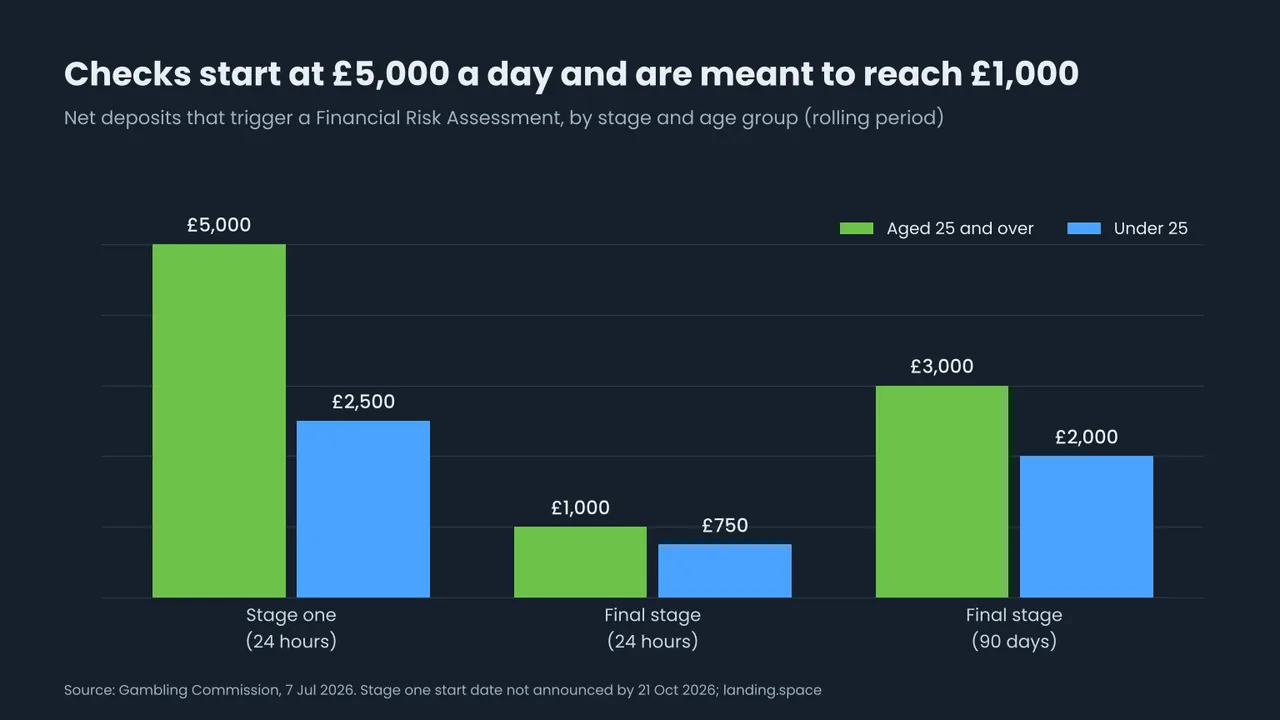
The checks most likely to raise this question are the Gambling Commission's financial risk assessments, which it confirmed on 7 July 2026 after a pilot with credit reference agencies. They are frictionless and document-free, provided by the credit reference agencies, and the Commission says they have "no impact on their credit score". They look for signs of significant financial difficulty in the agencies' data, such as serious arrears, defaults or bankruptcy; in the pilot 97% of assessments needed no action from the customer.
They will come in stages. Stage one covers the largest operators and customers depositing very large amounts: £5,000 net in a rolling 24 hours, or £2,500 for under-25s. The final stage lowers that to £1,000 in 24 hours or £3,000 over 90 days, and £750 or £2,000 for under-25s. On 7 July the Commission said the stage one timetable would be confirmed after work with the industry; when we checked on 21 October no start date had been announced.
Where gambling does show: your bank statements
The credit file is only part of a lending decision. Experian's mortgage guide says lenders usually ask for bank statements covering the last three to six months and may use them to understand your regular outgoings. Payments to and from gambling sites are on those statements like any other transaction. MoneySavingExpert says gambling does not rule you out automatically, but lots of deposits or several accounts could raise doubts with a mortgage lender.
Paying a casino by e-wallet or in crypto changes what the statement shows, not what you spent: the top-ups to the wallet or exchange still appear on it. If a mortgage application is coming up, it helps to know that the statements a lender asks for usually cover the last three to six months. Our pages on crypto casinos and casinos without ID checks explain how those sites work, including the checks they skip and what that means for you as a customer; they do not make a payment invisible to a lender.
If gambling has already hurt your credit
- Add a Notice of Correction. Experian lets you add a statement of up to 200 words to your report, which lenders see when you apply. You do not have to mention gambling; it takes Experian 2 to 4 weeks to add, and Equifax says it adds, changes or removes one within 28 days. Equifax suggests adding it at all three agencies.
- Turn on a gambling block. Experian names Lloyds Bank, Monzo, Barclays and Starling among the banks that let you block gambling payments on your card.
- Get free debt advice. National Debtline on 0808 808 4000 and StepChange on 0800 138 1111, both listed by Equifax, help with arrears before they become defaults.
- Talk to someone about the gambling itself. The National Gambling Helpline, run by GamCare, is free on 0808 8020 133, 24 hours a day. MoneyHelper also points to GAMSTOP, which excludes you from UK-licensed sites for six months to five years.
Frequently asked questions
Does gambling affect your credit score in the UK?
Can a mortgage lender see that I gamble online?
Does an online casino's ID check go on my credit file?
Will the new financial risk assessments hurt my credit score?
What is a Notice of Correction?
Read next
18+ only. General information, not financial advice. Sources are the credit reference agencies' and the Gambling Commission's pages, read 22 Oct 2026. If gambling is affecting your money, the National Gambling Helpline is on 0808 8020 133, 24 hours a day.