
Why Australian cards get declined at offshore casinos
Because the site is breaking Australian law, and the payment is the part of it an Australian bank can see. Online casinos are banned services under the Interactive Gambling Act. Visa requires online gambling merchants to code their payments as betting, and banks act on that category: through a gambling block you switched on, or through their own card rules, such as Macquarie refusing gambling-coded payments on its credit cards. The credit card ban of 11 June 2024 is about online and telephone betting services. From 1 January 2027, the 2026 reforms require banks and payment systems to prevent payments from Australian accounts to illegal gambling operators, so far as reasonably practicable.
The casino's website loads, the games run, the deposit screen takes your details, and the card is declined. That order is not an accident. The site breaks Australian law simply by offering casino games to you, and the regulator's tool against the site itself is asking internet providers to block the specific addresses it has identified. The payment is different: it has to pass through an Australian bank that knows what kind of merchant is asking.
Nothing on this page is a way around that. It sets out which layer said no, what each bank actually blocks, and what changes from 2027, so you can tell a bank control from a fault.
Three layers between your card and an offshore casino
| Layer | What it does | Since |
|---|---|---|
| The law | The Interactive Gambling Act makes it illegal for providers to offer online casinos to people in Australia; the offence is the provider's | 2001 |
| Site blocking | The ACMA asks internet providers to block illegal gambling sites: 1,178 sites and affiliates from November 2019 to March 2025 | Nov 2019 |
| Card coding | Online gambling merchants must use code 7995, "Betting"; banks block by that category | Visa rule |
| Credit card ban | Online and phone betting services may not take credit cards, credit-linked wallets or crypto | 11 Jun 2024 |
| Bank blocks | Blocks you switch on, and card rules some banks apply anyway | Bank policy |
| Payment blocking | Banks and payment systems must prevent payments from Australian accounts to illegal gambling operators, so far as reasonably practicable | 1 Jan 2027 |
The first layer explains the others. The ACMA's own summary of the law is about providers: the Act "makes it illegal for gambling providers to offer some online services", with online casinos on the list. The same regulator warns that "Australians who use illegal gambling services risk losing their money". That warning is about what you can get back if something goes wrong, and it is why the payment layer matters.
The gambling code your bank sees
Every card payment carries a merchant category code. Visa's merchant data manual says a merchant that runs online gambling "must use MCC 7995 for all transactions, even if gambling is not the Merchant's primary business". Banks name the category rather than the number: Westpac's gambling preference stops personal credit and debit card transactions "registered under the merchant category code 'Betting/Casino Gambling'", and Macquarie says it is "unable to make authorisation of transactions from merchants that are classified under the gambling merchant category code" on its credit cards. Macquarie adds the honest caveat that the category "is determined by the merchant or their bank, and from time to time may be incorrect".
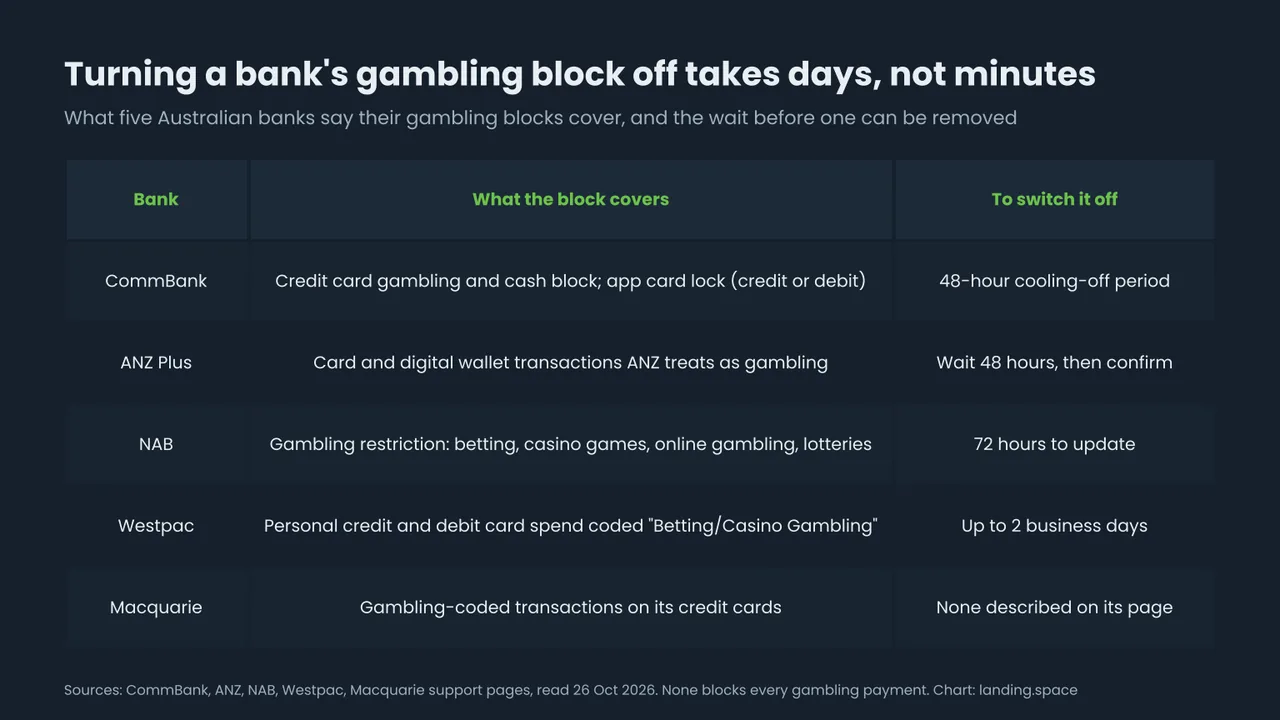
Every bank that offers a block also says it is not airtight. CommBank "isn't able to guarantee that all gambling related purchases will be stopped", NAB's restriction blocks "most (but not all) gambling transactions", and ANZ says some gambling payments will get through while some ordinary ones may be stopped. A payment that slips past a block does not make the casino legal; a decline with no block switched on is the bank's own decision on that card, and only the bank can explain it.
What the 2024 credit card ban covers, and what it does not
Since 11 June 2024, in the ACMA's words, "you won't be able to use a credit card or digital currency to place bets". The rule is narrower than its name suggests:
| Question | What the official pages say |
|---|---|
| Who it binds | "Online and telephone betting services, including those provided by on-course bookmakers"; companies that fail to enforce it face fines of up to $247,500 |
| What it bans | "A credit card", "funds linked to a credit card (including digital wallets)" and "digital currency (such as cryptocurrency)" |
| What it leaves out | Lotteries, by name; neither the ACMA nor the department mentions debit cards |
| How it is going | "A very high level of compliance with the credit card and crypto ban, with no investigations commenced" (ACMA, October 2025) |
The ban explains why a licensed bookmaker refuses your credit card. It does not explain an offshore casino decline, because those sites never had permission to take your money in the first place. That decline comes from the code and the bank.
The 2027 rules aimed at the payment itself
The Interactive Gambling Amendment (Gambling Reform) Act 2026 received Royal Assent on 26 August 2026, and its commencement table starts every schedule except the transitional one on 1 January 2027. Schedule 2 opens with a part headed "Blocking financial transactions", and the minister's release describes the result as "allowing banks and payment systems to block transactions to illegal gambling operators".
The Act itself is firmer than "allowing". Its new section 15J says a bank or other payment-system participant "must prevent, so far as it is reasonably practicable to do so", a payment or transfer from an account held in Australia to the provider of a designated interactive gambling service, or anyone associated with or acting for it, with a civil penalty of up to 1,000 penalty units; the ACMA may publish guidelines on what is reasonably practicable. The duty runs one way: the government's overview of the May exposure draft said the bill "deliberately does not target transactions from designated interactive gambling services to Australian bank accounts". Payouts into Australian accounts are left alone; how withdrawals from offshore sites work, and why they take time, is on our fast withdrawal casinos page.
Regulators are already looking past cards. The ACMA's compliance report says it "engaged with AUSTRAC and financial institutions to identify and discuss the use of PayID", and it describes "significant risks to consumers through the use of high-volume, small-value transactions to illegal services". What PayID payments at offshore casinos involve, including those risks, is on our PayID casinos page.
If the block was yours
Bank blocks are built as harm tools, which is why lifting one takes time: 48 hours at CommBank and ANZ, 72 hours at NAB, up to two business days at Westpac, while Macquarie's credit card page describes no way to switch its restriction off. If the decline you hit was a block you set yourself, the wait is doing its job. Gambling Help Online answers on 1800 858 858, free and confidential, 24/7, and our gambling help page lists the state services. BetStop excludes you from licensed Australian online and phone betting providers; an offshore casino is not one of them, which is one place a card block can help where BetStop cannot.
Frequently asked questions
Is it illegal for me to play at an offshore online casino?
Does the credit card ban apply to offshore casinos?
How long does it take to turn off a bank's gambling block?
Will banks block offshore casino payments from 2027?
Why does the casino site still load if it is illegal?
Read next
18+ only. General information, not legal or financial advice. Bank rules come from the CommBank, ANZ, NAB, Westpac and Macquarie support pages read on 26 Oct 2026, and your own bank's terms apply. Free, confidential help: 1800 858 858.