
Do You Pay Tax on Gambling Winnings in Australia?
For most people, no. Under ATO taxation ruling IT 2655, the winnings of an ordinary punter are not assessable income, and by the same logic their losses are not tax deductible. The ATO accepts that gambling can be a business, but says that is rare, and gambling with a significant element of skill is more likely to have tax consequences. Crypto you win is not taxed as a win either, but it takes a cost base equal to its market value on the day you won it, so selling it later can trigger capital gains tax.
Australians who win at the races, on the pokies or at an online casino usually keep the whole amount, and those who lose cannot claim it back at tax time. The position comes from the way Australian courts have treated gambling, which the Australian Taxation Office summarises in taxation ruling IT 2655, issued on 17 October 1991 and still published in the ATO legal database. This page walks through what the ruling says, the test for when gambling becomes a business, the separate rule for crypto you win, and the questions the ruling leaves open, including winnings from offshore casinos. It is general information, not tax advice.
What ATO ruling IT 2655 says about punters
Hobby or business: the four Brajkovich questions
| Question from the ruling | Points towards a mere punter | Points towards a business |
|---|---|---|
| Is the gambling systematic, organised and conducted in a businesslike way? | Bets placed when the mood strikes, no records | Planned, recorded and organised the way a business would be |
| What is the volume and size of the activity? | Occasional bets, modest stakes | Large and frequent bets |
| Is it connected with other businesslike activities? | No connection beyond betting | Linked to a related business, such as breeding horses |
| Is it driven mainly by profit or by pleasure? | Mainly entertainment | Mainly profit |
| How much do chance and skill decide the result? | Chance is the predominant ingredient | A significant element of skill |
The first four rows are the criteria from the Brajkovich case that the ruling relies on; the last row reflects the ruling's own comments on chance and skill. No single answer settles the question. The ruling says it will be rare for a taxpayer "with no connection with racing other than betting" to be carrying on a business, and that "the intrusion of chance into the activity as a predominant ingredient" will generally prevent gambling from being treated as a business. That is why a large win, on its own, does not change a punter into a professional.
Where skill changes the picture
The ruling states that "gambling which involves a significant element of skill is more likely to have tax consequences". It does not name particular games, and it was written in 1991, well before online poker rooms or betting models existed. What it gives is a direction: the more your results come from skill, method and volume rather than luck, the closer you move to the business side of the table above.
Someone who plays online pokies or roulette for fun sits clearly on the punter side, because the result of each spin is chance. Someone who plays poker seriously for years, keeps detailed records and relies on the results for a living is in a different position. Most people fall somewhere between, and that middle ground is exactly where a registered tax agent earns their fee.
Crypto you win and capital gains tax
The ATO page on crypto asset prizes and gambling winnings (updated 22 June 2026) adds a rule that matters for anyone paid in coins. Gains and losses from gambling are disregarded for capital gains tax. The same page says prizes won in ordinary lotteries, such as lotto draws and raffles, and prizes won on game shows are generally not ordinary income. But crypto you win becomes an asset you own, with a cost base equal to its market value at the time you won it, and when you later sell or otherwise dispose of it, that disposal can be a CGT event. The ATO gives this example:
- The win: a person wins crypto assets worth A$20,000 in an online lottery. That A$20,000 becomes the cost base.
- The wait: they hold the coins for 2 years.
- The sale: they sell for A$30,000, a capital gain of A$10,000.
- The discount: because they held the assets for more than 12 months, the CGT discount applies and the net capital gain is A$5,000.
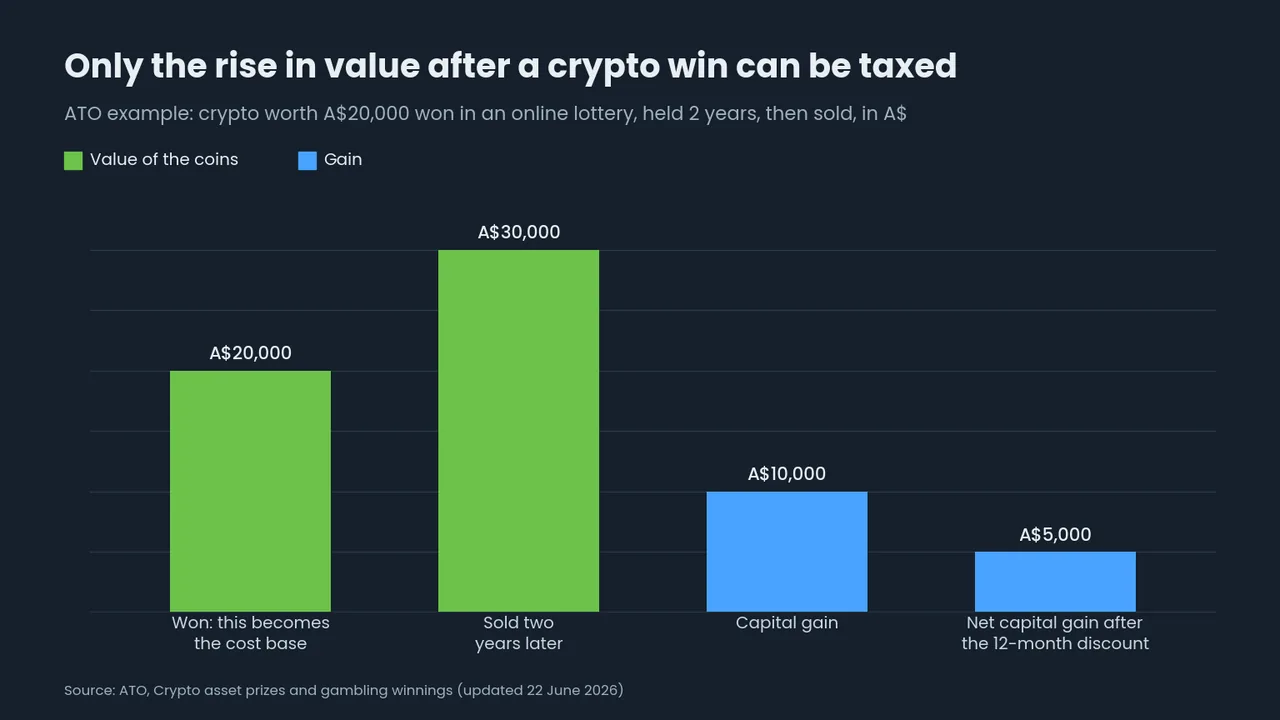
Put simply, the win itself is not taxed, but the change in value after you win can be. That is why the A$ value on the day a crypto win lands in your wallet is worth writing down. Offshore casinos that pay in coins, like the ones in our crypto casinos guide, show balances in the coin, not in Australian dollars. Other crypto steps around gambling, such as swapping coins to make a deposit, are outside what we checked; ask the ATO or a registered tax agent.
Five situations, read against the ruling
To make the principles concrete, here is how the ruling and the ATO crypto page line up with some common situations. These are illustrations of the published guidance, not rulings on anyone's return.
| Situation | What the ATO guidance points to |
|---|---|
| A weekend pokies player at a club lands a large win | Mere punter: chance is the predominant ingredient, so the win is not assessable |
| A casual player wins at an online casino licensed overseas | The punter principles describe the activity, but the ruling does not address offshore sites; ask the ATO or a tax agent if unsure |
| A player is paid a win in crypto and sells the coins a year and a half later for more | The win is disregarded for CGT; the rise in value after the win can be a capital gain |
| A bettor runs a written system, high volume and detailed records, aiming for profit | Several Brajkovich questions point towards a business; get advice |
| A horse breeder who also bets heavily on races | A link to other businesslike activity is one of the factors the ruling lists |
The pattern is consistent: the size of a single win matters far less than how the gambling is carried on. Where several business indicators line up, the answer can change, and that is the point to stop reading guides and speak to someone who can see the whole picture.
Is there a dollar limit before winnings are taxed?
No dollar threshold appears in IT 2655. The ruling does not say winnings become taxable above a set amount. The test is about how you gamble overall, including the volume and size of your activity, not a cut-off figure for a single win. If you see a "gambling winnings tax threshold" quoted for Australia, ask where it comes from, because it is not in the ruling. For the same reason, an ordinary punter normally has nothing to declare for winnings and nothing to claim for losses: both sit outside assessable income and deductions.
Offshore casinos: what the ruling leaves open
IT 2655 dates from 1991 and does not address offshore gambling sites at all. We read the ruling and the ATO crypto page only, and found nothing in either that deals specifically with winnings from an overseas online casino. Online casino games may not be offered to people in Australia, so any online casino that accepts Australians, including those compared on our best online casinos Australia page, operates from overseas. The general principles above describe how the ATO treats a mere punter; whether anything about an offshore site changes that in your case is a question for the ATO or a registered tax agent, not for us.
Records worth keeping anyway
- Crypto wins: the date, the coin, the amount and its A$ market value when it reached you. That figure is the cost base the ATO example starts from.
- Deposits and withdrawals: casino and bank or wallet statements, which show where money came from if a large deposit lands in your bank account.
- If skill or volume is high: a simple log of sessions, stakes and results gives an adviser something concrete to work with.
Frequently asked questions
Do I have to declare casino winnings on my tax return?
Can I claim gambling losses as a tax deduction?
Are poker winnings taxed in Australia?
Is crypto I win at a casino taxed?
Is lottery or lotto prize money taxable?
Does the ATO see my gambling winnings?
Read next
18+ only. General information, not legal or tax advice. This page summarises ATO ruling IT 2655 and the ATO crypto prizes page as read on 24 Sep 2026; for your own situation ask the ATO or a registered tax agent.