
Gambling and your home loan: what lenders check
Yes, it can. Australian lenders must make reasonable inquiries about your finances and verify them, and the usual evidence is three months of bank statements (six if you are casually employed), where betting and casino payments show by name. ASIC's responsible lending guide lists "gambling accounts" among the outgoings a lender can check. Gambling does not appear on your credit report, but if a lender treats it as an ongoing expense it can reduce what you can borrow.
ASIC's responsible lending guide, RG 209, is mostly about process: what a lender must ask, what it must check, and when a loan is unsuitable. Near the back, in a table of variable outgoings a lender can verify, a list of everyday spending ends with two words: "gambling accounts". The same table names the evidence: "bank statements recording relevant transactions". There is no special gambling rule in Australian home lending, and there does not need to be. The general duty to look at your finances puts your statements in front of an assessor, and a deposit to a betting app reads the same as a payment to a gym.
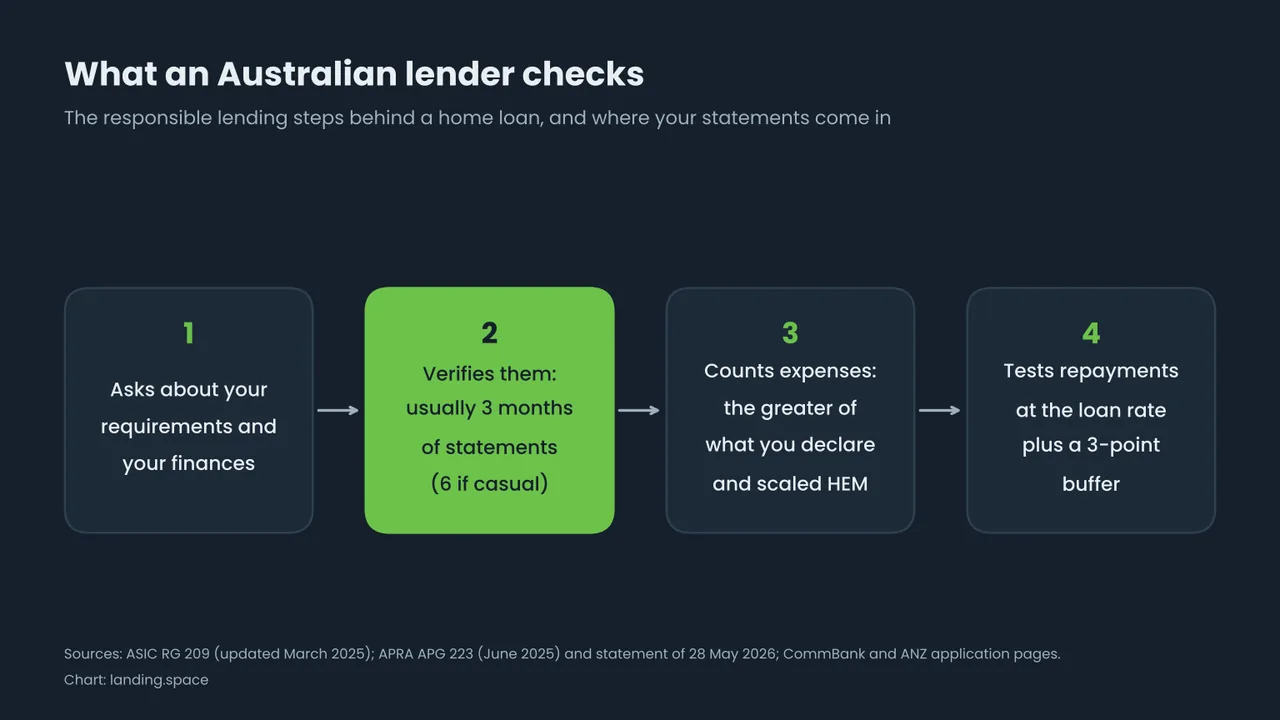
What the rules ask lenders to do
The National Consumer Credit Protection Act requires a lender or broker to do three things before a loan: make reasonable inquiries about what you want the credit for, make reasonable inquiries about your financial situation, and "take reasonable steps to verify" it. A loan is unsuitable if, among other things, you could only keep up the repayments "with substantial hardship". RG 209 adds that "it is not sufficient merely to rely on" the information a borrower gives, and that many borrowers "will need to reduce their current expenditure to afford the repayments", which is why the conversation about spending happens at all.
How far lenders must dig was tested in court. ASIC sued Westpac over a system that used the Household Expenditure Measure (HEM), a benchmark of modest living costs, rather than borrowers' declared expenses. ASIC lost at first instance in 2019 and again on appeal in June 2020, when the Full Federal Court dismissed its appeal two to one; the dissenting judge, Middleton J, wrote that "Reliance on the HEM Benchmark itself cannot ensure compliance with the responsible lending provisions". APRA, the banking regulator, sets the floor for banks and other deposit-taking lenders: its practice guide expects them to use "the greater of" a borrower's declared living expenses and a scaled HEM figure, and to test repayments at least 3 percentage points above the loan rate, a buffer APRA confirmed on 28 May 2026. Since February 2026 APRA has also limited banks' new lending at six times income or more to 20% of their new mortgage lending, for owner-occupier and investor loans separately.
What your statements show
| Lender | Statements asked for | Spending questions | Gambling named? |
|---|---|---|---|
| CommBank | Last three months; six if casually employed | A breakdown of monthly living expenses | No |
| ANZ | Three months for full-time or part-time work; six for casual, temporary or contract work | A breakdown of monthly living expenses | No |
| NAB | Proof of savings history, such as bank statements | Monthly expenses "including school fees, rent, dining out and regular bills" | No |
| Westpac (checklist current at May 2020) | Last three months for all loan, savings and transaction accounts | Categories including "Recreation/Entertainment" | No |
| Macquarie | Access to your transaction history or statements | Living expenses such as groceries, utilities and insurances | No |
None of the big lenders' consumer pages mentions gambling, and none needs to: a statement shows every transaction with the merchant's name, and an assessor reading three months of them sees deposits to and payouts from betting apps and casino sites like any other line. A worked example in RG 209 has a lender treating transaction statements as "the most convenient and efficient way" to get the picture, either supplied by the borrower or collected by a data service with their permission; the Consumer Data Right is one opt-in way to share transaction history. Brokers say what lenders then look for. A broker's guide from July 2025, written under an Australian credit licence, says lenders "typically review your last 3-6 months of bank statements" and that frequent sports betting, online casino or pokies activity "can be a red flag"; another says gambling "can be one of the most sensitive areas on a bank statement".
Offshore casino payments are no different: a deposit or a payout is a transaction on the statement like any other. How those sites take and return money is covered on our pages on PayID casinos and fast-withdrawal casinos.
How gambling can change what you can borrow
Whether gambling costs you anything at the assessment depends on how it is counted. Most lenders compare your declared living expenses with a HEM figure scaled to your income and use the larger of the two; Macquarie's broker guidelines, dated 22 October 2026, describe exactly that, with any "Additional living expenses" added on top. If a lender treats regular betting as an ongoing outgoing on top of that floor, every dollar of it comes off the surplus that services the loan, and that surplus is tested at the higher, buffered rate.
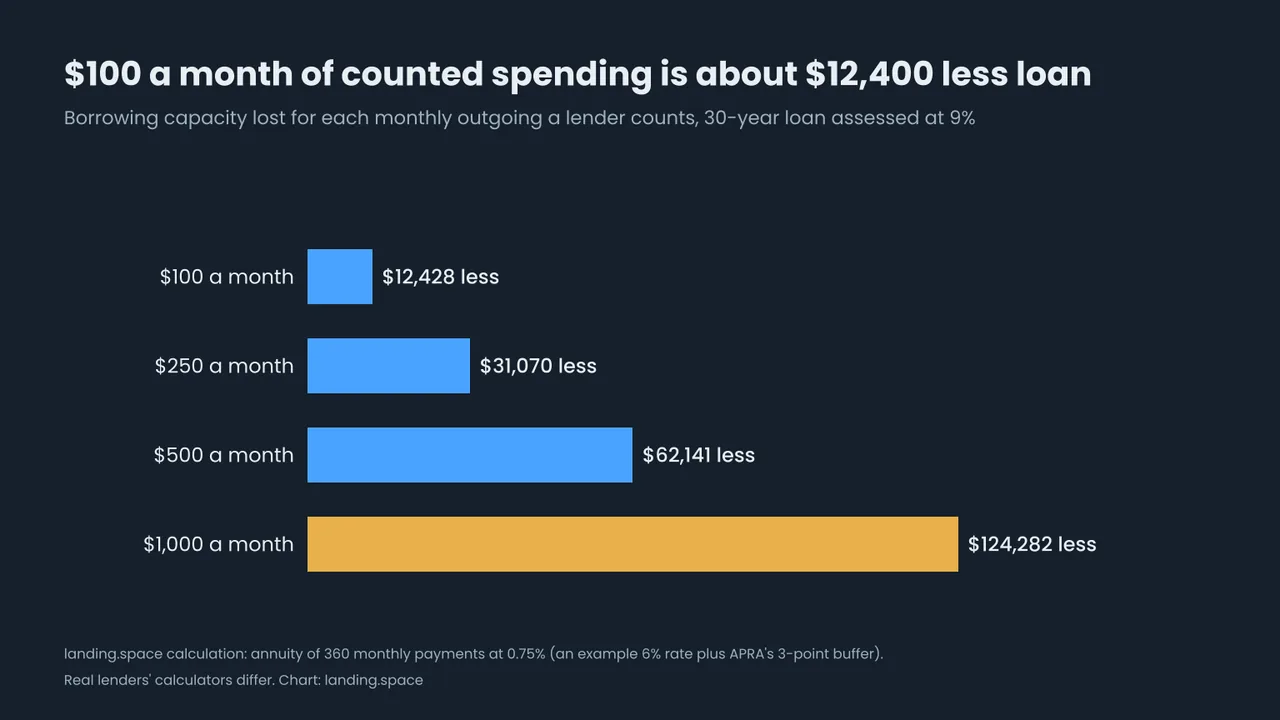
The chart is our calculation. On a 30-year loan assessed at 9%, each dollar of monthly repayment supports about $124 of loan, so $100 a month of counted spending is about $12,400 less you can borrow, and $500 a month about $62,100. If your declared spending, betting included, still sits below the HEM figure for your income, the number used may not move at all; the effect is largest when betting pushes your declared expenses above it. Roy Morgan's survey to June 2025 found that over a third (34.1%) of "problem gamblers" were "At Risk" of mortgage stress.
What does not show: your credit report
Your credit report is a separate record, and gambling is not on it. The Office of the Australian Information Commissioner and Moneysmart set out what a report can hold, including:
- personal details that identify you, and the credit you have applied for and hold;
- repayment history, meaning whether each consumer credit payment was made on time;
- financial hardship information;
- defaults on consumer credit payments of $150 or more, and bankruptcy.
A credit provider "is not permitted to give a CRB any other information about your consumer credit activities", and bank transactions are not on the list. What can reach your report is the effect of gambling on credit: missed repayments, defaults or a run of credit applications.
One route has also closed. Since 11 June 2024 you cannot use a credit card or digital currency to bet with a licensed online or phone wagering service, and those services cannot offer you credit or help you get it from third parties. The ban does not cover lotteries.
Before you apply
- Read your last three to six months of statements as an assessor would. Count the betting and casino lines, deposits and payouts both, and see what they add up to against your income.
- Declare your spending honestly. Lenders must verify what you tell them and cannot merely rely on it, so an undeclared pattern on a statement raises more questions than a declared one.
- Be ready to explain a change. RG 209 recognises that many borrowers cut spending to afford a loan; if you have stopped betting, say when, and expect the lender to look for the statements that show it.
- Talk to a broker if your situation is unusual. Lenders' policies differ, and a broker can explain how, and what your statements will need to show.
- Get help if gambling is the problem, not the loan. BetStop, the national self-exclusion register, blocks you from licensed online and phone betting for a minimum of three months. The National Gambling Helpline is on 1800 858 858, and the National Debt Helpline on 1800 007 007 is open Monday to Friday, 9:30am to 4:30pm, according to Moneysmart. More options are on our gambling help page.
Frequently asked questions
Do banks look at gambling when you apply for a home loan?
Does gambling show on my credit report in Australia?
Can gambling stop me getting a home loan?
How many months of bank statements do lenders check?
Will one big win or a few small bets matter?
Can I use a credit card to bet in Australia?
Read next
18+ only. General information, not financial or credit advice. Rules come from ASIC, APRA and the OAIC, and lender requirements from CommBank, ANZ, NAB, Westpac and Macquarie pages read on 1 Nov 2026 (Westpac's checklist is dated May 2020); your lender's own policy applies. Free, confidential help: 1800 858 858.