
Melbourne Cup betting explained: scratchings, barriers
Bets on the 2026 Melbourne Cup (Tuesday 3 November, Flemington, 3200 m) change character at 4.30pm on Saturday 31 October, when the final field is declared. A TAB fixed-odds bet struck before then is all-in: if your horse does not start, the stake is gone. A bet struck after it is refunded if your horse is scratched, but a winning bet can be cut by a deduction when another runner comes out. The field is capped at 24 and the Cup has no emergencies.
The Melbourne Cup is the race a lot of Australians bet on without following racing for the rest of the year, and that is exactly why its rules catch people out. It is a handicap with a long build-up, the field is not settled until the Saturday before, and a price taken in September comes with conditions that a bet on race morning does not. Most of the surprises come from three things: when you bet, what a scratching does to your stake, and how barriers and weights can move after you have bet.
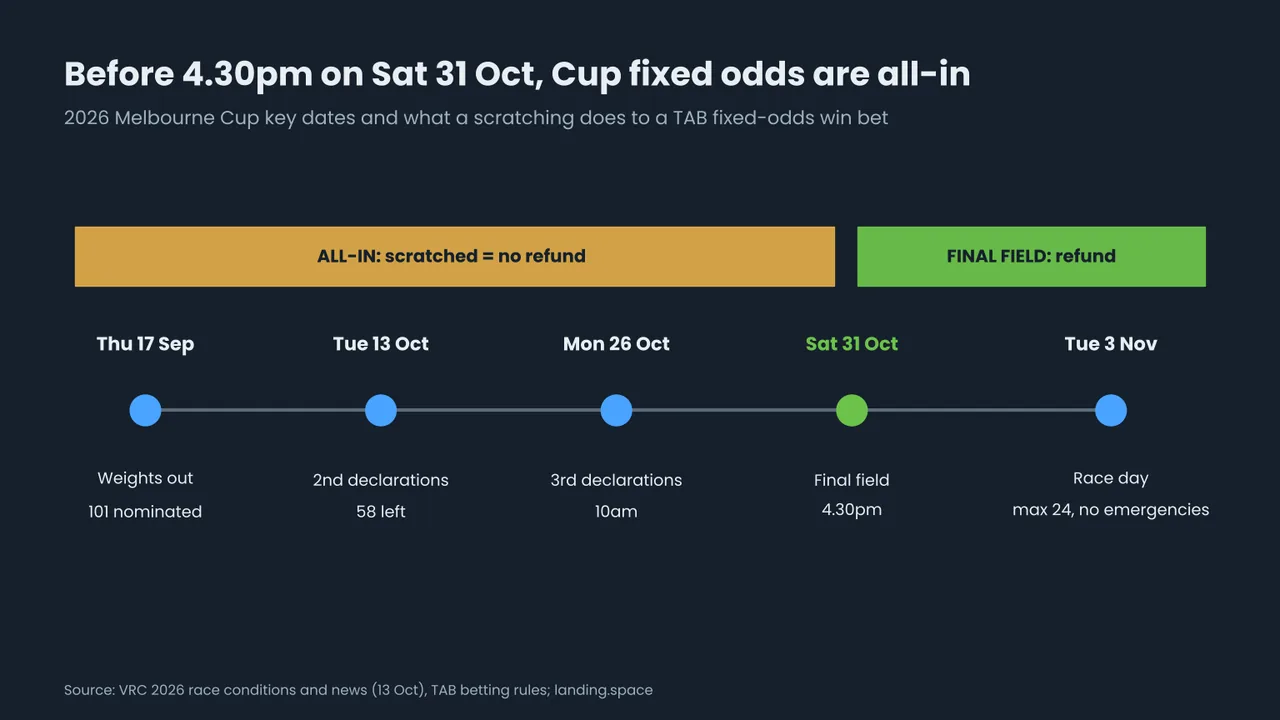
The 2026 Cup calendar, and where it stands now
The VRC received 101 nominations on 1 September for the 166th running, worth $10.2 million: $4.5 million and trophies valued at $1.11 million to the winner, and $100,000 even for 13th to 24th. Weights came out on 17 September. After second declarations on 13 October, 58 horses were still in, with last year's winner Half Yours topweight on 59 kg.
| Date (2026) | Stage | What it means for a bet |
|---|---|---|
| Thu 17 Sep | Weights released | The handicapper's weights shape the early market. A later win can still add weight. |
| Tue 13 Oct | Second declarations, 58 left | Horses not declared drop out. A futures bet on one of them is lost. |
| Mon 26 Oct, 10am | Third declarations | The list shrinks again; futures bets on the dropped horses are lost too. |
| Sat 31 Oct, 4.30pm | Final declarations: the final field | From here, a TAB fixed-odds bet on a horse that is scratched is refunded. |
| Tue 3 Nov | Race day, 3200 m, maximum 24 starters | No emergencies, so a late scratching leaves a smaller field. |
The barrier draw is not on the conditions sheet. By VRC practice the barriers are drawn with some ceremony at Flemington once the field is final, after racing on Derby Day, the Saturday before the Cup, which this year is 31 October. The VRC had not published a time for it when we checked on 21 October.
No emergencies this year: what that changes
Many Australian races carry emergencies, reserve horses that get a start if a runner is scratched before the deadline. The 2026 conditions say it in so many words: "Maximum of 24 Starters - No Emergencies". Once the final field is declared at 4.30pm on 31 October, a scratching simply leaves the Cup with fewer runners. Nobody comes in from a reserve list, so there is no emergency to back and no question of whether an emergency "got a run".
The conditions also stop the nominator or agent from pulling a final acceptor out later. A scratching after Saturday is a decision for the stewards, which is why late Cup scratchings are rare but expensive when they happen: the market has already formed around a field of up to 24. If you are betting on race morning, check the final scratchings first.
All-in or final field: the line that decides a refund
TAB's racing rules draw the line at the official time for final acceptances. Fixed-price win and place bets struck before it are all-in: the bet stands "regardless of whether or not a particular contestant" starts, and "no refund shall be payable". TAB's help pages call these Futures markets. Bets struck after the final field is declared are Final Field bets, and a bet on a horse that is then scratched "will be refunded in full".
| When and how you bet | Your horse is scratched | Another horse is scratched |
|---|---|---|
| Fixed odds before 4.30pm Sat 31 Oct (Futures, all-in) | No refund | TAB's deduction rule (4.6) is written for bets placed after final acceptances |
| Fixed odds after 4.30pm Sat 31 Oct (Final Field) | Refunded in full | A winning bet is subject to TAB's scale of deductions |
| Tote, single bet | Refunded after the final dividends are paid | The dividend comes from the pool after the race |
| Tote Quaddie or other multi-leg bet | Your nominated substitute takes the scratched runner's place | The dividend comes from the pool after the race |
In practice, a September futures bet is a bet that the horse makes the field as well as wins it, which is why futures prices are longer. If the refund matters more to you than the price, wait for the final field on Saturday evening and take what is on offer then. Other bookmakers set their own rules, and the line may not sit in the same place, so read the racing terms of the one you use; our Australian betting sites guide compares the ones we review.
How deductions work when another horse comes out
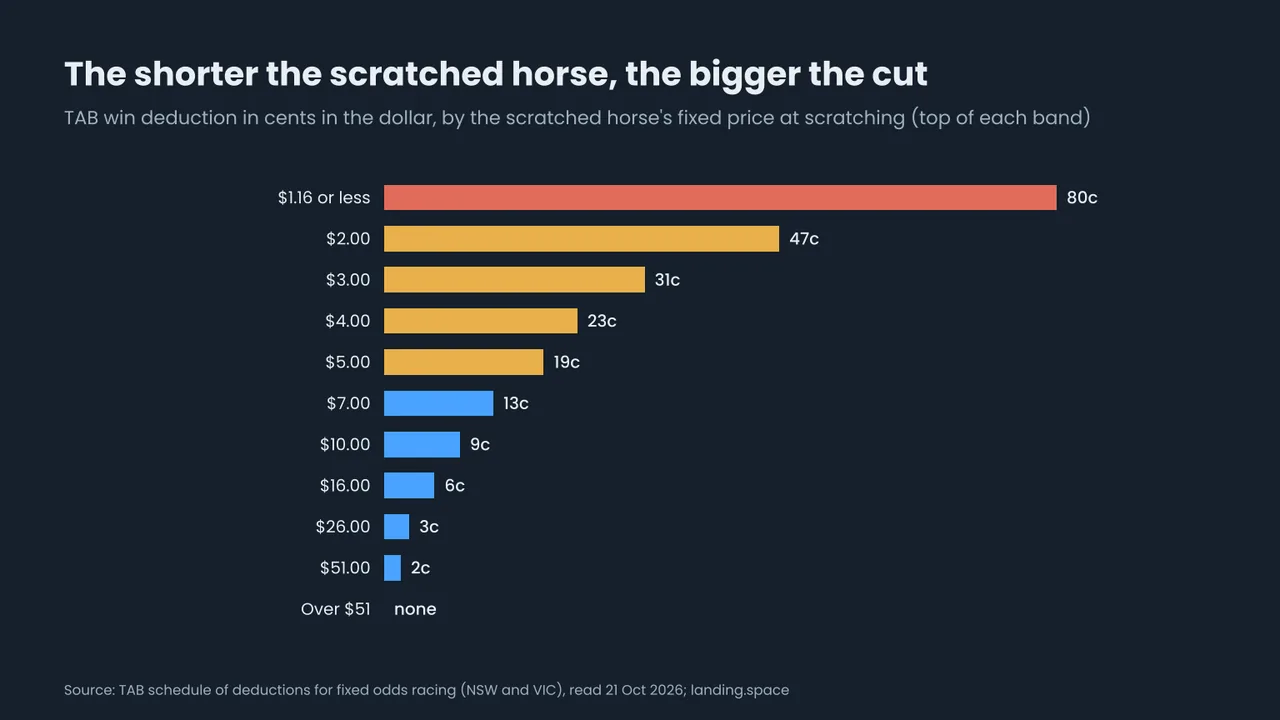
When a horse is scratched after the final field, every other runner's chance improves, and bookmakers who laid fixed prices recover that with a deduction based on the scratched horse's price at the moment it came out. TAB publishes one scale for its NSW and Victorian fixed-odds racing bets, stated in cents in the dollar, with separate columns for win and place bets.
| Scratched horse's price | Win deduction | Place deduction (3 dividends) | Place deduction (2 dividends) |
|---|---|---|---|
| $1.96 to $2.00 | 47c | 25c | 35c |
| $2.91 to $3.00 | 31c | 21c | 28c |
| $4.81 to $5.00 | 19c | 16c | 20c |
| $9.51 to $10.00 | 9c | 10c | 12c |
| $21.01 to $26.00 | 3c | 4c | 5c |
| $41.01 to $51.00 | 2c | 2c | 2c |
| Over $51.00 | None | None | None |
The pattern is what matters for the Cup. A short-priced favourite scratched near the jump takes a large slice off every other winning ticket, while a $41 roughie coming out barely registers. One thing the rules do not settle: TAB's gazetted wording ties the deduction to "the payout due on successful bets" without saying whether it comes off the whole return or only the winnings. If the exact figure matters to you, ask your bookmaker for a worked example before race day rather than after it.
Barriers are drawn on Saturday, and then they move
The draw is random, and it only happens once the field is final, so a futures bet is always struck without knowing where the horse will jump from. The detail many punters miss is what a scratching does afterwards. In the VRC's own words, "every competitor drawn outside the withdrawal moves up one place at the barrier". Back a horse drawn in 18, see the horse in 4 scratched, and yours starts from 17.
- Original draw and actual start are different numbers. The VRC's barrier history for 1958 to 2024 counts both. Horses that originally drew 8 or 20 have never won the Cup in that time, yet horses that ended up starting from those barriers won 5 Cups between them.
- The best record depends on which you count. By original draw, barriers 5 and 12 lead with 6 winners each; by the barrier actually started from, 11 leads with 7.
- Treat it as colour, not a system. Sixty-odd races spread over 24 stalls is a small sample, and every year's field and track are different.
Weights, and why a late win changes the picture
The Cup is a handicap: the handicapper gives better horses more weight to even up the field. For 2026 the topweight could not be less than 59 kg when weights were released and must be at least 57 kg at final acceptances. The minimum is 51 kg for horses aged four and up and 49 kg for three-year-olds, and the conditions add "No allowances for Apprentices", so a young rider's usual claim does not apply in this race.
Weights can still move after release. The winner of an internationally recognised Listed, Group or Graded flat race after the weights are out may carry extra weight in the Cup if that race was a handicap of 1600 metres or more or any other race of 2300 metres or more; the handicapper decides how much, if any. That is why a lead-up handicap like the Caulfield Cup matters twice to Cup punters: a win can shorten a horse's price and add to its weight at the same time. A Cox Plate win (2040 metres, weight-for-age) does not bring a Cup penalty. Winning one of 11 named races, among them the Caulfield Cup, the Cox Plate and the Geelong Cup, also exempts a horse from the ballot if it stays in as a final acceptor.
Betting on the Cup online from Australia
Race betting with a provider licensed in Australia is a legal, regulated service, which is why Cup markets are everywhere in October. Two federal rules apply to every online and phone bet you place with one. Since 11 June 2024 you cannot fund a bet with a credit card or digital currency; ACMA enforces that ban against the providers. And BetStop, the national self-exclusion register, lets you block yourself from every licensed online and phone wagering provider for anything from 3 months to a lifetime. Our BetStop guide explains how it works and what it does not cover.
Cup Day is also a public holiday across Victoria, on Tuesday 3 November 2026, unless a council outside Melbourne has arranged a local holiday instead, so the race lands in the middle of a lot of office sweeps and long lunches. If the day stops being fun, the National Gambling Helpline on 1800 858 858 is free; more options are on our gambling help page.
Frequently asked questions
Is my Melbourne Cup bet refunded if the horse is scratched?
What does all-in mean in Cup betting?
Are there emergencies in the Melbourne Cup?
When is the 2026 Melbourne Cup barrier draw?
Why was my winning bet paid less than the price I took?
Can I use a credit card to bet on the Cup online?
Read next
18+ only. General information, not betting or financial advice. Dates and rules are the VRC 2026 conditions and TAB's published rules as read on 21 Oct 2026; other bookmakers set their own terms. Free help: 1800 858 858.