
US senators press Kalshi and Polymarket on election trading



Two US senators, the Democrat Elizabeth Warren and the Republican John Curtis, have asked the prediction markets Kalshi and Polymarket to show how they keep insiders out of their election contracts, with written answers due by 3 November 2026, the day of the US midterm elections. Their letter of 28 October cites four candidates Kalshi has sanctioned for trading on their own races and a WIRED report of more than $600 million in trading on Polymarket contracts about elections in Ethiopia and Romania. Whether either company has sent its written answers is not public.
Seven questions, due on Election Day
The letter is addressed to Tarek Mansour, chief executive of Kalshi, Inc., and Shayne Coplan, chief executive of Blockratize, Inc., which does business as Polymarket. Warren is the Ranking Member of the Senate Banking, Housing, and Urban Affairs Committee; Curtis is a Republican senator from Utah. The committee's minority office published the letter on 29 October; the senators asked for responses "by Election Day, Tuesday, November 3rd".
The senators write that they are "particularly troubled by election-related event contracts", the contracts that pay out according to who wins a race. They set out seven numbered questions:
| No. | What the senators ask each company |
|---|---|
| 1 | What stops candidates, campaign staff, election officials and pollsters from trading on election contracts |
| 2 | How it spots trading on non-public information, including trades placed through third parties or linked accounts |
| 3 | What assurance and evidence it can give that similar conduct is not going undetected |
| 4 | How it detects wash trading, coordinated trading and other manipulation |
| 5 | How many suspected cases there have been since 1 January 2026, how many were stopped before the trade, and how many went to the CFTC or law enforcement |
| 6 | Whether its surveillance of election markets has been evaluated independently, and which safeguards it will add before the midterms |
| 7 | How it keeps election contracts from being read as polls, and which disclosures and controls apply |
Four candidates who traded on their own races
The case against Kalshi rests largely on cases Kalshi itself pursued. The first is described in an enforcement advisory of 25 February 2026 from the US Commodity Futures Trading Commission (CFTC): in 2025 a candidate traded on his own candidacy, which Kalshi's rules forbid to anyone with "direct or indirect influence over the outcome". He acknowledged that he knew the trades were improper; Kalshi imposed $246.36 in disgorgement and a $2,000 penalty and suspended him from the exchange for five years.
On 22 April 2026 Kalshi published three more cases, without naming the candidates: a Democratic primary in Minnesota's 2nd congressional district, a Republican primary in Texas's 21st, and a Democratic primary for a US Senate seat in Virginia. Each candidate was suspended for five years. The first two settled, agreeing to fines of $539.85 and $784.20. The Virginia candidate stopped responding, and Kalshi fined him $6,229.30 in a disciplinary action. Kalshi says its new safeguards flagged all three and that none of the cases was referred to the CFTC or the Department of Justice.
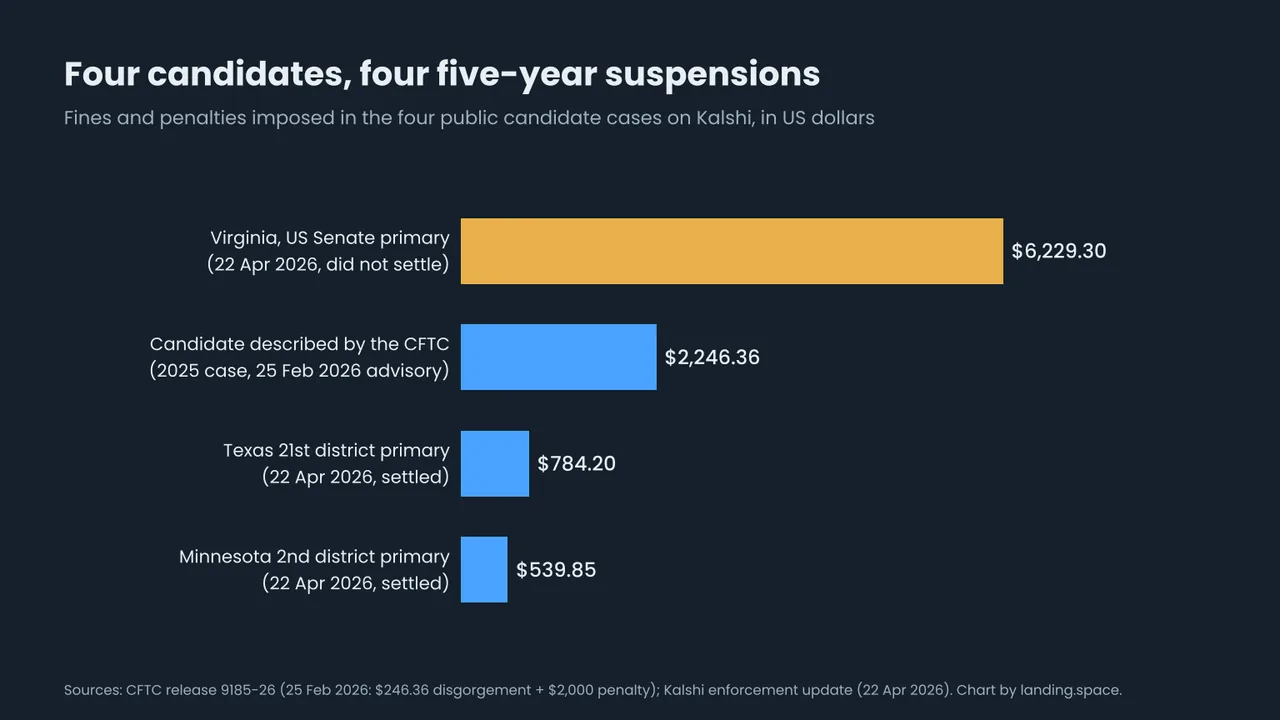
By our arithmetic the four cases add up to $9,799.71 in fines and disgorgement. The senators do not treat the cases as proof that screening works. Their letter cites an NPR report of July 2026 that a campaign operative listed in Federal Election Commission records "was able to trade on a race in which they were involved despite Kalshi's new screening system".
Polymarket: Ethiopia, Romania and an older question
For Polymarket the letter turns to press reports. It cites a WIRED report of 15 October 2026 for "more than $600 million in trading volume" across Polymarket contracts on elections in Ethiopia and Romania, including "extensive repetitive transactions that researchers said suggested artificial volume". WIRED's headline says those trades took place after the races ended, a claim the letter's own text does not repeat. The letter records that Polymarket told WIRED it flagged the activity, investigated and blocked the accounts.
The senators do not read that as reassurance. "The identification of isolated instances of improper trading does not demonstrate that these markets are adequately protected," their release says. "Instead, it raises serious questions about how much similar activity may be going undetected." The letter also goes back to the 2024 presidential race, when Fortune reported that two blockchain analysis firms had found patterns consistent with possible wash trading, where the same party sits on both sides of a trade. One firm estimated that roughly a third of that market's volume was likely affected.
Why election contracts, and why now
The senators argue that internal polling and election-administration information can be worth money to anyone who trades on a race, a concern they call "particularly acute as Election Day approaches". The letter names the groups it worries about:
- Candidates: the four Kalshi cases above, which in the release's words "documented cases of candidates betting on their own races".
- Campaign insiders: an NPR report of May 2026 on "campaign insiders who said they profited by trading before the release of polling information".
- Election officials and pollsters: named next to candidates and staff in the first question, as people the companies should keep from trading on these contracts.
- Voters: the last question asks how the companies keep their prices from being taken for polls. The release says the contracts are "treated by some observers as indicators of political momentum", and the letter cites a Brennan Center for Justice study of 20 October 2026, whose title says prediction markets are influencing voters.
Where the CFTC comes in
Kalshi's exchange, KalshiEX, is a designated contract market (DCM), which the CFTC oversees. In its February advisory the CFTC said insider trading, meaning trading on confidential information taken in breach of a duty of trust, is among the practices it can pursue under section 6(c)(1) of the Commodity Exchange Act and its Regulation 180.1. It has "full authority to police illegal trading practices occurring on any DCM", it said, even when an exchange's own team has handled a case.
That is the background to the fifth question, which asks how many cases went to the CFTC or law enforcement. The letter itself is a request for answers, not an enforcement action. Separately, the CFTC is consulting until 18 November on whether sports and other event contracts are swaps under federal law, as our report on the CFTC's two rules on event contracts explains.
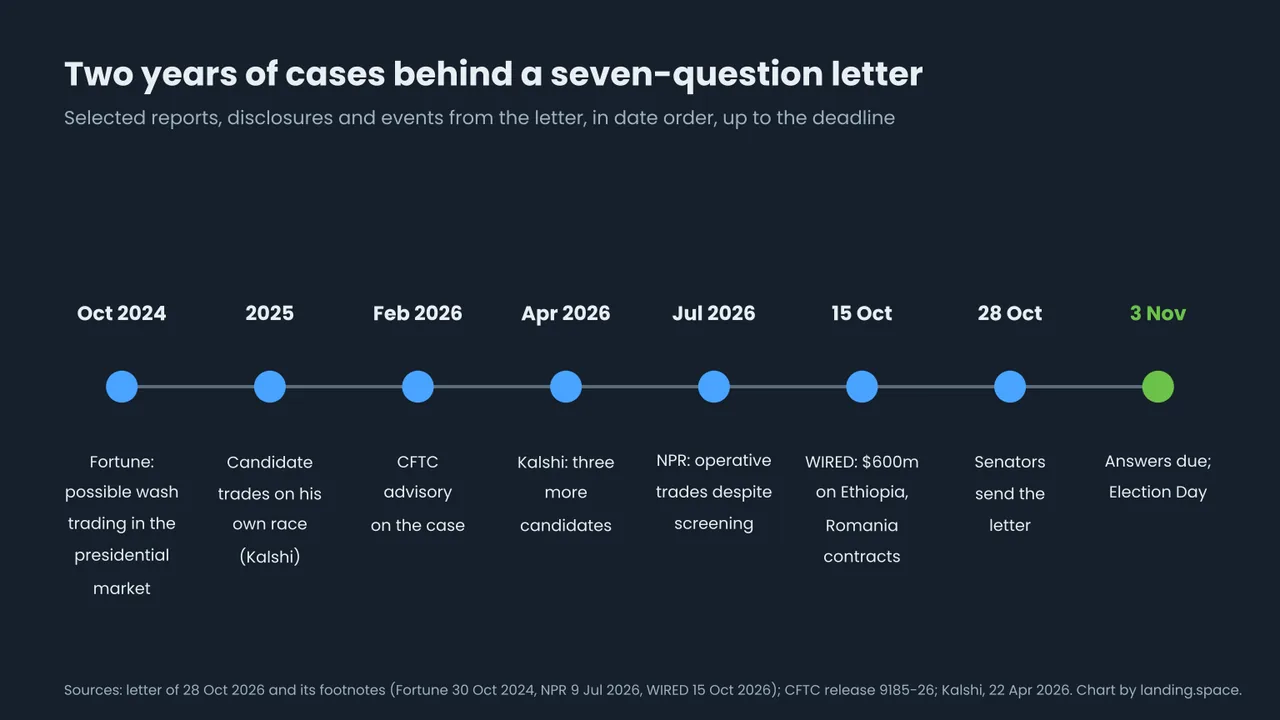
From the first case to the deadline
Most of the letter's evidence dates from 2026; the first Kalshi case is described in a CFTC advisory.
What is confirmed and what is not yet known
- Confirmed: the letter of 28 October, signed by Senators Curtis and Warren, asks seven questions and wants written answers by 3 November 2026. Four candidate cases on Kalshi are public, one described by the CFTC and three published by Kalshi, each ending in a five-year suspension.
- Confirmed: Kalshi's head of enforcement told Business Insider that the company "proactively blocks candidates and campaign staff from trading to protect market integrity". Polymarket did not respond to Business Insider's request for comment.
- Not yet known: whether either company has sent written answers, and whether the senators will publish them.
- Not yet known: how many suspected cases the companies will report for 2026, how many they referred to the CFTC, and whether any regulator is looking at the Ethiopia and Romania trading.
What it means for players
For anyone who trades on election contracts, the letter is about who may be on the other side of a trade. Published answers would give the first count of suspected insider cases on election markets this year. Until then, the public record is four small Kalshi cases and press reports about Polymarket.
The question is not only American. In Britain, betting on an election with inside knowledge has been prosecuted under the cheating offence in the Gambling Act: three people who worked for the Conservative Party were sentenced on 23 October for bets on the date of the 2024 general election, as our report on the UK election-date sentences explains. The US letter is addressed to the platforms rather than to traders, and it asks them for numbers.
Frequently asked questions
What did Senators Warren and Curtis ask Kalshi and Polymarket?
Seven questions: how each company stops candidates, campaign staff, election officials and pollsters from trading on election contracts, how it detects trading on non-public information and manipulation, how many suspected cases it has had since 1 January 2026, how many it referred to the CFTC or law enforcement, and how it keeps its prices from being read as polls. Written answers were due by 3 November 2026.
Why is the deadline 3 November 2026?
It is Election Day for the US midterm elections. The senators asked for answers by then, and their release says the concern about insiders trading on non-public information is particularly acute as Election Day approaches.
Have candidates bet on their own elections on Kalshi?
Yes, by Kalshi's own account. The CFTC described a 2025 case in February 2026, and Kalshi published three more on 22 April 2026, in primaries in Minnesota, Texas and Virginia. Each candidate was suspended for five years and faced fines or penalties of between $539.85 and $6,229.30. Neither the CFTC nor Kalshi named them.
What is the $600 million figure about Polymarket?
The letter cites a WIRED report of 15 October 2026 on more than $600 million in trading volume across Polymarket contracts on elections in Ethiopia and Romania; WIRED's headline says the trades took place after the races ended. Polymarket told WIRED it flagged the activity, investigated and blocked the accounts.
Have Kalshi and Polymarket responded to the letter?
Kalshi's head of enforcement told Business Insider that the company proactively blocks candidates and campaign staff from trading. Polymarket did not respond to Business Insider's request for comment. Whether either company has sent written answers to the senators is not public.
Does the letter have any legal force?
It is a request for answers from two senators, not an enforcement action. Insider trading on exchanges such as Kalshi falls to the CFTC, which said in February 2026 that it has full authority to police illegal trading practices on any designated contract market.
Sources
- Senate Banking Committee (minority) - Warren, Curtis Probe Kalshi and Polymarket on Improper Election-Related Trading (29 Oct 2026)
- Letter from Senators John R. Curtis and Elizabeth Warren to Kalshi and Polymarket (28 Oct 2026)
- CFTC - Enforcement Division Issues Prediction Markets Advisory, release 9185-26 (25 Feb 2026)
- Kalshi - Enforcement update: Kalshi continues crackdown on political insider trading (22 Apr 2026)
- Business Insider, republished by Yahoo Finance - Senators want Kalshi and Polymarket to prove election odds aren't tainted ahead of the midterm vote (2 Nov 2026)
Go deeper

Two CFTC rules of 9 October: sports and other event contracts would be swaps under federal law; sportsbooks and casino games would not. What the courts said.
Read article →
Three who worked for the Conservative Party got suspended terms and a 12-month gambling-app ban for betting on the 2024 election date with inside knowledge.
Read article →
Limits, time-outs, self-exclusion and where to get help.
Read guide →This article is independent editorial coverage and is not sponsored; no operator or supplier paid for inclusion. The facts were checked against the sources listed above on 3 November 2026, and rules, programmes and offers can change after that date. Nothing here is legal or betting advice. 18+ only (21+ for online casino in the US states that license it); if you gamble, set your limits in advance.