
Three sentenced for betting on the date of the 2024 UK general election



Three people were sentenced at Southwark Crown Court on 23 October 2026 for betting on the date of the 2024 UK general election before it was announced, the first sentences in a prosecution the Gambling Commission calls "a first of its kind". Anthony Lee, who was the Conservative Party's Director of Campaigning, Laura Lee and Amy Hind had pleaded guilty to cheating under section 42 of the Gambling Act 2005. All three received suspended prison terms, unpaid work and a 12-month requirement not to use online gambling apps.
The sentences
The Commission's announcement sets out each sentence. All three terms are suspended for 12 months, so none of the three goes to prison unless the sentence is activated, by a further offence or a breach of its requirements. Each also carries a 12-month probation requirement and a 12-month prohibited activity requirement that bars them from using online gambling applications.
| Person, as described by the Commission | Custodial term (suspended 12 months) | Unpaid work | Prosecution costs |
|---|---|---|---|
| Anthony Lee, the party's Director of Campaigning, party to confidential discussions on the timing | 10 months 2 weeks | 100 hours | £1,000 |
| Laura Lee, the party's Head of International and a candidate at the 2024 election | 4 months 2 weeks | 40 hours | £1,000 |
| Amy Hind, a former party employee working for the NHS at the time, who bet after receiving confidential information | 6 months | 50 hours | No order |
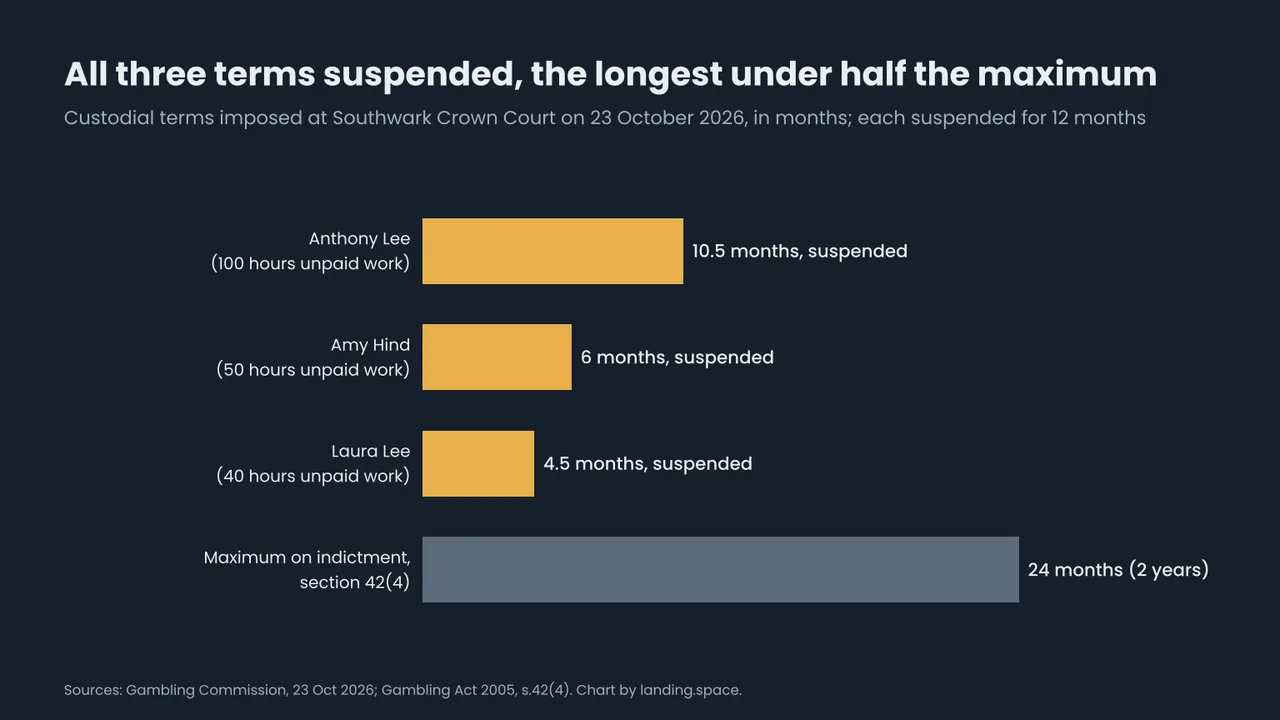
Anthony Lee's term was imposed on each count and runs concurrently. For comparison, section 42 allows up to two years' imprisonment, a fine or both on conviction on indictment. The release mentions no fine for any of the three.
Why nobody went to prison, and what the app ban is
A suspended sentence is still a prison sentence, but under section 286 of the Sentencing Act 2020 it does not take effect unless there is an activation event: a further offence in the UK during the operational period, here 12 months, or a breach of one of the requirements attached to the order. Only then can a court order the custodial term to be served.
The ban on gambling apps is one of those requirements. The Act defines a prohibited activity requirement as a requirement to refrain from participating in specified activities on particular days or for a particular period. Here the activity is using online gambling applications and the period is 12 months, alongside 12 months of probation. The release does not say how compliance will be checked.
Why betting on a date counts as cheating
Section 42 makes it an offence to cheat at gambling or to help someone else cheat. It does not mention inside information. What it says is that cheating may consist of "actual or attempted deception or interference" in connection with the gambling process or the event the bet is on, and that it is immaterial whether the cheat improves their chances or wins anything. The prosecution's case, as the Commission described it when charging, was that the defendants used "advance knowledge of the proposed election date" to gain an unfair advantage in betting markets on the timing of the election.
Because the three pleaded guilty, their cases did not go to trial. The pleas give the Commission what its general counsel, Katharine Diamond, called convictions that "demonstrate the importance of protecting the integrity of gambling markets". The case is the Commission's own prosecution: section 28 of the Act lets it investigate offences under the Act and institute criminal proceedings for them; the power to institute proceedings does not apply in Scotland.
From the announcement to the sentences
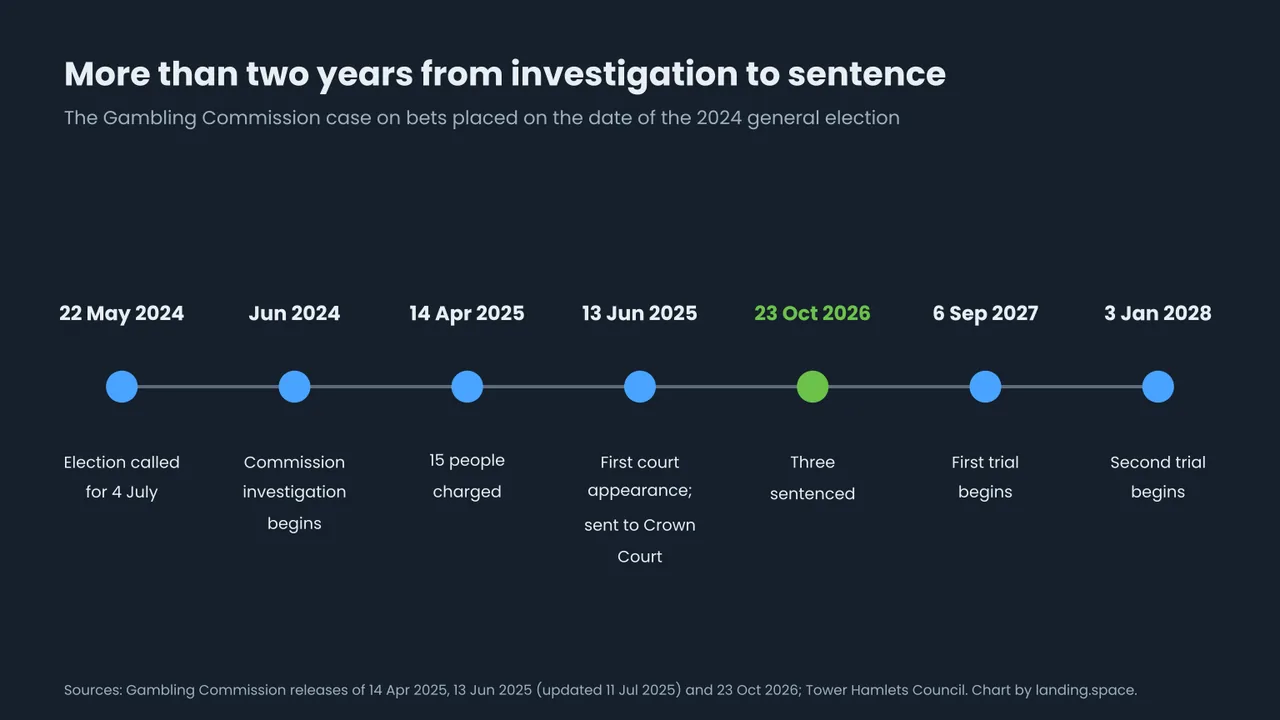
Prime Minister Rishi Sunak called the election on 22 May 2024 for 4 July. The Commission says its investigation began in June 2024 and that it is separate from an earlier Metropolitan Police investigation, which was discontinued. Fifteen people were charged in April 2025 and first appeared at Westminster Magistrates' Court on 13 June 2025, when twelve denied the charges and three entered no plea; the case was sent to Southwark Crown Court.
The latest release lists fourteen people. Besides the three sentenced, a fourth has pleaded guilty and will be sentenced later, and ten others are charged and due to stand trial in September 2027 and January 2028, on dates the court set in July 2025 as 6 September 2027 and 3 January 2028. Until then they are presumed innocent, and we do not name them. The release does not say what happened to the fifteenth person charged in April 2025.
That is also why so much of the case is still unknown. When it charged the fifteen, the Commission said it could not provide further details on ongoing criminal cases, and the sentencing release gives no more: it names no bookmaker and gives neither the number of bets nor the amounts staked or won. With ten defendants still to be tried, those details may only come out in court in 2027 and 2028.
What bookmakers have to report, and what can happen to the bets
Every betting operator licensed in Great Britain works under licence condition 15.1.2. It must tell the Commission, as soon as reasonably practicable, any information it knows or suspects relates to an offence under the Act, and any information it suspects may lead the Commission to consider voiding a bet. Information about a suspected breach of a sport's betting rules goes to that sport's governing body as well. The Commission has not said how the election bets first came to its attention.
The voiding power sits in section 336. The Commission can order that a bet accepted by a licensed operator is void if it is satisfied the bet was "substantially unfair", and it must take into account whether either party has been convicted under section 42 in relation to the bet. A void order cancels the contract: money paid on the bet, stake and winnings alike, goes back to whoever paid it. The release of 23 October does not mention any such order.
What is confirmed and what is not yet known
- Confirmed: three people sentenced on 23 October 2026 after guilty pleas to section 42 cheating offences; suspended terms of 10 months 2 weeks, 4 months 2 weeks and 6 months; unpaid work of 100, 40 and 50 hours; a 12-month ban on online gambling apps; fifteen people charged in April 2025, of whom the latest release lists ten awaiting trial in 2027 and 2028.
- Not yet known: the sentence for the fourth person who has pleaded guilty; what happened to the fifteenth person charged; whether the Commission will seek to void the bets under section 336; how many bets were placed and for how much, which the releases do not state; whether any sentence will be appealed.
What it means for players
Gambling operators offered markets on the timing of the election, as this case shows, and the charges were not about betting on politics as such. What the Commission prosecuted was the use of confidential knowledge of the answer before the market had it. When a bookmaker licensed in Great Britain suspects that kind of bet, condition 15.1.2 obliges it to tell the Commission, and section 336 gives the Commission a way to unwind a bet taken by such a licensee, so an edge of this kind can cost the winnings as well as bring a prosecution.
The app ban is a court order on three people, not a tool anyone can sign up for. If you want to stop yourself using gambling sites, the voluntary routes, from deposit limits and time-outs to self-exclusion across licensed operators, are set out in our guide to responsible gambling tools.
For anyone who simply bet on when the 2024 election would be held, without confidential information, nothing in the releases points their way. Section 336 works bet by bet, on bets the Commission finds substantially unfair, and the Commission has announced no order of any kind in this case.
Frequently asked questions
Who was sentenced for betting on the 2024 election date?
Anthony Lee, who was the Conservative Party's Director of Campaigning, Laura Lee, who was its Head of International, and Amy Hind, a former party employee, at Southwark Crown Court on 23 October 2026. All three had pleaded guilty to cheating under section 42 of the Gambling Act 2005.
What sentences did they receive?
Suspended custodial terms of 10 months 2 weeks, 4 months 2 weeks and 6 months, each suspended for 12 months, with 100, 40 and 50 hours of unpaid work, 12 months of probation and a 12-month requirement not to use online gambling apps. Two must each pay £1,000 in prosecution costs.
Is it illegal to bet on an election in the UK?
The charges in this case were not about betting on politics as such: gambling operators offered markets on the election date. The offence was cheating, because the Commission's case was that the defendants used advance knowledge of the election date to gain an unfair advantage.
What is section 42 of the Gambling Act 2005?
The cheating offence. A person commits it by cheating at gambling or by doing anything to enable or help another person to cheat. It covers deception or interference in connection with the gambling process or the event, whether or not the cheat wins anything.
How many people were charged?
Fifteen were charged in April 2025. The Commission's latest release lists fourteen: three sentenced, a fourth who has pleaded guilty and awaits sentence, and ten due to stand trial in September 2027 and January 2028.
Can the bets be cancelled?
Section 336 of the Gambling Act lets the Commission void a bet it finds substantially unfair, taking into account a section 42 conviction connected with the bet. A void order returns stake and winnings to whoever paid them. The Commission has not announced any such order in this case.
Sources
- Gambling Commission - Three sentenced for General Election betting offences (23 Oct 2026)
- Gambling Commission - Gambling Commission charges 15 with General Election betting offences (14 Apr 2025)
- Gambling Commission - Fifteen appear at Westminster Magistrates Court charged with cheating (13 Jun 2025, updated 11 Jul 2025)
- legislation.gov.uk - Gambling Act 2005, section 42 (Cheating)
- legislation.gov.uk - Gambling Act 2005, section 28 (Investigation and prosecution of offences)
- legislation.gov.uk - Gambling Act 2005, section 336 (Bet void by Commission order)
- Gambling Commission - LCCP condition 15.1.2, reporting suspicion of offences, betting licences
- Tower Hamlets Council - General Election called, 22 May 2024
- legislation.gov.uk - Sentencing Act 2020, Part 10, Chapter 5 (suspended sentences)
- legislation.gov.uk - Sentencing Act 2020, Schedule 9 (community requirements)
Go deeper

Bonnie Blue says a £1.2m auction named her baby BetBolt, a crypto casino with no GB licence. What is confirmed, and what UK ad and licensing rules say.
Read article →
The Treasury is reported to be weighing a higher tax on gaming machines before the 28 October Budget. What is proposed, who objects and what the figures show.
Read article →
Limits, time-outs, self-exclusion and where to get help.
Read guide →This article is independent editorial coverage and is not sponsored; no operator or supplier paid for inclusion. The facts were checked against the sources listed above on 25 October 2026, and rules, programmes and offers can change after that date. Nothing here is legal or betting advice. 18+ only (21+ for online casino in the US states that license it); if you gamble, set your limits in advance.