
New Jersey orders online operators to act on ten problem-gambling triggers



New Jersey has become the first US state to make data-driven responsible gaming checks mandatory for online operators. Rules announced on 20 October 2026 by Attorney General Jennifer Davenport and the Division of Gaming Enforcement require every online casino and sportsbook licensee to name a responsible gaming lead, to review any customer who trips one of ten listed play triggers, from more than $10,000 deposited within 24 hours to two sessions in a week ending with less than $1 left, and to work through three phases of intervention that can end with the account being closed.
Ten triggers, written into the rule
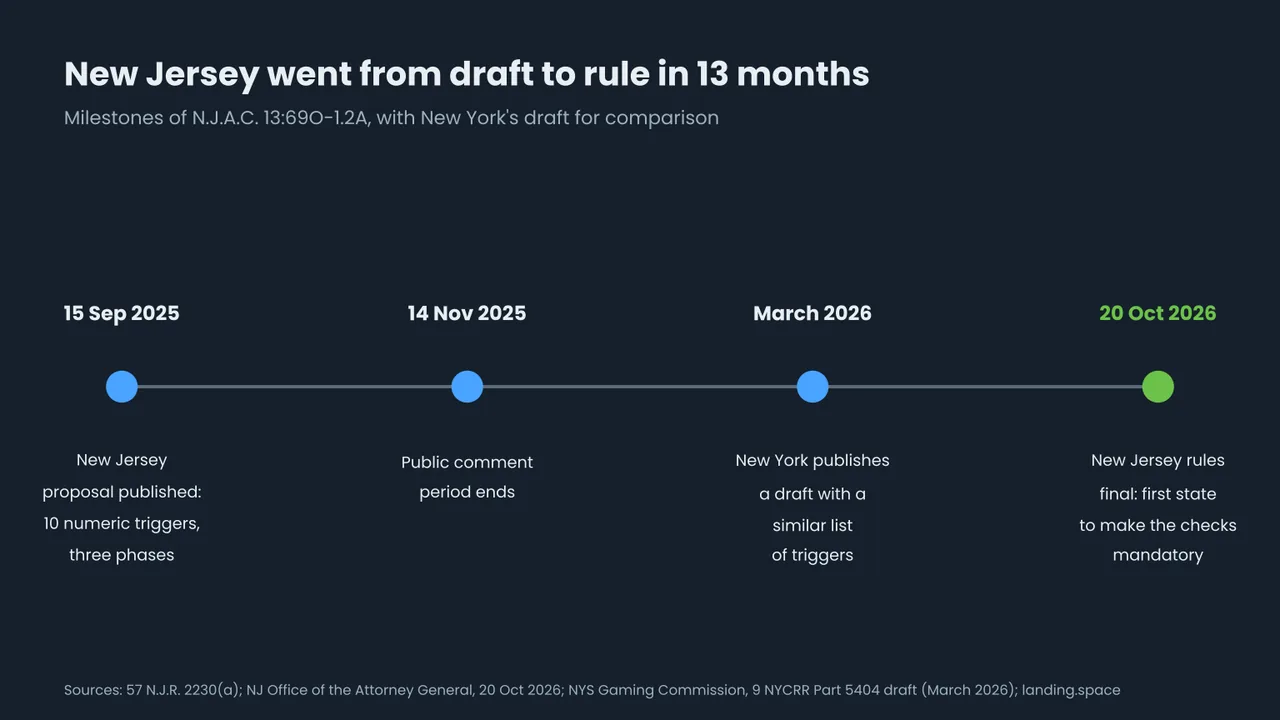
The requirements sit in a new section of the state's internet gaming rules, N.J.A.C. 13:69O-1.2A, first published as a proposal in the New Jersey Register on 15 September 2025 with comments invited until 14 November 2025. The Attorney General's release says they "now have been codified into state regulations with the force of law." Until now, operators followed the Division's best practices, but in the release's words there was "no uniform, regulatorily enforceable standard for when further review and phased intervention is required."
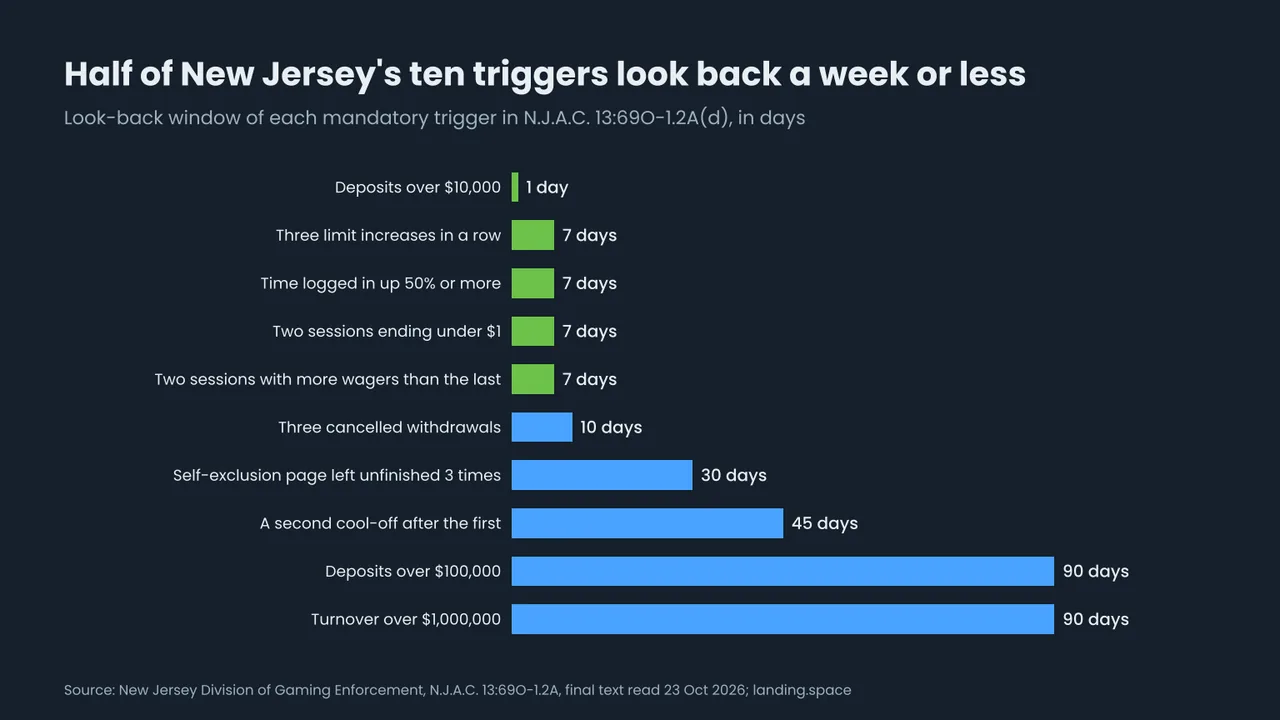
The core is a list of patron play criteria that each operator must build into its systems "at a minimum" as automatic triggers for a review. Ten of them are specific:
| Trigger | Threshold | Window |
|---|---|---|
| Deposits | More than $10,000 | 24 hours |
| Deposits | More than $100,000 | 90 days |
| Self-exclusion page opened but not completed | 3 or more times | 30 days |
| A second cool-off period | Requested after the first ends | 45 days |
| Responsible gaming limits raised | 3 increases in a row, no decrease | 7 days |
| Withdrawal requests cancelled | 3 times | 10 days |
| Total turnover | More than $1,000,000 | 90 days |
| Time logged in | Up 50% or more on the previous two weeks | 1 week |
| Sessions ending with less than $1 left | 2 or more | 1 week |
| Sessions with more wagers than the last | 2 or more | 1 week |
Three further items let the list grow: operators may add triggers of their own, and the Division may add, modify or rescind criteria by rulemaking or a Director's Order. The rule calls the published numbers "requisite minimum standards" and encourages operators to set lower thresholds.
Three phases, ending with a phone call
A trigger does not by itself label anyone. It starts a "due diligence review" of the customer's play. If the operator concludes the customer may be showing signs of problem gaming, the customer goes on its list of at-risk patrons, kept by the responsible gaming lead and open to the Division on request. If the review finds no risk, the operator must write down why and keep that record for five years. A customer may be taken off the list once 180 days have passed since the last review without a new trigger, if the lead then sees no signs of problem gaming.
Phase 1 is an email, or another method the Division approves, setting out the operator's time, loss and deposit limits, cool-off options, self-exclusion and account closure, with support resources. Phase 2 blocks further betting until the customer has watched a video tutorial approved by the Division, in full, with the operator keeping a record that it was watched. Phase 3 is a live conversation by phone, video call or another approved live channel, which can include live chat or in-product messaging. If the customer cannot be reached after three attempts at least 24 hours apart, the operator emails them and suspends the account until the conversation happens. If the lead then concludes that the customer still meets the at-risk criteria, "the patron's account shall be closed" and the customer is referred to problem gambling resources. Customers in Phases 2 and 3 must not receive direct marketing, promotions, event invitations or complimentary items.
New York is following the same path more slowly. Its Gaming Commission published a draft in March 2026 with a list of triggers that closely follows New Jersey's, which we covered in our article on New York's AI bonus rules; it is not final.
The rule also closes a loophole at the cashier: a withdrawal request cannot be cancelled or reversed by the customer for three days, and operators may not ask customers to take a pending withdrawal back.
What changed between the 2025 draft and the final text
Comparing the proposal with the text now on the Division's website shows the ten numeric thresholds survived unchanged; one trigger gained a qualifier, and the larger changes are elsewhere:
| Provision | Proposal, September 2025 | Final text |
|---|---|---|
| No direct marketing | All at-risk patrons | Patrons in Phase 2 or Phase 3 only |
| Phase 3 contact | The responsible gaming lead, by phone, video call or another approved method | The lead, designated staff or an approved designee, by a live channel, which may include approved live chat or in-product messaging |
| Closing the account | If the patron is "exhibiting signs of problem gaming" | If the patron "continues to meet the criteria" for at-risk status |
| Time logged in trigger | Any 50% rise on the previous two weeks | Only for accounts active in those two weeks |
| Changing the triggers | Division by Director's Order | Division by rulemaking or Director's Order, which may also modify or rescind them |
The narrower marketing ban is the change with the most practical weight: a customer flagged at Phase 1 can still receive offers until the operator moves them to Phase 2. The adopted text also adds "prefer not to say" to the gender question operators must ask for the Division's annual problem gambling reports. Our comparison rests on the two documents linked here; we have not seen the formal adoption notice with the Division's answers to the public comments.
Why now, and the Kalshi case
The release gives two reasons beyond standardisation. The state says it is aware of press reports that "some operators are using aggressive marketing or promotion tactics to target gamblers who are exhibiting signs of a gambling disorder", without naming anyone, and that this is "just one reason" the rules were codified. It also uses the rules in its fight with prediction markets: New Jersey is asking the US Supreme Court to hear its case against Kalshi, arguing that prediction markets must be subject to state gaming laws, and the Attorney General says 39 states and the District of Columbia, 146 tribes and tribal organisations and the NFL have filed amicus briefs in support. SBC Americas reports that Kalshi's response is due on 9 November. We cover the federal side of that dispute in our article on the CFTC's event contracts rule.
Alongside the rules the state made RecoverMe, a cognitive behavioural therapy app, free to anyone in New Jersey with the code NJ100. It joins GamFin, the free financial counselling service the Division began offering last year.
What is confirmed and what is not yet known
- Confirmed: the rules are final according to the Attorney General; ten numeric triggers, an at-risk list, three phases of intervention and account closure as the last step; no direct marketing to customers in Phases 2 and 3; a three-day bar on cancelling withdrawals.
- Confirmed: the rules cover internet gaming and online sports wagering operators in New Jersey.
- Not yet known: the date from which operators must comply, the formal adoption citation in the New Jersey Register, how many customers the triggers are expected to catch, and whether another state will copy the list. The documents we read are silent on all four.
What it means for players
Online players in New Jersey now have a published list of what operators must watch. A large deposit in a day, a run of limit increases, a second cool-off soon after the first, or opening the self-exclusion page again and again without going through with it will each start a review. If the operator then judges you at risk, the first contact is the Phase 1 email about limits and tools, unless it skips ahead to a later phase; our overview of self-exclusion registers shows how the same tools work in other markets. Players in Britain will recognise the idea from the financial risk checks described in our article on affordability and deposit limits, although those checks look at money only. If gambling is already causing problems, New Jersey's helpline 1-800-GAMBLER is free, and so is the RecoverMe app with the state's code.
Frequently asked questions
What did New Jersey change on 20 October 2026?
It made data-driven responsible gaming checks mandatory for online casino and sports betting operators. Each operator must name a responsible gaming lead, review customers who trip any of ten play triggers, keep a list of at-risk patrons and work through three phases of intervention.
Which behaviour triggers a review?
The list mixes money and habits. On the money side: more than $10,000 deposited within 24 hours, more than $100,000 deposited or more than $1,000,000 wagered over 90 days. On the habit side: ending two sessions in a week with under $1, logging 50% more time this week than in the previous two weeks, cancelling withdrawals three times in 10 days or raising limits three times in a week.
Can an operator close my account under the new rules?
Yes, as the last step. After a live conversation in Phase 3, the account is closed if the customer still meets the at-risk criteria, and the customer is referred to problem gambling resources.
Can I cancel a withdrawal in New Jersey?
Not for three days after the request, before the money is paid out. Operators are also banned from asking customers to take a pending withdrawal back.
Is this the same as a self-exclusion?
No. Self-exclusion is a step the customer takes. These rules oblige the operator to act on what it sees in the customer's play, from an email in Phase 1 to closing the account after Phase 3.
Where can New Jersey players get help?
The helpline 1-800-GAMBLER is free, and the state has made the RecoverMe app free for anyone in New Jersey with the code NJ100.
Sources
- New Jersey Office of the Attorney General - New Jersey Is the First State in the Nation to Impose Mandatory Data-Driven Responsible Gaming Requirements (20 October 2026)
- New Jersey Division of Gaming Enforcement - N.J.A.C. 13:69O-1.2A Responsible gaming, final text (read 23 October 2026)
- New Jersey Register - 57 N.J.R. 2230(a), proposed new rule N.J.A.C. 13:69O-1.2A (15 September 2025)
- SBC Americas - NJ mandates data-driven responsible gambling program (21 October 2026)
Go deeper
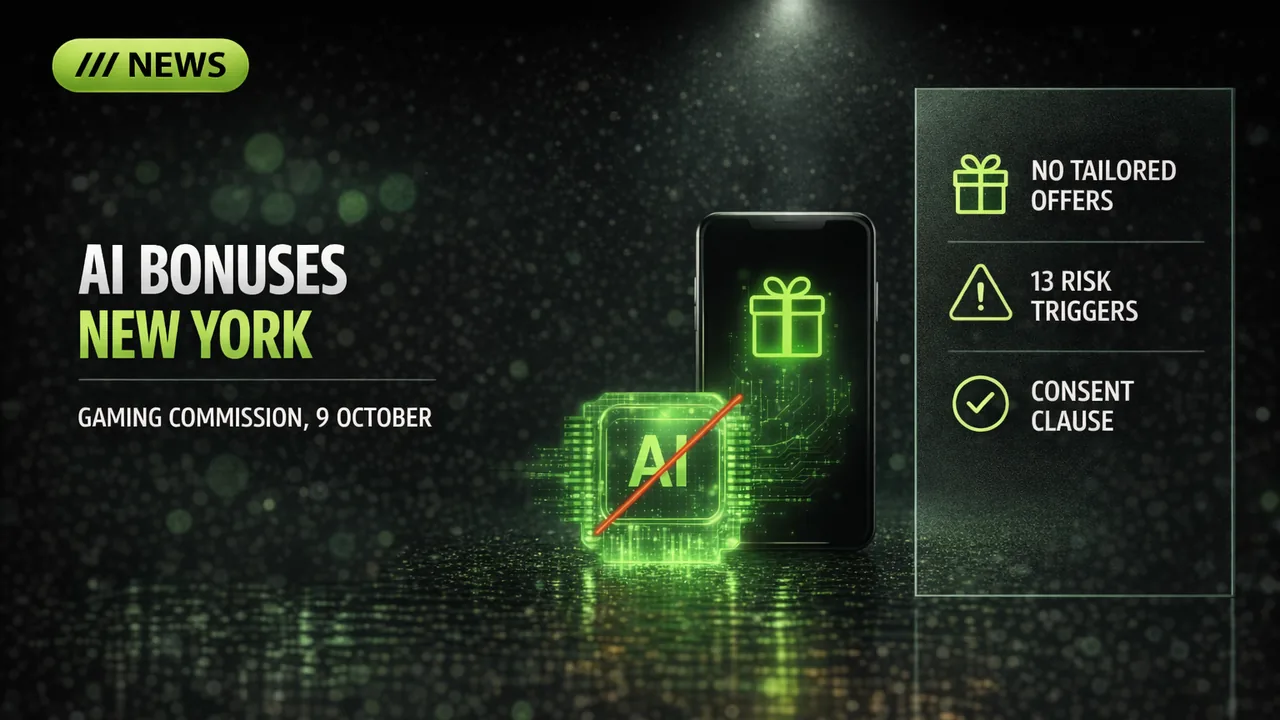
New York regulators advanced rules to stop sportsbooks using AI to tailor bonuses and odds, and to flag at-risk bettors. What the draft says and what changed.
Read article →
BetStop reached 65,430 registrations by 30 June 2026 and GAMSTOP had its busiest month in May 2026. How national self-exclusion registers compare.
Read article →
Limits, time-outs, self-exclusion and where to get help.
Read guide →This article is independent editorial coverage and is not sponsored; no operator or supplier paid for inclusion. The facts were checked against the sources listed above on 23 October 2026, and rules, programmes and offers can change after that date. Nothing here is legal or betting advice. 18+ only (21+ for online casino in the US states that license it); if you gamble, set your limits in advance.