
Spain's one deposit limit for every licensed site faces a Supreme Court challenge



Spain will stop counting deposit limits one operator at a time. From 25 March 2027, a single default limit of EUR 700 a day, EUR 1,750 a week and EUR 3,300 over four weeks will apply to each player across every Spanish-licensed gambling site at once, unless the player asks for a different one. The rule is Royal Decree 520/2026, published in the official gazette on 25 June. On 1 October the licensed operators' association Jdigital said it would take the decree to the Supreme Court, and on 6 October the government called a general election for 29 November, so the system enters its last months of preparation under a legal challenge and an election campaign.
What the decree changes
Deposit limits in Spanish online gambling have so far been set operator by operator: a player with accounts at five licensed sites has five separate limits, and nothing adds them up. Royal Decree 520/2026 inserts a new article 36 bis into the 2011 regulation on licences, authorisations and registers, and with it a second layer. The regulator, the Dirección General de Ordenación del Juego (DGOJ), will run a central system that totals a player's deposits across all of their gaming accounts, and every licensed operator has to connect to it and check it before taking a deposit. If a deposit would take the player past the joint limit, operators "no podrán aceptar" it, in the decree's words, and must tell the player. The per-operator limits of article 36 stay where they are; the decree describes the joint system as complementary to them and independent of them.
| Period | Default joint limit | How the period is counted |
|---|---|---|
| Day | EUR 700 | From 06:00 to 06:00 the next day |
| Week | EUR 1,750 | From Tuesday 06:00 to the following Tuesday 06:00 |
| Four weeks | EUR 3,300 | From Tuesday 06:00 of the first week, for four weeks |
The amounts sit in a new annex to the regulation and are defaults rather than fixed ceilings. The regulator can change them by resolution after technical and legal reports, and each player can move their own limits in either direction, under the conditions described below. The ministry behind the decree, the Ministry of Social Rights, Consumer Affairs and Agenda 2030 under Pablo Bustinduy, presented it on 23 June as a step towards a safer environment for people who play online.
Which of the three caps bites first
The three numbers do not work as three separate allowances. Seven days at EUR 700 would come to EUR 4,900, far above the weekly EUR 1,750, and four full weeks at EUR 1,750 would be EUR 7,000, more than twice the four-week figure. We worked through what that means for a player who deposits the most the system allows from the first Tuesday of a period: EUR 700 on the first day, EUR 700 on the second, EUR 350 on the third, and the week is used up. The next week starts the same way and stops on day ten, when the running total reaches EUR 3,300; after that nothing more can go in until the four-week period ends. Spread evenly, EUR 3,300 over 28 days is about EUR 118 a day.
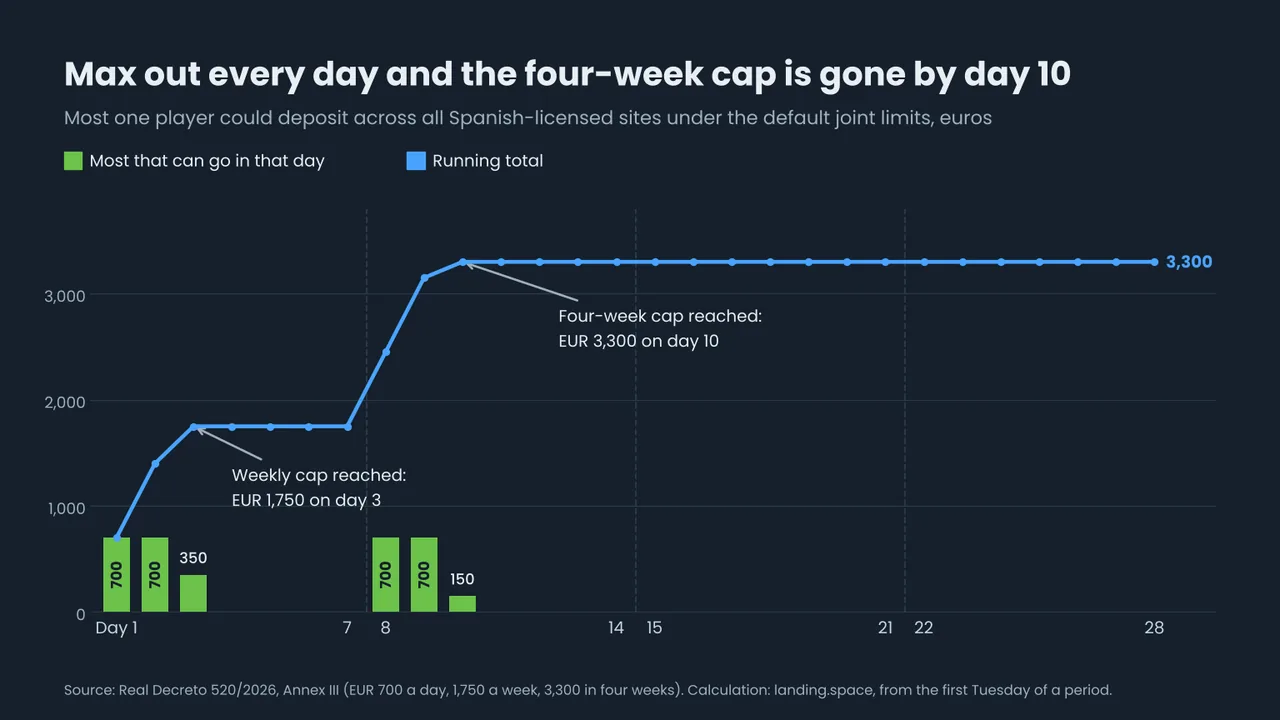
So for a heavy player the four-week number is the one that does the work, and the daily figure mostly limits a single night. The preamble explains why the government wanted to count across sites at all. Around a third of active online players use more than one operator, a share the ministry put at 31% when the decree was approved, and about 80% of the accumulated losses are concentrated among 10% of participants. A per-site limit, however strict, does nothing about the second account.
Raising the limit: three working days and three months
The decree keeps the limits in the player's hands, but makes it slower to loosen them than to tighten them:
- Lowering: a player can set joint limits below the defaults at any time, and the new figures are registered in the system straight away.
- Raising or removing: allowed on request, but the change only takes effect three working days later, and before it does the regulator shows the player information about the risks of gambling.
- The three-month rule: a request to raise or remove a limit is refused if three months have not passed since the player's last increase.
- One set of defaults: the decree applies the same amounts to every adult player; it contains no separate band for younger players.
- Personal data: the DGOJ is the data controller and processes name, identity document, date of birth, sex, email, phone number, the limits and the deposits; sensitive data such as health or political opinions is excluded, and the processing falls under the GDPR.
The preamble calls the limits "plenamente disponibles para las personas jugadoras", fully at the players' disposal. That is the design choice in one line: a default that applies unless the player acts, with a waiting period and a risk notice on the way up and none on the way down.
Jdigital's appeal, and how its last one ended
Jdigital, the Asociación Española de Juego Digital, which represents licensed online operators, announced on 1 October 2026 that it would take the decree to the Supreme Court. According to the trade outlet Sector del Juego, which summarised a video statement, the association "cuestiona la adecuación de esta regulación al marco legal", questioning whether the rule fits the legal framework, and considers the measure disproportionate. It also said it supports a reform of the 2011 gambling law, as long as it is negotiated with the sector. By 20 October we had found no notice on Jdigital's own press page that the appeal had been lodged, and no report of a request to suspend the decree while the case runs. As Casino News Daily pointed out, an appeal on its own does not suspend a regulation.
The association has been to the same court before. In April 2024 the Supreme Court partly upheld Jdigital's appeal against Royal Decree 958/2020, the advertising decree, and annulled several of its articles: limits on promotions aimed at new customers, on famous people in adverts and on gambling advertising on social networks and video platforms. The reason was that those articles "carecen de la necesaria cobertura legal". A regulated business can be restricted, the court held, but the limits have to rest on criteria set by a law, and "una mera remisión en blanco", a blank referral, is not enough. It rejected the procedural complaints and upheld the rest of that decree. Whether the deposit decree has enough footing in the 2011 law is the kind of question the court would now be asked to decide; we make no prediction about the answer.
An election in the middle of the countdown
On 6 October the official gazette published Royal Decree 806/2026, which dissolved the Congress, and general elections to the Cortes Generales are set for 29 November 2026. The deposit decree is already in the gazette with a start date, so the vote does not switch it off. What it puts in doubt, as the trade press has noted, is the government's wider plan to reform the gambling law. A future government could change a royal decree with another one, in the same way that this decree changes the 2011 regulations; until that happens, 25 March 2027 stands.
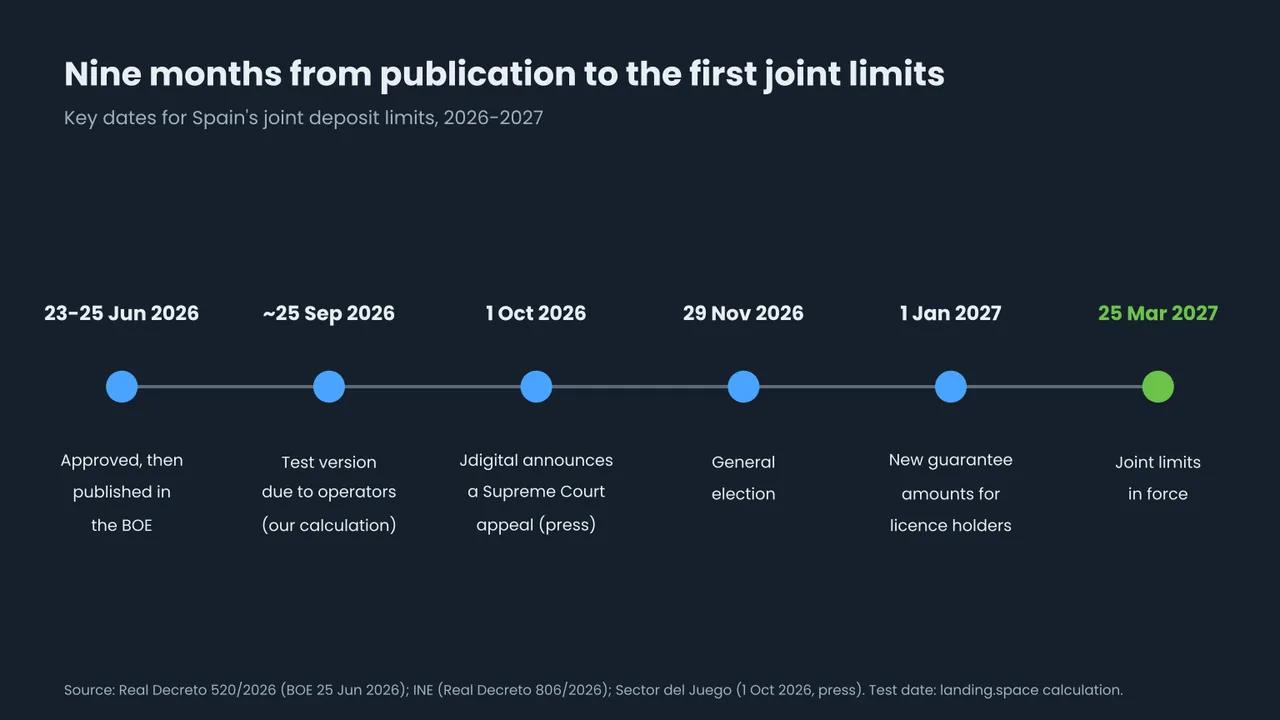
The decree sets its own schedule. Operators were to receive a test version of the central system six months before the start, which by our count fell around 25 September 2026. New guarantee amounts for licence holders apply from 1 January 2027. The joint limits take effect on 25 March 2027, nine months after publication, and the first weekly and four-week periods begin on the first Tuesday after that, 30 March. According to an analysis by the consultancy PwC, the 2025 draft had given operators six months rather than nine, and the regulator estimated the cost of adapting at about EUR 5,400 per operator.
How Spain's model compares
Most of the markets we follow regulate deposits in one of two ways. Some make each player choose a limit and leave the amount to them; others use spending thresholds that oblige the operator to check on a customer rather than stop the payment. Spain is doing something different from both: a number written into the regulation, applied by default across the whole licensed market, which the player can change but not avoid by opening another account. Our overview of deposit limits and affordability checks across Europe sets out the other approaches country by country.
What is confirmed and what is not yet known
- Confirmed: Royal Decree 520/2026 was published on 25 June 2026; the default joint limits are EUR 700 a day, EUR 1,750 a week and EUR 3,300 over four weeks; they apply from 25 March 2027; raising them takes three working days and is barred within three months of the last increase; the general election is on 29 November 2026.
- Not yet known: whether Jdigital has lodged its appeal and whether it will ask for the decree to be suspended; when the Supreme Court might rule; what the next government will do with the decree and with the wider reform; whether the regulator will change the default amounts before March.
What it means for players
If you play at sites licensed in Spain, nothing changes until 25 March 2027. From then on the default joint limits apply to you without any action on your part, across every licensed site you use, and a site that turns down a deposit because of them is applying the law rather than malfunctioning. You can lower the limits whenever you like and the change is immediate; raising them takes three working days, comes with a risk notice and is not possible again for three months. The limits you have already set at each site stay as they are. If you play outside Spain, the decree does not affect you. Our responsible gambling guide explains how deposit limits, time-outs and self-exclusion work alongside each other.
Frequently asked questions
What are Spain's new joint deposit limits?
Default limits of EUR 700 a day, EUR 1,750 a week and EUR 3,300 over four weeks, counted across all of a player's accounts at Spanish-licensed gambling sites. They are set by Royal Decree 520/2026.
When do the joint limits start?
On 25 March 2027, nine months after the decree was published on 25 June 2026. The first weekly and four-week periods begin on the first Tuesday after that, 30 March 2027.
Can a player raise or remove the limit?
Yes. A request to raise or remove it takes effect after three working days, the regulator first shows information about gambling risks, and the request is refused if the player raised the limit in the previous three months. Lowering is immediate.
Does the joint limit replace the limits set at each site?
No. The per-operator limits stay in place. The decree describes the joint system as complementary to them and independent of them.
Who is challenging the decree?
Jdigital, the association of licensed online operators, announced on 1 October 2026 that it would appeal to the Supreme Court, arguing that the measure does not fit the legal framework and is disproportionate. An appeal does not by itself suspend the decree.
Will the 29 November election change it?
Not automatically. The decree is published and has a start date. A new government could amend or repeal it with another royal decree, but no such plan had been announced by 20 October 2026.
Sources
- BOE - Real Decreto 520/2026, de 24 de junio (BOE-A-2026-13762, 25 Jun 2026)
- Ministerio de Derechos Sociales, Consumo y Agenda 2030 - El Gobierno aprueba un nuevo sistema de límites conjuntos de depósito (23 Jun 2026)
- Sector del Juego (press) - Jdigital anuncia un recurso ante el Tribunal Supremo contra los límites conjuntos de depósito (1 Oct 2026)
- Jdigital - press page (checked 20 Oct 2026)
- Consejo General del Poder Judicial - El Tribunal Supremo anula varios artículos del Real Decreto 958/2020 (10 Apr 2024)
- INE - Elecciones Generales de 29 de noviembre 2026 (Real Decreto 806/2026)
- PwC NewLaw Pulse - Desgranamos el nuevo sistema de límites de depósito conjunto (30 Jun 2026)
- Casino News Daily (press) - Spain gambling reforms face legal and political tests (15 Oct 2026)
Go deeper
UK financial risk assessments will start at GBP 5,000 a day. How deposit limits, stake caps and credit bans compare in the Netherlands, Sweden and Finland.
Read article →
BetStop reached 65,430 registrations by 30 June 2026 and GAMSTOP had its busiest month in May 2026. How national self-exclusion registers compare.
Read article →
Limits, time-outs, self-exclusion and where to get help.
Read guide →This article is independent editorial coverage and is not sponsored; no operator or supplier paid for inclusion. The facts were checked against the sources listed above on 20 October 2026, and rules, programmes and offers can change after that date. Nothing here is legal or betting advice. 18+ only; if you gamble, set your limits in advance.