
New York wants to ban AI-tailored betting bonuses, unless the customer agrees



New York's gambling regulator has voted to take forward rules that would stop sportsbooks from using artificial intelligence to tailor bonuses, odds and betting suggestions to individual customers, and that would oblige them to find and contact customers who show signs of gambling problems. The New York State Gaming Commission advanced the revised proposals unanimously on Friday 9 October 2026, according to ProPublica and the trade press, and they now go out for public comment; nothing is final. The version reported after the vote differs from the draft the Commission published in March in one point that matters to players: it would not apply to customers who consent.
What the Commission voted on
Two separate proposals went through at the same meeting. As described by CasinoBeats, SiGMA and BettingNews in the days after the vote, they would do the following:
- Artificial intelligence: sportsbooks, their affiliates and their vendors could not use AI, machine learning, algorithmic profiling, automated-decision systems or generative systems on customer data to personalise promotions, bonuses, odds, betting limits, messages or product recommendations.
- Suggestions and spending: operators could not suggest specific wagers, types of wager or stake amounts, and could not run promotions designed to increase a customer's spending, revenue or engagement.
- Exceptions: the AI rule would not apply to customers who consent, and parimutuel horse racing is left out.
- At-risk customers: licensees would have to identify patrons who may be showing signs of problem gambling and name a person to engage with them.
According to ProPublica and BettingNews, a 60-day public comment period follows, after which the proposals return to the Commission for discussion and a possible vote; no date has been set. When we checked on 20 October, the Commission's own website listed no meeting in September or October and no formal proposal under Part 5404 of its rules, so the revised text itself was not yet public there. What follows on the details comes from the draft the Commission did publish, in March.
The March draft and the October version
The Commission announced the rules at its meeting of 16 March 2026, and on 30 March Governor Kathy Hochul's office released the draft for comments, which were due by 15 May. Set side by side with what was reported in October, the AI rule has become wider in what it covers and narrower in whom it protects:
| Point | March 2026 draft (published) | October 2026 version (as reported) |
|---|---|---|
| Who is covered | Casinos, mobile sportsbooks and their platform providers, video lottery agents, racing associations, off-track betting, online horse-race wagering and lottery couriers | Sportsbooks, affiliates and vendors; parimutuel horse racing excluded |
| What AI may not be used for | Personalised promotions, suggested wagers and suggested wager amounts | Personalising promotions, bonuses, odds, betting limits, messages and product recommendations; suggesting wagers, types or amounts |
| Exceptions | None in the text | Customers who consent |
| Model | Responsible gaming part adapted from a New Jersey proposal | Modelled on a New Jersey rule that limits some AI uses without banning the technology |
The consent exception is the change to watch, and we have not seen its wording. CasinoBeats reported that the rule "would not apply to customers who consent"; BettingNews said only that the draft "includes provisions concerning customer consent". How consent is asked for, whether it can be part of the sign-up terms and whether it can be withdrawn will decide whether the ban covers most customers or few. Until the text is published, that is an open question, not a criticism.
Thirteen ways to be flagged as at risk
The second proposal is the more detailed one. In the March draft, a mobile sportsbook must run a due diligence review of any patron who hits one of these triggers:
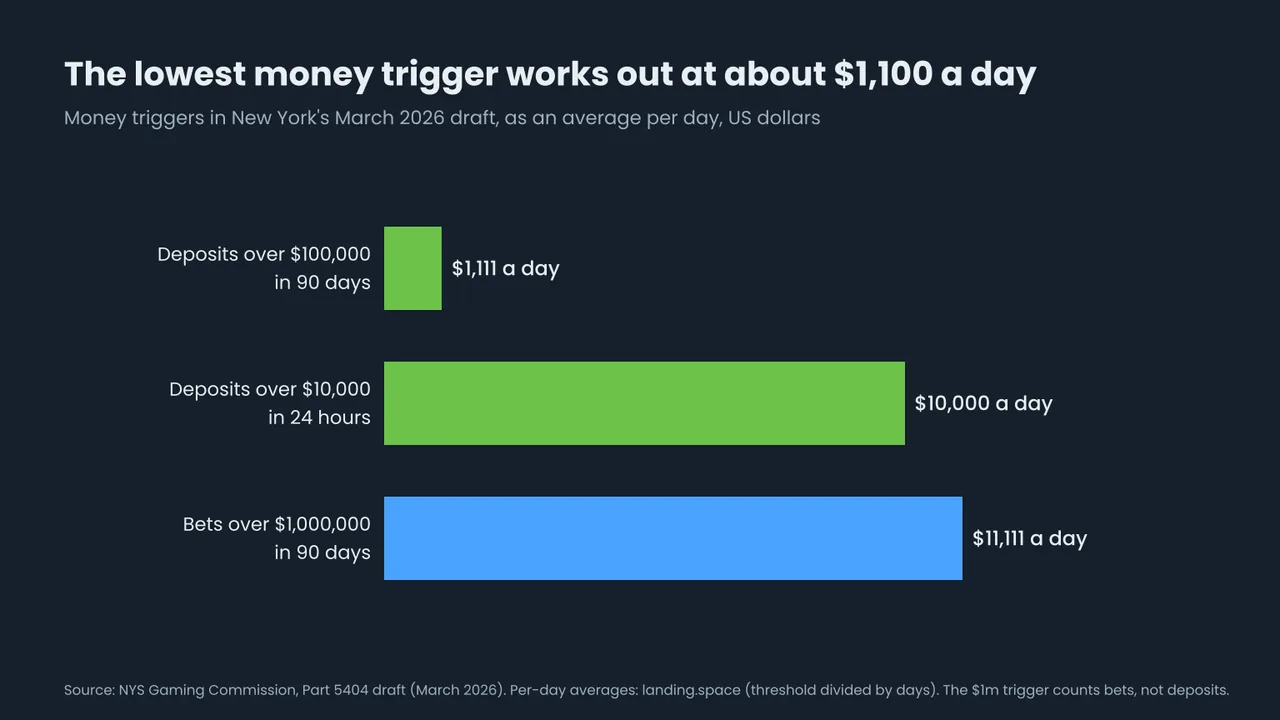
- deposits of more than $10,000 in 24 hours, or more than $100,000 in 90 days;
- bets totalling more than $1,000,000 in 90 days;
- three or more visits to the self-exclusion page in 30 days without completing it;
- a second cool-off period requested within 45 days of the first ending;
- three limit increases in a row within seven days, with no decrease;
- three cancelled withdrawals in 10 days;
- time logged in up by half or more compared with the two weeks before;
- two or more sessions in a week that end with less than $1 in the account, or with more bets than the session before;
- deposits from more than two sources in 24 hours;
- and any further triggers that the operator or the Commission identifies.
The money triggers look high, and the 90-day ones are the easier to reach. We divided each threshold by its period: $100,000 in 90 days is an average of about $1,111 a day, against $10,000 for the single-day trigger. ProPublica and BettingNews report the same deposit and turnover thresholds in the version advanced in October.
What would happen to a flagged customer
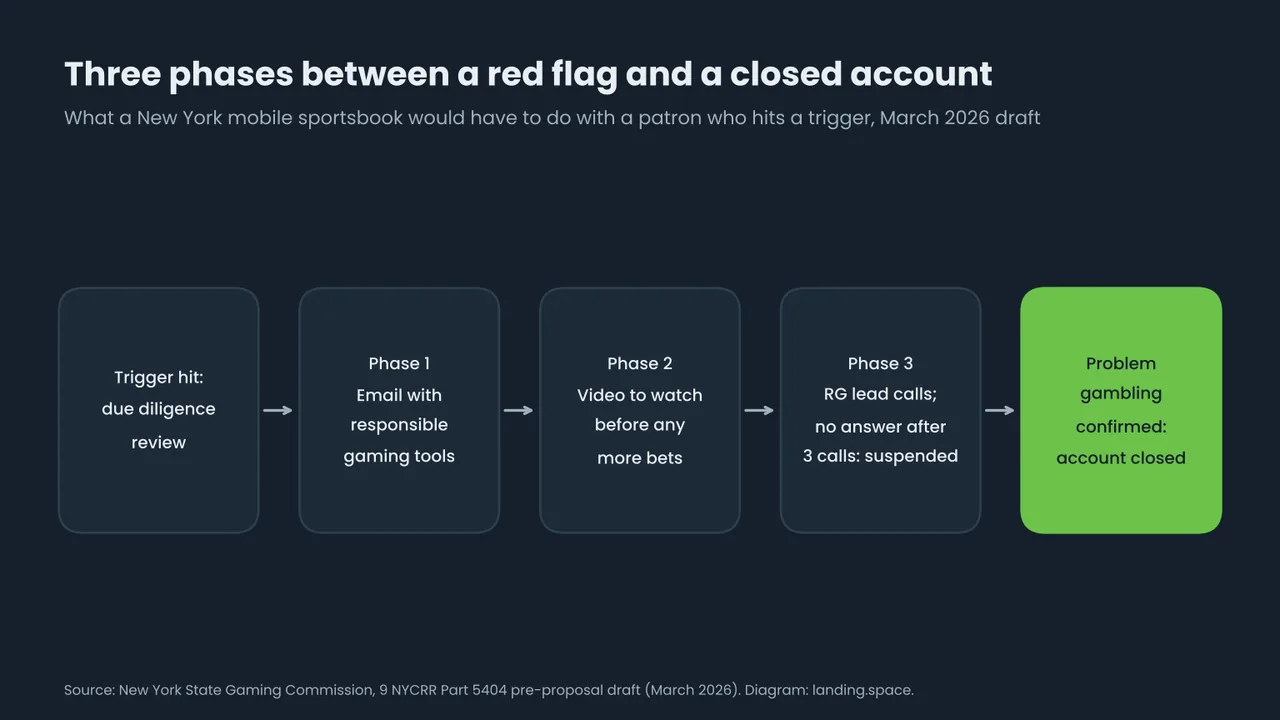
Each operator would appoint a responsible gaming lead, keep a list of at-risk patrons, send them responsible gaming information and stop sending them direct advertising. The draft then sets out three phases of intervention. First, the operator contacts the patron by email or another approved method about the tools and help available. Second, the patron must watch a video on responsible gaming approved by the Commission before placing any further bets. Third, the responsible gaming lead contacts the patron directly by phone or video; after three unanswered calls at least 24 hours apart, the account is suspended until contact is made, and if problem gambling is confirmed it is closed.
Two smaller rules point at practices that matter to anyone who has tried to stop. A cool-off period would last at least 72 hours and could not be reversed once started. And a withdrawal could not be cancelled within three days of the request, while operators would be barred from asking customers to cancel a pending withdrawal, the familiar prompt to put the money back into play.
Why the rules are on the table now
The AI part of the debate took off in September with the New York Times reporting on how one large US sportsbook used machine learning to decide who received which promotions, which we covered in our article on that investigation; Massachusetts then asked its operators how they use AI. ProPublica's report on the October vote adds an account of its own: a reporter deposited $21,600 into a sportsbook account in under eight weeks and received more than 30 marketing messages. We report that as ProPublica's experience, not as a finding about any operator.
The Commission's chair, Brian O'Dwyer, raised a different gap. A customer whom one sportsbook restricts can open an account at another, so he asked licensees to share data that could stop that movement "from defeating an intervention", as CasinoBeats quoted him, and warned that "The industry is on notice by me and this commission that they need to solve this problem." The proposals do not yet say how such sharing would work. New York has nine licensed mobile sportsbooks and taxes their revenue at 51%.
What the industry and campaigners say
The two sides read the same vote very differently. Joe Maloney, president of the Sports Betting Alliance, said the group would keep working with regulators on proposals meant to strengthen the regulated market, and pointed to more than $1 billion a year in tax from licensed operators, an industry figure. Brianne Doura-Schawohl, a gambling-harm advocate quoted by ProPublica, called the package "nothing more than giving the appearance of reform and not effectuating actual change". O'Dwyer himself spoke of "the limitations of this proposal", and presented it as a chance for the industry to show its commitment before the Commission acts further.
What is confirmed and what is not yet known
- Confirmed: the Commission published a draft in March 2026 that would bar AI-personalised promotions and suggested wagers and would set 13 at-risk triggers and a three-phase intervention; the governor's office released it for comments due on 15 May 2026.
- Reported, not yet seen in an official text: the unanimous vote of 9 October 2026; the wider AI scope covering affiliates, vendors, odds and betting limits; the consent exception; the exclusion of horse racing; the 60-day comment period.
- Not yet known: the exact consent wording; when the comment period starts and ends; whether the 13 triggers survive unchanged; how operators would share data on restricted customers; when a final vote could take place.
What it means for players
For now, nothing changes for customers of New York's sportsbooks: these are proposals, and a final vote is not scheduled. If the rules pass as reported, the offers and suggestions you see would no longer be tailored to you by AI unless you agree to it, so it will be worth reading any consent request rather than accepting it with the sign-up terms. Wherever you play, an offer built around your own betting history is still a bonus with conditions; our welcome bonus guide explains what to check first, and UK readers can compare how the UK market handles bonus rules. Spain is going the other way on deposits, with a default cap across all sites: see Spain's joint deposit limit. The responsible gambling guide covers the tools that already exist, and in New York the HOPEline is on 1-877-846-7369.
Frequently asked questions
What did the New York Gaming Commission vote on in October 2026?
On 9 October 2026 it unanimously advanced two revised proposals, as reported by ProPublica and the trade press: one restricting the use of AI to personalise promotions, bonuses, odds and betting suggestions, and one requiring sportsbooks to identify and engage at-risk customers. Neither is final.
Does the ban apply if a customer agrees?
According to CasinoBeats, the revised AI rule would not apply to customers who consent. The March draft had no such exception. The exact wording had not been published on the Commission's website by 20 October 2026.
What counts as an at-risk trigger in the draft?
Thirteen triggers in the March draft, including deposits over $10,000 in 24 hours or $100,000 in 90 days, bets over $1,000,000 in 90 days, three cancelled withdrawals in 10 days, and repeated visits to the self-exclusion page without completing it.
What happens to a customer who is flagged?
Under the March draft: an email about responsible gaming tools, then a required video before more bets, then direct contact from the operator's responsible gaming lead. The account is suspended if three calls go unanswered and closed if problem gambling is confirmed.
When could the rules take effect?
No date has been set. A 60-day public comment period follows the vote, according to ProPublica and BettingNews, and the proposals then return to the Commission for discussion and a possible final vote.
Does this affect players outside New York?
No. The rules would apply only to operators licensed in New York. The trade press describes them as modelled on New Jersey rules that limit some uses of AI without banning it, and Massachusetts has asked its own operators how they use AI.
Sources
- NYS Gaming Commission - Potential Rulemaking for Responsible Gaming (9 NYCRR Part 5404), March 2026 draft
- Office of the Governor - Governor Hochul previews measures to keep youth from sports wagering (30 Mar 2026)
- NYS Gaming Commission - proposed rules (checked 20 Oct 2026)
- NYS Gaming Commission - commission meetings (checked 20 Oct 2026)
- ProPublica (press) - New York proposes rules to further restrict online sports betting (9 Oct 2026)
- CasinoBeats (press) - New York sportsbooks face proposed AI, intervention limits (12 Oct 2026)
- SiGMA (press) - New York proposes AI rules for sports betting (13 Oct 2026)
- BettingNews (press) - NY proposes AI restrictions and at-risk sportsbook rules (14 Oct 2026)
Go deeper

The New York Times says DraftKings built a model scoring who would respond to promotions. The reporting, the company's denial, and the regulator now asking.
Read article →
The EU AI Act timeline shifted in July 2026, the Dutch regulator plans AI guidelines and UK rules already require automated harm checks. What it means.
Read article →
Limits, time-outs, self-exclusion and where to get help.
Read guide →This article is independent editorial coverage and is not sponsored; no operator or supplier paid for inclusion. The facts were checked against the sources listed above on 20 October 2026, and rules, programmes and offers can change after that date. Nothing here is legal or betting advice. 18+ only; if you gamble, set your limits in advance.