
Machine Games Duty rises to 25% on higher-stake machines



Chancellor John Healey's Budget on 28 October 2026 raises Machine Games Duty, the tax on gaming machines in betting shops, arcades and other licensed venues, from 20% to 25% on machine games with stakes over £1 or prizes over £100, from 1 April 2027. Lower-stake machines keep today's rate, which the government says protects pubs and seaside arcades. HMRC's impact note puts the net gain to the Exchequer from the rate rise at £135m in 2027-28 and £130m a year after that, money that helps pay for a business rates freeze for retail, hospitality and leisure properties in England. From April 2028 the duty on supplier-owned machines run on profit-sharing deals moves to the suppliers. The Budget document does not mention the online gambling duties. The Betting and Gaming Council, citing EY, says almost 9,000 jobs could be lost; Entain puts its own extra cost at about £25m a year before mitigation.
Update, 30 October: HMRC's note, the costing and the first responses
HMRC published its tax information and impact note on the change on 29 October. Finance Bill 2026-27 will amend the machine types in Schedule 24 to the Finance Act 2012: a Type 2 machine, which pays the standard 20% rate, will have to keep its maximum charge to play within £1 and its maximum prize within £100. A machine above either limit becomes Type 3 and pays the higher 25% rate, which until now has applied only above a £5 stake. The lowest band, a 20p stake and a £10 prize, does not change, and the Treasury will be able to move the £1 and £100 limits up or down by order. HMRC estimates that around 5,100 operators with about 12,400 active premises are affected, particularly adult gaming centres, bingo premises, betting shops and casinos.
The note gives the rate rise on its own, which corrects how we first reported the Budget figures. Line 56 of the Budget's Table 6.1 combines the rate rise with the move of liability to machine suppliers; HMRC's note and the Treasury's policy costings put the rate rise alone at a net gain to the Exchequer of £135m in 2027-28 and £130m a year from 2028-29. The policy costings put the supplier change at £20m in 2028-29, £15m in each of the following two years and £10m in 2031-32, money the Treasury expects from fewer unpaid and late payments rather than from a higher rate. Each costing is rounded separately, so for 2031-32 the two add to £140m rather than line 56's £145m. The figure in the 28 October section below now shows the rate rise alone. The costing assumes operators pass part of the rise on by paying back less to players, uses a stake elasticity of -0.95, and assumes that a quarter of the stakes lost on machines moves to online casino, where Remote Gaming Duty applies; it also counts lower Corporation Tax receipts. The Treasury names the behavioural response as the main uncertainty.
One more Budget line reaches the same venues. From April 2027 adult gaming centres in England will no longer be eligible for the retail, hospitality and leisure business rates multipliers, the group of properties whose rates freeze the MGD rise helps to pay for. Table 6.1 puts the gain at £10m a year from 2027-28, a figure that also covers removing the same multipliers and Small Business Rates Relief from vape shops.
The industry's responses came on Budget day. The Betting and Gaming Council said that at 25%, EY projects almost 9,000 jobs could be lost and almost 1,000 betting shops and casinos could close or be at serious risk of closure; against a 40% rate, its campaign had warned of up to 16,000 jobs and nearly 1,500 shops. We have not seen the EY analysis. The BGC also says more than 600 betting shops have closed or announced closure since the November 2025 Budget. Entain, the owner of Ladbrokes and Coral, told the stock exchange that the rise adds about £25m a year to the costs of its UK and Ireland retail business before any mitigation, an estimate based on analysts' consensus for its 2027 retail gaming revenue. It expects to cover that by the end of 2028 through estate rationalisation, savings across the group and market share gains, including customers it expects to recapture as rivals re-evaluate their UK presence, and left its guidance unchanged. Gambling shares rose after the speech because a 40% rate had been feared; Entain's were 5.4% higher late on Budget day.
Bacta, the trade body for arcades and adult gaming centres, told its members that "the fight is not over". Its president Joseph Cullis said that, according to Bacta's own intelligence, some policymakers had pressed for 35% as a compromise while 90 Labour MPs backed 40%, and that the machines many seaside arcades rely on to stay viable are still caught by the rise, despite the Budget's stated aim of protecting them. Bacta says it will challenge the business rates change for adult gaming centres and take part in the consultation on supplier liability.
Update, 28 October: what the Budget decided
The measure itself is short. Section 7.19 of the Budget document's HTML version says the government "will increase the rate of MGD from 20% to 25% for machine games with stakes over £1 or prizes over £100 from 1 April 2027". It describes these as "higher-risk machines, which are more associated with gambling harm and commonly found in venues such as adult gaming centres", and says that "in order to protect pubs and seaside arcades" it is keeping the existing rate for lower-stake machines. The document does not change the 5% rate for the smallest machines or the 25% rate that already applies to stakes over £5.
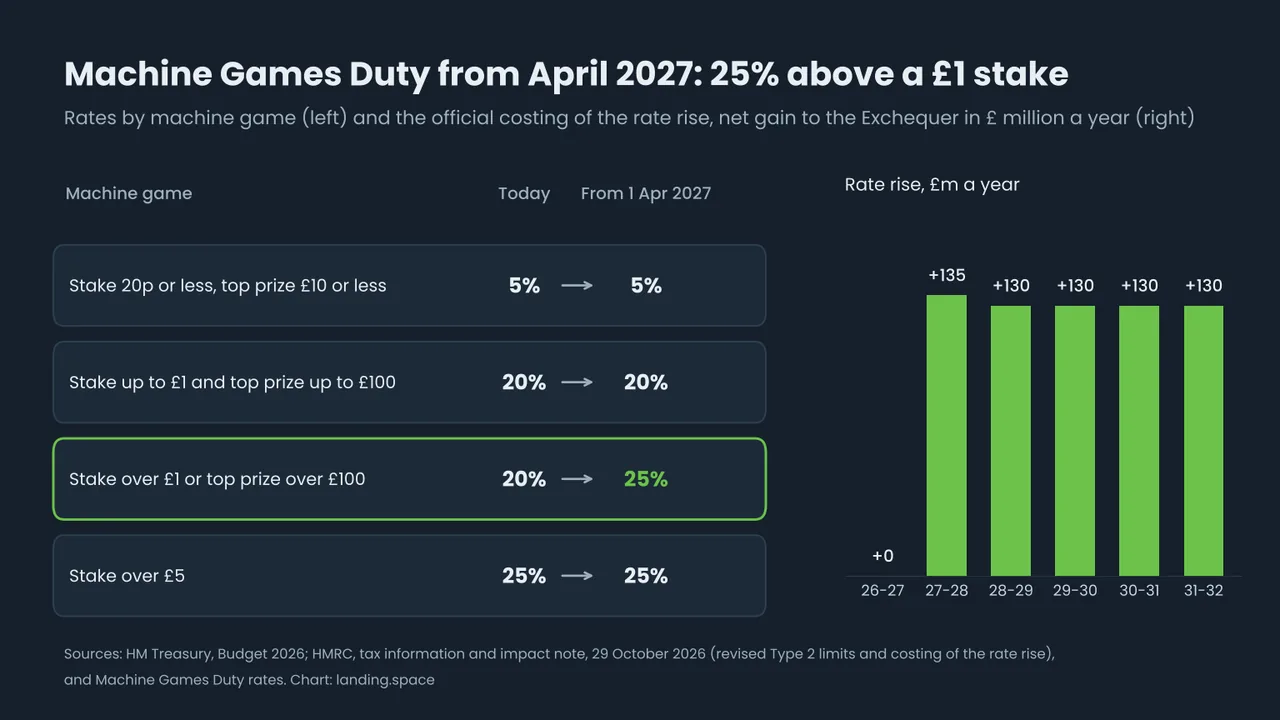
The new line matches the limits of a Category C machine, which the Gambling Commission caps at a £1 stake and a £100 prize. Category C is the highest category allowed in pubs and licensed family entertainment centres; Category B machines, with stakes of up to £2, or £5 on the B1 machines found only in casinos, are above it. On our reading, the rise therefore falls on Category B play in betting shops, adult gaming centres, bingo halls, clubs and casinos, while pub machines and the lower-stake games in seaside arcades keep their current rates. HMRC's rules add a detail that matters in betting shops: where one machine offers games at different rates, the highest rate applies to all of its takings.
The Treasury's costing, line 56 of the Budget's table of policy decisions, puts the two MGD measures together at nothing in 2026-27, £135m in 2027-28, £150m in 2028-29 and £145m a year from 2029-30 to 2031-32; the 30 October update above separates the rate rise from the supplier change. The Budget says the money will help pay for a two-year real-terms freeze in business rates for retail, hospitality and leisure properties in England. For scale, five points on all £3.15bn of takings taxed at the standard rate in 2025-26 would be about £158m if play did not change; the rise covers only the higher-stake part of that band, so a static figure for this measure would be lower, by an amount the published data do not show. The official figure is well below the £275m to £458m that the Social Market Foundation expected from a 40% rate on Category B machines, the modelling that 90 Labour MPs pointed to when they asked for a higher rate on 16 October.
Two smaller changes sit beside the rate. From 1 April 2028, liability for MGD on supplier-owned machines run under profit-sharing arrangements moves to the machine suppliers; today HMRC's guidance says a business that only supplies the machines is not responsible for the duty. A 12-week consultation on how to do this closes on 20 January 2027. The Gross Gaming Yield bands for Gaming Duty, the tax on land-based casino gaming, will be frozen from 1 April 2027 until 31 March 2028. The Budget document does not mention Remote Gaming Duty or General Betting Duty, so online casino stays at 40% and most online betting still moves to 25% in April 2027 (online bets on UK horseracing stay at 15%).
Before the Budget: what was reported
On 7 September 2026 The Times reported that Treasury officials were working out how much a higher Machine Games Duty (MGD) would raise from Category B machines, the higher-stake machines found in betting shops, arcades and casinos. Earlier proposals had put the standard rate at 40%, double today's 20%. A government source quoted in the coverage said further gambling tax rises were being considered. Until the Budget, the Treasury did not confirm a rate, a machine category or a start date.
The date was fixed in advance. HM Treasury told the Treasury Select Committee on 31 July that the Budget would be held on 28 October 2026. It was John Healey's first: he was appointed Chancellor on 20 July 2026, the day Andy Burnham became Prime Minister. His predecessor Rachel Reeves raised the online gambling duties in November 2025 and left machines unchanged.
The duties and the changes now set
Britain taxes gambling businesses, not players. Most of the duties are charged on gross profit: the stakes a business takes in, minus the winnings it pays out (our guide to how casinos make money explains the term). The November 2025 Budget nearly doubled the rate on online casino games from April 2026 and will raise it on most online betting from April 2027. The table sets the current rates beside what each duty collected in the financial year to March 2026.
| Duty | What it taxes | Rate today | Change already set | Receipts 2025-26 |
|---|---|---|---|---|
| Remote Gaming Duty | Online casino games and slots | 40% | Up from 21% on 1 April 2026 | £1,321m |
| General Betting Duty | Fixed-odds and other bets | 15% | Online bets 25% from 1 April 2027 (UK horseracing stays 15%) | £685m |
| Machine Games Duty | Gaming machines in licensed venues | 5% / 20% / 25% | 25% from 1 April 2027 on games with stakes over £1 or prizes over £100 (Budget 2026) | £641m |
| Gaming Duty | Land-based casino gaming | Banded, top band 50% | Bands frozen 1 April 2027 to 31 March 2028 (Budget 2026) | £174m |
| All betting and gaming duties | Including Lottery Duty | - | Bingo Duty abolished 1 April 2026 | £3,831m |
Who pays Machine Games Duty
MGD is paid by the business that makes machine games available, typically on premises licensed for gambling or for alcohol, and until April 2027 it has three rates: 5% for the lowest-stake machines, 25% for machines allowing stakes over £5, and 20% for everything in between. Almost all of it is standard-rate money. In 2025-26 the 20% band accounted for £630.5m of £638.2m in liabilities, or 98.8%. That allows a simple static check. At 20%, £630.5m of duty means about £3.15bn of taxed machine takings, so doubling the rate with no change in play would add about £630m a year. No serious estimate is that high, because players, machines and venues would not stay where they are.
The first quarter at 40%: online receipts doubled
HMRC's statistics, published on 30 September, give the first look at how the online increase has worked. Remote Gaming Duty is accounted for in three-month periods and paid within 30 days of each period's end, so most of it arrives in four months of the year: January, April, July and October. July 2026 is the first of those months to cover a quarter taxed entirely at 40%, and it brought in £589.7m, against £283.0m in July 2025.
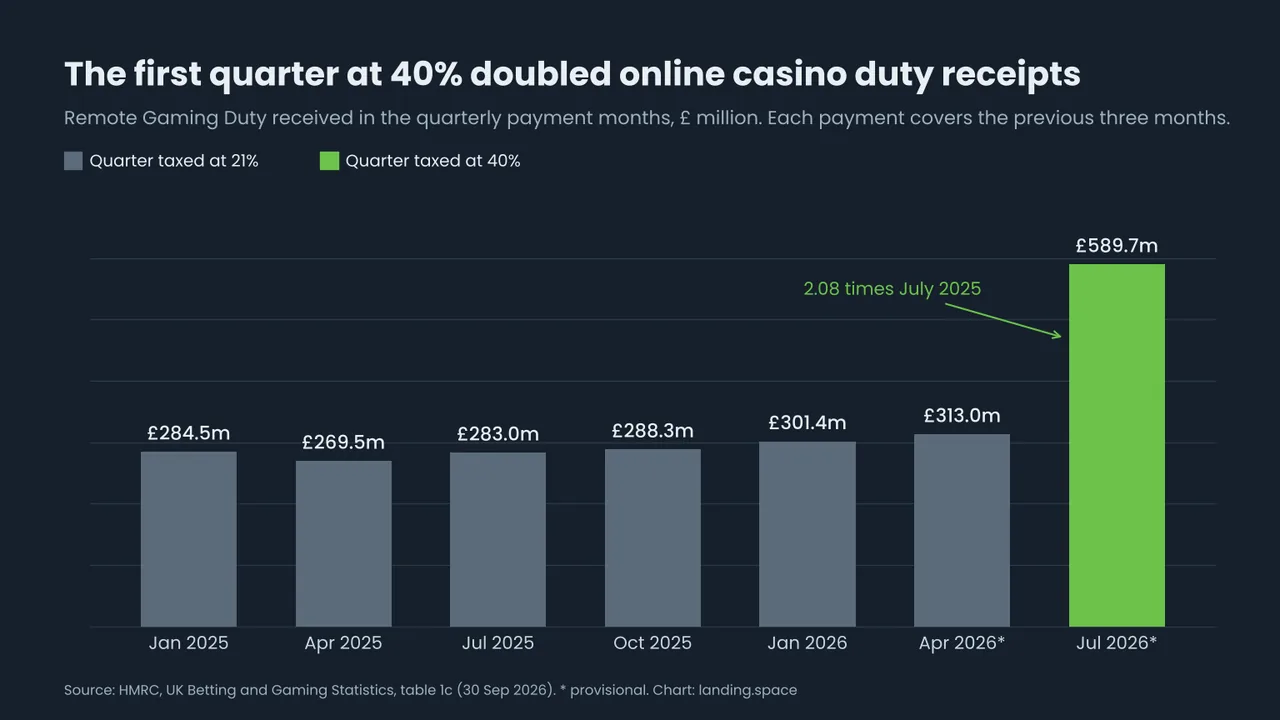
The rate rose 1.9 times; the July receipts rose 2.08 times. Dividing each payment by its rate gives the profit it was charged on: about £1,348m for April to June 2025 and about £1,474m for the same quarter of 2026, a rise of roughly 9%. On these figures, the profit taxed in the first quarter at 40% was higher than a year earlier, not lower. The caveats are real: the 2026 figures are provisional, the method assumes each July payment covers the April to June quarter, and one quarter is not a trend.
The industry's warning: shops, jobs and a sponsorship
Operators have made their case loudly since the report. On 16 September Entain, the Ladbrokes owner, said it would cut up to 400 of its 2,000 UK customer-care roles, describing it as a simplification driven by the new tax burden. Its chief executive Stella David wrote to the Prime Minister asking the government to look at the effect on jobs and communities before deciding on MGD. Coverage of the letter said the idea under discussion would double all three rates, to 10%, 40% and 50%.
Three days later Betfred's founder Fred Done told the Racing Post that a 40% rate would force the company to close 495 more shops, with 2,575 jobs, on top of the 132 closures it announced in July. His forecast for the high street was blunter: "I believe that by 2030 we will have no betting shops." On 21 September Betfred said it would end its title sponsorship of rugby league's Super League, held since 2017, after the 2026 season, and put the decision down to last year's Budget and rising wage costs.
The Betting and Gaming Council launched its Back Our Betting Shops campaign on 29 September. It says a 40% rate would put up to 16,000 jobs, nearly 1,500 shops and up to 34 casinos at risk, and that the Treasury would end up £124m a year worse off overall. On 2 October the consultancy Regulus Partners published its own analysis: about £45,000 a year added to an average shop's costs, around 1,500 shops still trading three years later, and about £92m a year lost to British racing in levy and media-rights income. The Gambling Commission counted 5,617 betting shops at the end of March 2026, 3.6% fewer than a year before.
The case for a higher rate
The idea did not start in the Treasury. In June the think tank Social Market Foundation argued for a 40% rate on Category B machines, leaving pub machines out, and estimated it would raise between £275m and £458m a year. Its argument is that machine gambling causes about £2.33bn a year of economic harm, and that money not spent on machines would be spent in sectors that employ more people and pay more tax. A poll it published found 43% of adults in favour of higher taxes on slot machines in betting shops and 11% in favour of cutting them. The BGC replied that a rise would put venues and jobs at risk and push customers towards illegal operators, and Regulus questioned how the harm figure was calculated.
The numbers in this debate measure different things, which is why they look irreconcilable. Set side by side:
| Estimate | Who made it | What it measures | Figure at 40% |
|---|---|---|---|
| Static check | landing.space, from HMRC data | Extra MGD if play did not change | about +£630m a year |
| Think-tank estimate | Social Market Foundation | Extra receipts, Category B only | +£275m to +£458m |
| Industry campaign | Betting and Gaming Council | Net effect on the Exchequer | -£124m a year |
| Consultancy model | Regulus Partners | Shops still trading after 3 years | about 1,500 |
| Company claim | Betfred | Its own extra closures | 495 shops |
None of these figures describes what was decided. The Chancellor chose 25% on machine games with stakes over £1 or prizes over £100 (on our reading, the games above the Category C limits), not 40%, and the official costing of that rate rise, £130m to £135m a year, is set out in the updates at the top of this article.
Ireland left its betting duty at 2%
Across the Irish Sea the same argument ended the other way, for now. Ireland's Budget 2027, delivered on 6 October, kept betting duty at 2% despite calls for an increase. The Irish Bookmakers Association welcomed the decision but said operators still do not know the rate of the social impact fund levy that the Gambling Regulatory Authority of Ireland will charge from 2027. We relied on the Racing Post's report for this; the Irish government's Budget pages did not load for us.
What is confirmed and what is not yet known
- Confirmed: the Budget raises MGD from 20% to 25% for machine games with stakes over £1 or prizes over £100 from 1 April 2027 (HMRC's 29 October note: a Type 2 machine must stay within a £1 stake and a £100 prize, and the Treasury can later move both limits); the rate rise is costed at £135m in 2027-28 and £130m a year after that; lower-stake machines keep their rates; liability for supplier-owned machines under profit-sharing arrangements moves to suppliers from 1 April 2028; Gaming Duty bands are frozen for 2027-28; Remote Gaming Duty stays at 40% and online betting duty rises to 25% on most bets on 1 April 2027.
- Confirmed: Entain's job cuts, Betfred's sponsorship decision and the BGC campaign, from the companies' own statements as reported.
- Confirmed: adult gaming centres in England lose the retail, hospitality and leisure business rates multipliers from April 2027; Entain's estimate of about £25m a year of extra cost before mitigation comes from its own stock exchange announcement.
- Not known: the detailed legislation, and the outcome of the consultation on supplier liability, which closes on 20 January 2027.
- Not known: how operators respond, whether by changing stakes and prizes, moving games below the £1 line or closing venues.
- Not known: the EY analysis behind the BGC's revised figures for 25%, which we have not seen, and whether Entain's planned estate rationalisation means shop closures, and how many.
- Disputed: the closure and job forecasts, which come from businesses that would pay the tax and their advisers, and the harm cost, which comes from the think tank proposing the rise.
What it means for players
For anyone who plays online, MGD is not a tax on their play: it applies to physical machines in venues. The online changes are already in force or scheduled. Players do not pay any of these duties directly, and the Gambling Commission states that winnings are tax-free for customers in the UK whatever the amount. What higher duties change is the operator's margin. HMRC's note says players are affected only if operators pass the rise on through lower returns to players, and the Treasury's costing assumes some will; none of the sources above puts a number on how much. On our reading, any change players notice would be on higher-stake (Category B) machines in betting shops, adult gaming centres, bingo halls, clubs and casinos from April 2027, not on pub machines.
Frequently asked questions
Has the government raised Machine Games Duty?
Yes. The Budget on 28 October 2026 raises the rate from 20% to 25% for machine games with stakes over £1 or prizes over £100, from 1 April 2027. Lower-stake machines, including those in pubs and seaside arcades, keep their current rates. HMRC's impact note puts the net gain to the Exchequer from the rise at £135m in 2027-28 and £130m a year after that.
Which venues pay Machine Games Duty?
The business that makes machine games available pays it, typically on premises licensed for gambling or for alcohol: betting shops, adult gaming centres, bingo halls, casinos and pubs among them. The lowest-stake machines pay 5% and most others 20%; from 1 April 2027 games with stakes over £1 or prizes over £100 pay 25%, as machines allowing stakes over £5 already do.
Will machine suppliers pay Machine Games Duty?
For some machines, from 1 April 2028. The Budget moves the liability for supplier-owned machines run under profit-sharing arrangements to the suppliers, and a consultation on how it will work closes on 20 January 2027. Today a business that only supplies machines is not responsible for the duty. The Treasury expects this change to bring in £10m to £20m a year, from fewer unpaid and late payments.
How many businesses does the higher rate affect?
HMRC estimates around 5,100 Machine Games Duty operators with about 12,400 active premises, particularly adult gaming centres, bingo premises, betting shops and casinos. Machines within the £1 stake and £100 prize limits, pub machines among them, keep their current rates.
Do I pay tax on my winnings in the UK?
No. The Gambling Commission states that winnings from gambling are tax-free for customers in the UK, regardless of the amount. The duties are paid by operators on their gross profit.
Did the 40% online duty shrink what operators pay?
Not in its first quarter. HMRC's provisional figures show £589.7m of Remote Gaming Duty received in July 2026, against £283.0m in July 2025. Divided by the rate in force, that implies the profit being taxed was about 9% higher than a year earlier. It is one quarter of provisional data.
Why do estimates of the rise differ so much?
They answer different questions. A static check assumes nobody changes behaviour; the think tank estimates extra duty from Category B machines only; the industry campaign estimates the net effect on the Exchequer after closures; the consultancy models how many shops survive. None of them is the government's own costing, which for the 25% rate the Chancellor chose is £135m in 2027-28 and £130m a year after that.
Is Ireland raising its betting tax?
Not in Budget 2027, which kept betting duty at 2% on 6 October 2026. Operators are still waiting to learn the rate of a new social impact fund levy due from 2027.
Sources
- HM Treasury - Budget 2026, HTML version (28 October 2026)
- HMRC - Machine Games Duty: increasing the rate on higher stake and prize machines, tax information and impact note (29 October 2026)
- HM Treasury - Budget 2026 policy costings (28 October 2026)
- Betting and Gaming Council - BGC response to the Budget (28 October 2026)
- Entain plc - Statement regarding UK gambling tax increases, stock exchange announcement (28 October 2026), via Sharecast
- Sharecast - Entain to take additional £25m per year hit from latest tax hikes (28 October 2026)
- Bacta - Sector reels from Budget blows but Bacta insists the fight is not over (29 October 2026)
- HMRC - Machine Games Duty: how much you pay (read 28 October 2026)
- Gambling Commission - Gaming machine categories (updated 8 January 2024)
- SBC News - 90 Labour MPs publicly demand Machine Games Duty rise (16 October 2026)
- HM Treasury - Chancellor's letter to the Treasury Select Committee on the Budget 2026 date (31 July 2026)
- gov.uk - Chancellor of the Exchequer (read 7 October 2026)
- gov.uk - Prime Minister (read 7 October 2026)
- HMRC - Historical UK betting and gaming duty rates (updated 30 September 2026)
- HM Treasury - Gambling duty changes, policy paper (26 November 2025)
- HMRC - General Betting Duty, Pool Betting Duty and Remote Gaming Duty guidance (updated 1 April 2026)
- HMRC - Machine Games Duty guidance
- HMRC - UK Betting and Gaming Statistics, tables to July 2026 (30 September 2026)
- Gambling Commission - Gambling industry statistics 2025 to 2026 (17 September 2026)
- Gambling Commission - Winnings from gambling for customers (12 May 2026)
- The Times - Treasury modelling a Machine Games Duty rise (7 September 2026, paywalled; not opened by us), as reported by NEXT.io
- Yogonet - UK Chancellor reportedly weighing slot machine tax increase (9 September 2026)
- SBC News - Entain job cuts and letter to the Prime Minister (16 September 2026)
- Racing Post - Betfred founder's warning to the Chancellor (19 September 2026)
- NEXT.io - Betfred ends Super League sponsorship (21 September 2026)
- Gambling.com - BGC launches Back Our Betting Shops campaign (29 September 2026)
- Racing Post - Regulus Partners analysis of a 40% MGD rate (2 October 2026)
- NEXT.io - Social Market Foundation backs a 40% rate on Category B machines (29 June 2026)
- CARE - Two-fifths of people support increasing slot machine taxes (3 July 2026)
- Racing Post - No increase in betting tax in the Irish Budget (6 October 2026)
Go deeper
UK financial risk assessments will start at GBP 5,000 a day. How deposit limits, stake caps and credit bans compare in the Netherlands, Sweden and Finland.
Read article →
Britain has capped bonus wagering at 10x since 19 January 2026. How that rule works, what Denmark, Sweden and the Netherlands do, and the maths.
Read article →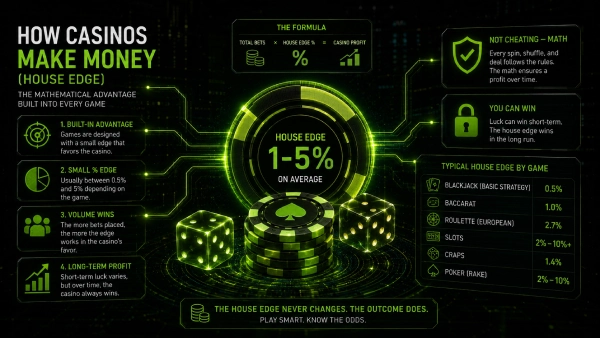
A plain-English guide to the house edge and RTP, with game-by-game figures and why betting systems fail.
Read guide →This article is independent editorial coverage and is not sponsored; no operator or supplier paid for inclusion. The facts were checked against the sources listed above on 7 October 2026 (updated 28 October against the Budget 2026 document and 30 October against HMRC's impact note and the Budget policy costings), and rules, programmes and offers can change after that date. Nothing here is legal or betting advice. 18+ only (21+ for online casino in the US states that license it); if you gamble, set your limits in advance.