
Dutch legal gambling market shrank to €4.1bn in 2025, while online accounts kept rising



The Dutch gambling regulator, the Kansspelautoriteit (Ksa), says the licensed market in the Netherlands shrank in 2025: gross gaming revenue, the stakes kept after winnings, fell from €4.5 billion in 2024 (inflation-corrected) to €4.1 billion, with online casino down 18.2% and online betting down 30.2%. In two reports published on 29 October 2026, it also finds that the number of online accounts in use kept rising in the first half of 2026, to 1.48 million a month, while the estimated number of people gambling did not rise. Its explanation is a hedged one: some players may be opening extra accounts to get round the limits that apply to each account.
Where the money fell
The Ksa's market scan for 2025 puts the whole licensed market, land-based and online, at €4.1 billion in gross gaming revenue. The comparison figure for 2024, €4.5 billion, is corrected for inflation; the Ksa's previous scan, published in November 2025, gave 2024 as €4.3 billion. In the inflation-corrected figures the fall came mostly online, where revenue dropped from €1.52 billion to €1.20 billion, or 21%.
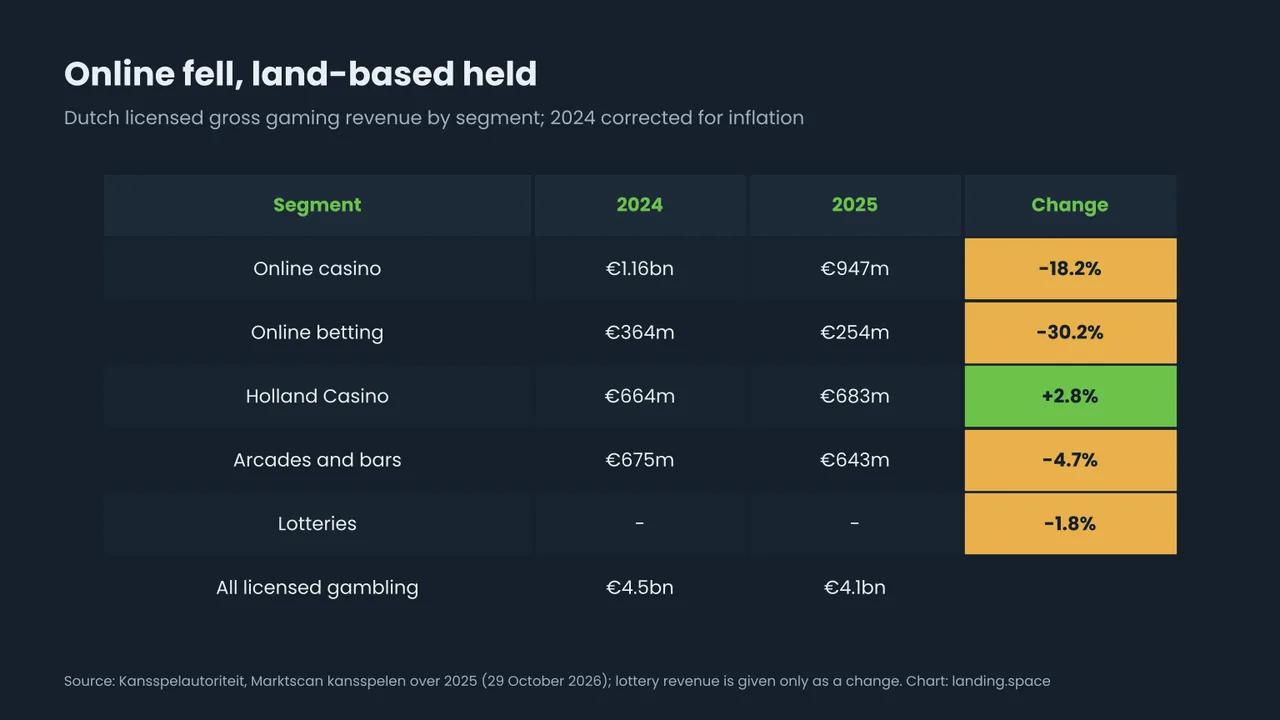
The Ksa gives two reasons:
- The player-protection rules that came in at the end of 2024, above all the net deposit limit: €300 a month for young adults and €700 a month for everyone else, which can only be raised if the player shows they can afford it.
- Football: the men's European Championship lifted betting revenue in 2024, and 2025 had nothing comparable.
Holland Casino, the land-based casino chain, went the other way, up 2.8% to €683 million on the strength of its slot machines.
The money that stayed in the legal market was taxed harder. Gambling tax rose from 30.5% to 34.2% in 2025 and to 37.8% from 1 January 2026, and the sector paid €1.05 billion of it in 2025. Spread over the adult population, the Ksa calculates that the average Dutch adult lost €282 on gambling in 2025, against an EU average of €369 once adjusted for Dutch income and prices.
More accounts, not more players
The half-yearly monitor, which covers January to June 2026, shows the online market picking up again: legal online revenue was about €670 million in the half-year against €602 million in the second half of 2025, which the Ksa says may be partly due to the men's World Cup in June and July. The number of accounts in use rose to an average of 1.48 million a month, from 1.38 million six months earlier. The number of people gambling did not follow: the Ksa says it has not increased significantly, and estimates about 490,000 people gambled online in an average month, against about 510,000 six months earlier, and about 820,000 at some point in the half-year.
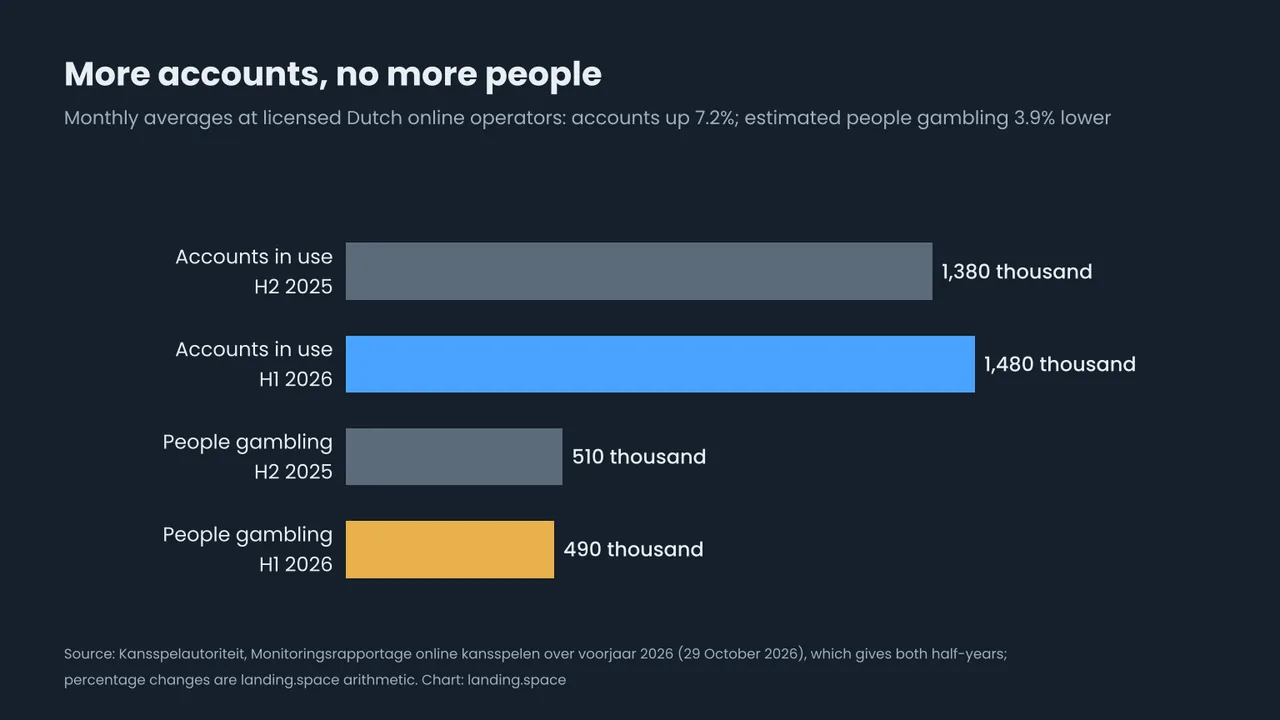
On its own page the Ksa says the rise in new accounts may partly reflect the World Cup, "maar kan ook betekenen dat mensen meerdere accounts maken om de stortingslimieten per account te omzeilen": but it may also mean people are opening several accounts to get round the deposit limits that apply per account. Its April report had already tied the growth in accounts to the net deposit limit. The monitor hedges the point, with "mogelijk" (possibly) and "vermoedelijk" (probably). Its consumer panel, which tracks browsing, shows players visiting 3.1 legal operators on average, down from 3.3, which the Ksa notes is at odds with the account counts reported by the licensees and its own control database.
A limit across operators is already being worked on. In a progress letter to parliament on 12 June 2026, State Secretary Van Bruggen said the cabinet is preparing an overarching deposit limit, using a central register run by the Ksa, which a player could only exceed after an affordability check; its stated aim is to stop players suffering excessive losses in a short time within the legal market. The amount is to be set in secondary regulation and has not been published; the letter allows for the public consultation slipping into 2027.
Legal by players, not by money
The Ksa's channelisation figures, the share of gambling that stays with licensed operators, tell two different stories. Counted by people, about 94% of those who gamble online do so only at legal sites; the monitor gives 94% or 97%, depending on whether people who use both legal and illegal sites are counted in or out, and calls both methods defensible. Counted by money, the legal share is much lower: 59% of gross gaming revenue in the first half of 2026, up from 54% in the previous half-year. The gap, the Ksa writes, suggests that people who gamble illegally lose considerably more on average than those who stay with licensed sites. We set out an earlier version of this picture in our report on its plan to cut off illegal gambling ads.
The money figure comes with two warnings. It rests on an estimate of illegal revenue built from search volume for illegal sites, and the Ksa has changed that method: it now leaves out operators it believes are artificially inflating their search volume, and it shows data only from summer 2025, because applying the new method to earlier years could give a misleading picture. The 54% and 59% therefore cannot be compared with the 49% to 53% it published before. The monitor also says plainly that figures for the illegal market are less accurate and reliable than those for licensed operators, and that its consumer panel contains only about 300 people who gamble.
Losses and harm
Per person, losses at licensed sites went up again in the first half of 2026: €137 a month on average, against €121 in the second half of 2025 and €160 in the first half of 2024, before the new rules. Per account the figure barely moved, from €73 to €75 a month, a gap consistent with the Ksa's suggestion that some people are using more accounts. Other harm measures in the reports:
- Treatment: 3,108 people were treated for gambling as their main addiction in 2025, over 14% more than the 2,708 in 2024, according to the national addiction care register LADIS, which notes that some people are treated outside addiction clinics.
- Risk: in an Ipsos survey of 6,948 people in spring 2026, 9% of online gamblers were at high risk of gambling harm, the same as in 2025; 65% showed no problem gambling.
- Young adults: players aged 18 to 23 used 329,000 accounts a month and spent €68 million in the half-year, losing €34 a month per account on average.
- Self-exclusion: the national register Cruks held 120,200 registrations on 31 July 2026.
What comes next
The same June letter sets out the rest of the government's plan: a ban on advertising for online gambling that also covers offering bonuses, indefinite self-exclusion in Cruks without automatic removal, and work on letting the Ksa suspend licences on its own authority. None of it has a date for parliament yet. No government response to the 29 October reports had been published by 1 November; the two previous monitors went to parliament within a day of publication. The Ksa's enforcement against illegal sites continues alongside: in October it announced its largest fine yet for illegal gambling, €37.25 million on EOD Code, the operator of Instantcasino.
For players in the Netherlands, the practical points are unchanged. A licensed site must apply the monthly limits, check affordability before raising them and check Cruks before letting anyone play; an unlicensed site is not bound by these rules, and the Ksa's figures suggest the people who use them lose more. How the Dutch limits compare with other countries' affordability rules is set out in our report on deposit limits and affordability checks.
Frequently asked questions
How big was the Dutch legal gambling market in 2025?
€4.1 billion in gross gaming revenue, the stakes kept after winnings, according to the Ksa's market scan published on 29 October 2026. That is down from €4.5 billion in 2024 in inflation-corrected terms; the Ksa's previous scan put 2024 at €4.3 billion.
How much did online casino revenue fall in the Netherlands?
By 18.2%, from €1.16 billion in 2024 to €947 million in 2025. Online betting fell 30.2%, from €364 million to €254 million, while Holland Casino rose 2.8%.
Why did the Dutch gambling market shrink?
The Ksa points to the player-protection rules introduced at the end of 2024, especially the net deposit limit of €300 a month for young adults and €700 for older players, and to the men's European Championship having lifted betting revenue in 2024.
Are Dutch players opening extra accounts to avoid deposit limits?
Possibly. Accounts in use rose to 1.48 million a month in the first half of 2026 while the number of people gambling did not rise, at about 490,000 a month, and the Ksa says this may mean people are opening several accounts to get round per-account limits. Its own browsing panel points the other way, showing players visiting fewer operators.
What share of Dutch gambling is legal?
Counted by people, 94% or 97% of online gamblers play only at licensed sites, depending on how mixed players are counted. Counted by money, the legal share was 59% in the first half of 2026, on a revised method the Ksa applies only from summer 2025, so it should not be set against its earlier 49% to 53%.
Will the Netherlands introduce a deposit limit across all operators?
The government said on 12 June 2026 that it is working on an overarching deposit limit across operators, run by the Ksa, with an affordability check to go above it. The amount has not been set and the public consultation may slip into 2027.
Sources
- Kansspelautoriteit - Stand van zaken Nederlandse gokmarkt 2025-2026 (29 Oct 2026)
- Kansspelautoriteit - Marktscan kansspelen over 2025 (29 Oct 2026)
- Kansspelautoriteit - Monitoringsrapportage online kansspelen over voorjaar 2026 (29 Oct 2026)
- Kansspelautoriteit - Factsheet Marktscan kansspelen over 2025
- Kansspelautoriteit - Monitoringsrapportage voorjaar 2026 (16 Apr 2026)
- Kansspelautoriteit - Marktscan 2025 (20 Nov 2025)
- Staatssecretaris van Justitie en Veiligheid - Voortgangsbrief kansspelen, Kamerstuk 24 557 nr. 282 (12 Jun 2026)
- Rijksoverheid - Kabinet scherpt beleid online kansspelen flink aan (12 Jun 2026)
Go deeper
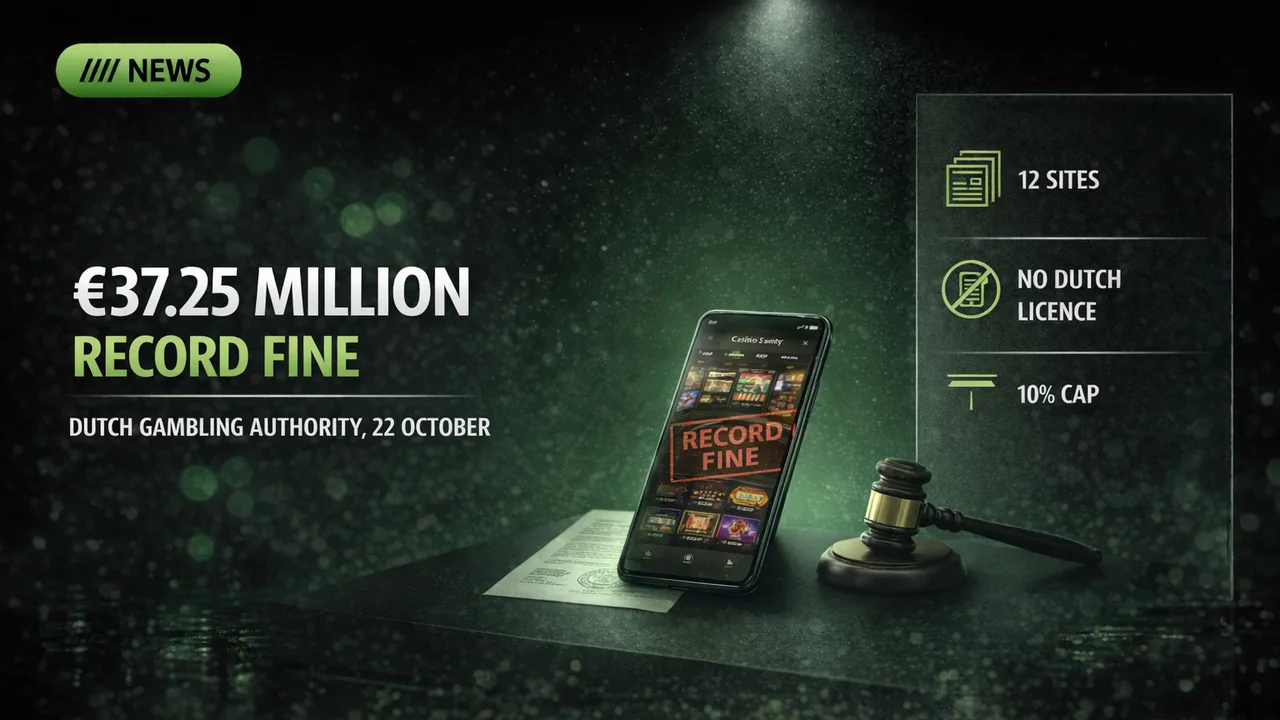
The Ksa fined EOD Code SRL €37.25m for offering Instantcasino and eleven other sites in the Netherlands without a licence. How the fine was set, and capped.
Read article →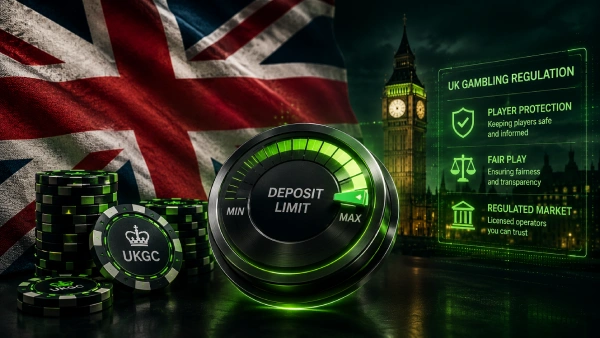
UK financial risk assessments will start at GBP 5,000 a day. How deposit limits, stake caps and credit bans compare in the Netherlands, Sweden and Finland.
Read article →
Limits, time-outs, self-exclusion and where to get help.
Read guide →This article is independent editorial coverage and is not sponsored; no operator or supplier paid for inclusion. The facts were checked against the sources listed above on 1 November 2026, and rules, programmes and offers can change after that date. Nothing here is legal or betting advice. 18+ only (21+ for online casino in the US states that license it); if you gamble, set your limits in advance.