
UK regulator traces illegal gambling through bank data



The UK Gambling Commission has traced illegal gambling through bank data, in what its own blog says may be the first analysis of its kind by any regulator. It bought anonymised open banking data on 38,000 people, found 3,426 payments by 179 of them to illegal gambling operators, and saw that 91% of those with repeated illegal payments also gambled with licensed operators. Of the 146 with a score, 45% were at 8 or more on the Problem Gambling Severity Index, against 6% of the panel's licensed gamblers outside lotteries.
How the Commission found the payments
The data comes from a YouGov panel whose members had agreed to share their banking transactions anonymously for research. The Commission bought it: 157.2 million transactions from 38,000 people between July 2018 and July 2026, of which 4.8 million were with licensed gambling companies other than lotteries. Licensed gambling was picked out by an algorithm developed by Yaspa, which labels a transaction as gambling when the probability is over 0.5; Warwick Business School gave technical support. The report was published on 28 October 2026 as a research report with a blog post, not as a news release.
Finding the illegal payments took three attempts:
- Names: a fuzzy search for the names of known illegal operators in transaction descriptions failed; the Commission suggests illegal operators "rarely or never include their name" in what they send to payment providers.
- Bank statements: exact matches with descriptions taken from bank statements with known illegal transactions found 821 payments.
- Merchant names: exact matches with merchant names from transactions "strongly suspected" to be with illegal operators found 2,628.
With 23 caught by both exact searches, that is 3,426 payments by 179 people, with an average age of 44, 115 of them men. The report does not say where the statements or the suspected names came from.
An add-on, not a switch
Among people with more than one detected illegal payment, 91% also gambled with licensed operators. For the 122 people with at least two illegal transactions, the report lines up their licensed and illegal payments month by month around the first illegal one. Licensed activity was a little lower afterwards, but it did not fall away: by our arithmetic an average of about 25 licensed transactions a month per person in the six months before, and about 23 in the six months after. Illegal payments peaked at 4.9 per person in the first month and then settled between 1.2 and 1.9.
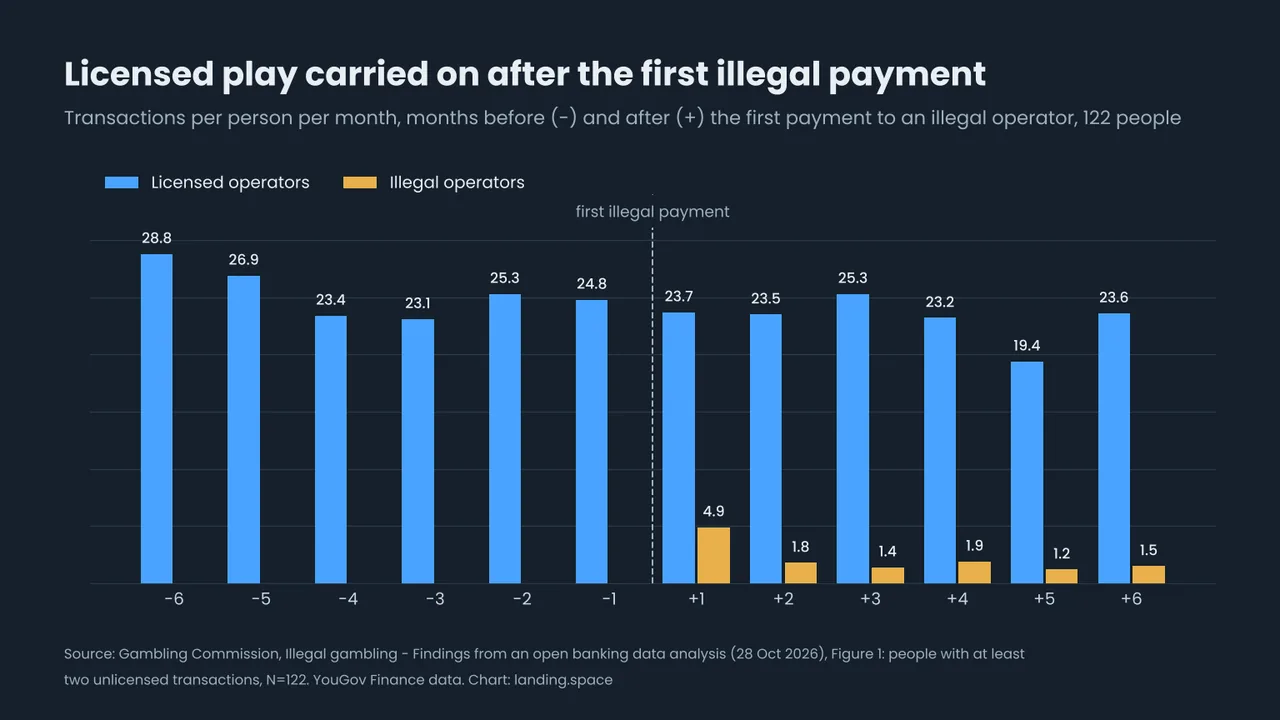
The Commission reads this as illegal gambling being "embedded within existing gambling behaviour rather than triggering a sustained shift". Its blog says the finding is consistent with its earlier Consumer Voice research, in which illegal gambling was "usually supplementary to legal gambling", and that it challenges the idea that illegal play is a direct substitute for legal play.
Harm: 45% against 6%
YouGov had earlier asked many panel members the nine questions of the Problem Gambling Severity Index (PGSI), and the Commission had scores for 146 of the 179. 45% of them scored 8 or more, the band usually read as problem gambling. Among all 12,543 panel members with any licensed gambling outside lotteries, it was 6%. At the other end, 26% of the illegal-site group scored 0, against 68% of licensed gamblers.
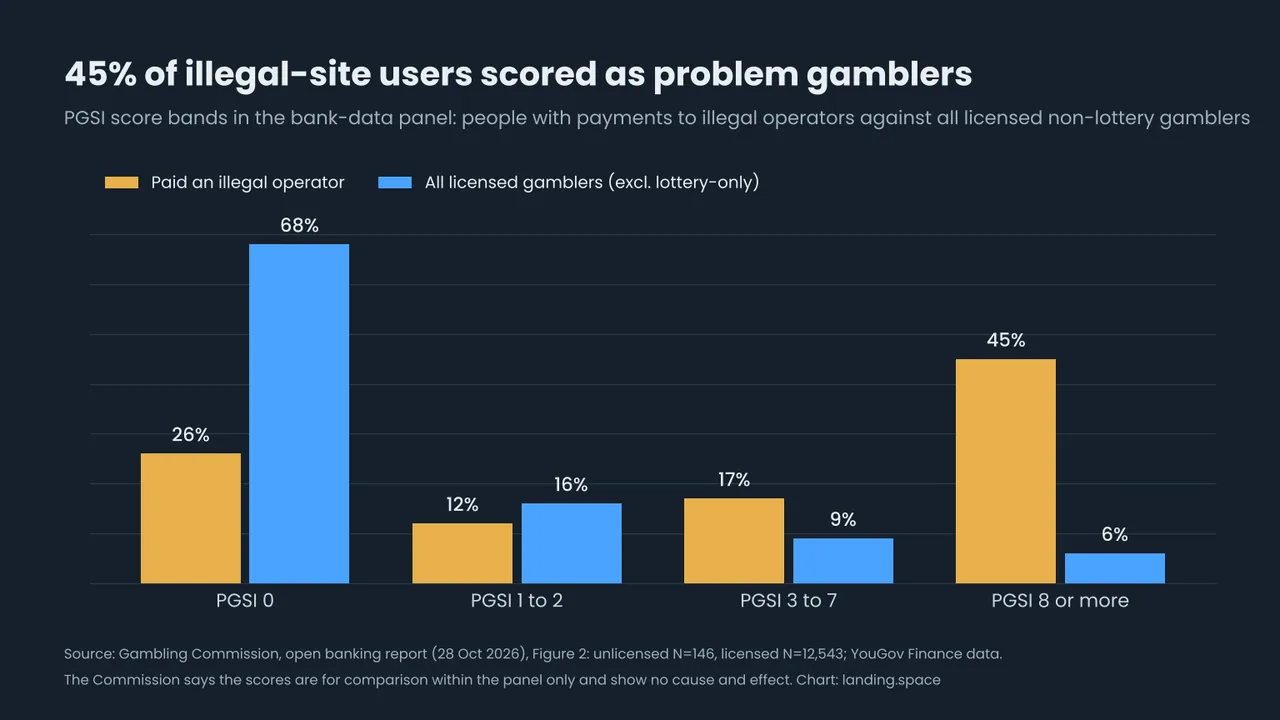
The Commission is careful with these numbers. The scores "can only be used for within-sample comparison" and cannot be set against its national Gambling Survey for Great Britain. The PGSI was taken "at some stage", not necessarily at the time of the payments, and the report says the design does not allow any causal analysis "between spending with illegal operators and harm", so it cannot show which comes first.
Credit cards: 4% of payments
Only 138 of the 3,426 illegal payments, 4%, were made from credit card accounts, by 15 of the 179 people. The other 96% came from current accounts. Licensed operators have not been allowed to take credit card payments for online gambling since the Commission introduced its ban on 14 April 2020; illegal operators are outside that rule. The report itself does not connect the two, and its count covers only the operators it could recognise.
The study arrives in a week of arguments about the illegal market. On 28 October the Betting and Gaming Council's response to the Budget said higher taxes make "the illegal gambling market more attractive to customers"; our report on the Machine Games Duty change covers that Budget. The bank data does not test the tax argument either way.
The third way of looking at the illegal market
The Commission's introduction places the bank data next to two other sources it has used: surveys and estimated web traffic. Each answers a different question:
- Surveys: in the first phase of its illegal gambling research, published in September 2025, 81% of 1,007 respondents said they gamble only with licensed websites and 4% only with unlicensed ones.
- Web traffic: a Commission blog of 30 September 2025 on estimated visits to illegal sites said "we cannot see any evidence of an overall pattern of growth" over the 15 months it covered.
- Bank data: the new study does not count people or visits; it follows the money of identified individuals before and after they paid an illegal operator. Its blog says this allows "direct observation" where most evidence "relies on estimates or indirect reports".
What the study cannot show
The 179 people are about 0.5% of the panel by our arithmetic, but that is not an estimate of how many Britons gamble illegally, and the Commission lists why:
- The panel: it is not nationally representative, slightly over-represents men and under-represents women, especially those over 55, and only includes people who shared their bank data for a small incentive.
- The payments: only cash transactions from banks that support open banking; payments in cryptocurrency are not captured.
- The operators: only a subset of illegal operators, some of them not believed to be active in Great Britain, and many illegal payments in the data may have gone undetected.
- The use: the data cannot size the illegal market, cannot show cause and effect, and cannot find illegal operators nobody knew about.
The Commission's next steps
In the blog, the Commission calls the work "a powerful proof of concept" and says it will widen its use of financial transaction data, staying open to work with banks and payment providers. It sits next to other recent steps on the illegal market. On 20 October the Commission published a third phase of research on why people use illegal sites, which describes four types of user, from "Self-Excluders" to "Accidental Tourists", and notes that the term "not on GamStop" has "evolved beyond its original meaning". In a keynote published the next day, Acting Chief Executive Sarah Gardner said the Commission issued 741 cease-and-desist notices and disrupted 1,134 websites in 2025/26, and that new powers to apply to a court for IP and domain name suspension orders are "coming soon".
For players in Britain the practical line has not moved: a licensed site has to offer the protections a black-market site does not, from the credit card ban to self-exclusion through GamStop, which our piece on self-exclusion tools explains. What the bank data adds is evidence that, in this panel, people with detected payments to illegal operators were much more likely to have high PGSI scores.
Frequently asked questions
What did the Gambling Commission's open banking study find?
In anonymised bank data on 38,000 people from July 2018 to July 2026, it found 3,426 payments to illegal gambling operators by 179 people. 91% of those with repeated illegal payments also used licensed operators, and 45% of those with a score had a PGSI of 8 or more, against 6% of the panel's licensed gamblers outside lotteries.
How many people in the study used illegal gambling sites?
179 of the 38,000 panel members had detected payments to illegal operators, about 0.5% by our arithmetic. The Commission says the data cannot be used to estimate the size of the illegal market, because the panel is not representative and many illegal payments may have gone undetected.
Do people stop using licensed sites after using illegal ones?
Not according to this data. 91% of people with repeated illegal payments also used licensed operators, and their licensed activity fell only a little after the first illegal payment. The Commission calls illegal gambling an addition to existing gambling rather than a switch.
Are people who use illegal gambling sites more likely to have problems?
In this panel, yes: 45% of illegal-site users with a PGSI score were at 8 or more, against 6% of licensed gamblers outside lotteries. The Commission says the design does not allow any conclusion about cause, and the scores are for comparison within the panel only.
Did people use credit cards on illegal gambling sites?
Rarely in this data: 4% of the detected illegal payments came from credit card accounts, made by 15 of the 179 people. Licensed operators have been banned from taking credit cards for online gambling since 14 April 2020.
Who carried out the study?
The Gambling Commission analysed bank data collected by YouGov with panel members' consent and bought by the Commission. Licensed gambling was identified with an algorithm from Yaspa, and Warwick Business School provided technical support.
Sources
- Gambling Commission - Illegal gambling: findings from an open banking data analysis (28 Oct 2026)
- Gambling Commission - Results (28 Oct 2026)
- Gambling Commission - Materials and methods (28 Oct 2026)
- Gambling Commission - Limitations (28 Oct 2026)
- Gambling Commission - Statistics release (28 Oct 2026)
- Gambling Commission blog - Exploring the potential of banking transaction analysis (28 Oct 2026)
- Gambling Commission - Illegal online gambling, Phase 1 (18 Sep 2025)
- Gambling Commission blog - The ups and downs of estimating trends (30 Sep 2025)
- Gambling Commission - Illegal online gambling, Phase 3 (20 Oct 2026)
- Gambling Commission - IAGR 2026 keynote, Sarah Gardner (21 Oct 2026)
- Gambling Commission - Prohibition of gambling on credit cards
- Betting and Gaming Council - Response to the Budget (28 Oct 2026)
Go deeper
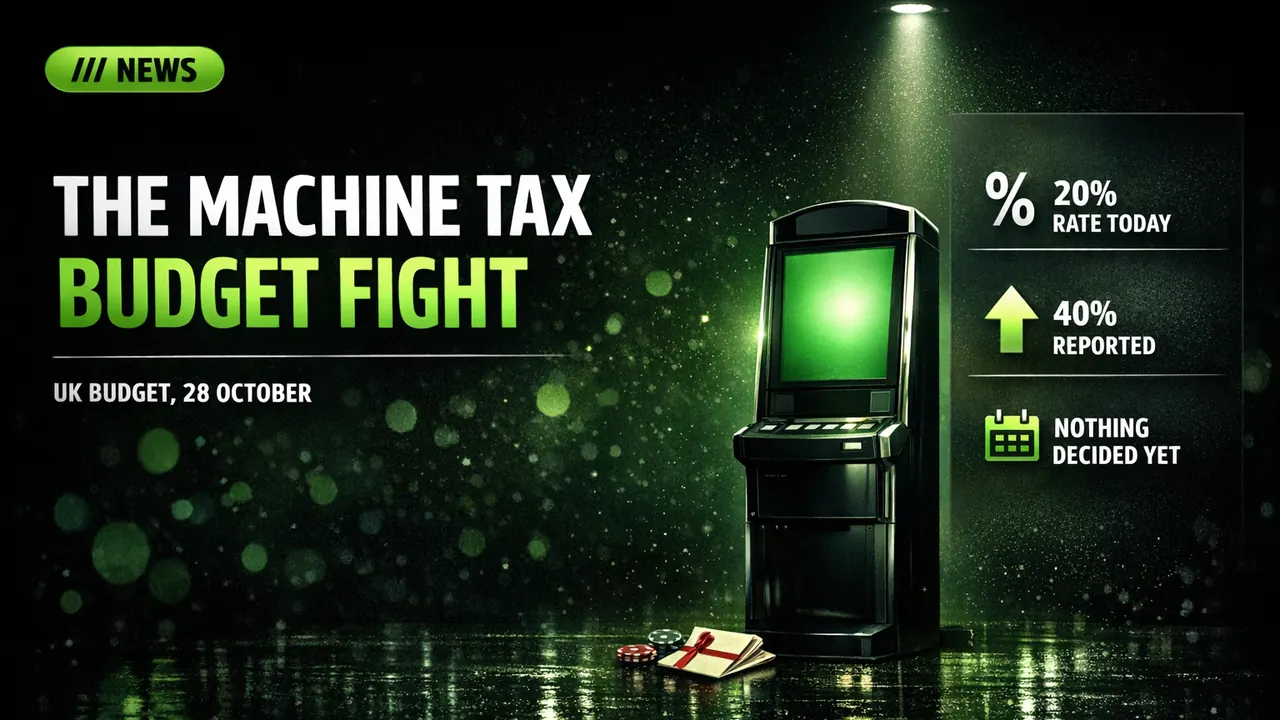
Budget 2026 raises Machine Games Duty from 20% to 25% on higher-stake machines from April 2027: what changes, what it raises and how the industry responded.
Read article →
BetStop reached 65,430 registrations by 30 June 2026 and GAMSTOP had its busiest month in May 2026. How national self-exclusion registers compare.
Read article →
Limits, time-outs, self-exclusion and where to get help.
Read guide →This article is independent editorial coverage and is not sponsored; no operator or supplier paid for inclusion. The facts were checked against the sources listed above on 2 November 2026, and rules, programmes and offers can change after that date. Nothing here is legal or betting advice. 18+ only (21+ for online casino in the US states that license it); if you gamble, set your limits in advance.