
Online casino play and your UK mortgage application
It can, through your bank statements, but there is no gambling rule as such. The FCA's affordability rules ask lenders to weigh your income against your commitments and living costs, and they never mention gambling; casino payments reach the decision as spending an underwriter sees on the statements. For an employed applicant's main account, the lenders we read that give a figure ask for one to three months, with more for some income types and higher loans. Kensington's checklist for brokers names the "level of gambling", and Halifax will not count gambling winnings as income.
We read the published criteria of eight UK mortgage lenders on 24 October 2026, most of them the pages written for the brokers who package applications. Where they put a number on an employed applicant's statements it is between one and three months, and only one of the eight mentions gambling in what it asks brokers to check; Halifax mentions it as income it will not accept. The rest of this page is about what that means for an application: what is asked for, what is read, and what the regulator's rules actually require.
Eight lenders, side by side
| Lender | Bank statements in its own criteria | Gambling in the same document |
|---|---|---|
| Nationwide (intermediaries) | 1-3 months from your main account, showing salary and outgoings; a full 3 months above 90% LTV | Not mentioned; above 90% LTV it checks for bounced payments, reliance on overdraft and "signs of financial distress" |
| NatWest (intermediaries) | 1-3 months of the main account your bills are paid from, if requested; 6 months for some investment income | Not mentioned |
| Coventry (intermediaries) | Latest 2 months for employed applicants, may be requested for first-time buyers; 3 or 6 months for some self-employed and investment income | Not mentioned |
| Santander | May be requested; the latest dated within 2 months of the application, with debits and commitments that match it | Not mentioned |
| Accord | Up to 75% LTV: one statement showing that month's salary credit | Not mentioned |
| Virgin Money (intermediaries) | "We don't always need bank statements", only for certain applications | Not mentioned |
| Halifax (intermediaries) | 3 months for some self-employed applicants, where applicable; no standard figure found for employed | Listed as an income type: not acceptable |
| Kensington | 3 months, through your broker | "Consider any returned direct debits and level of gambling" (checklist for brokers) |
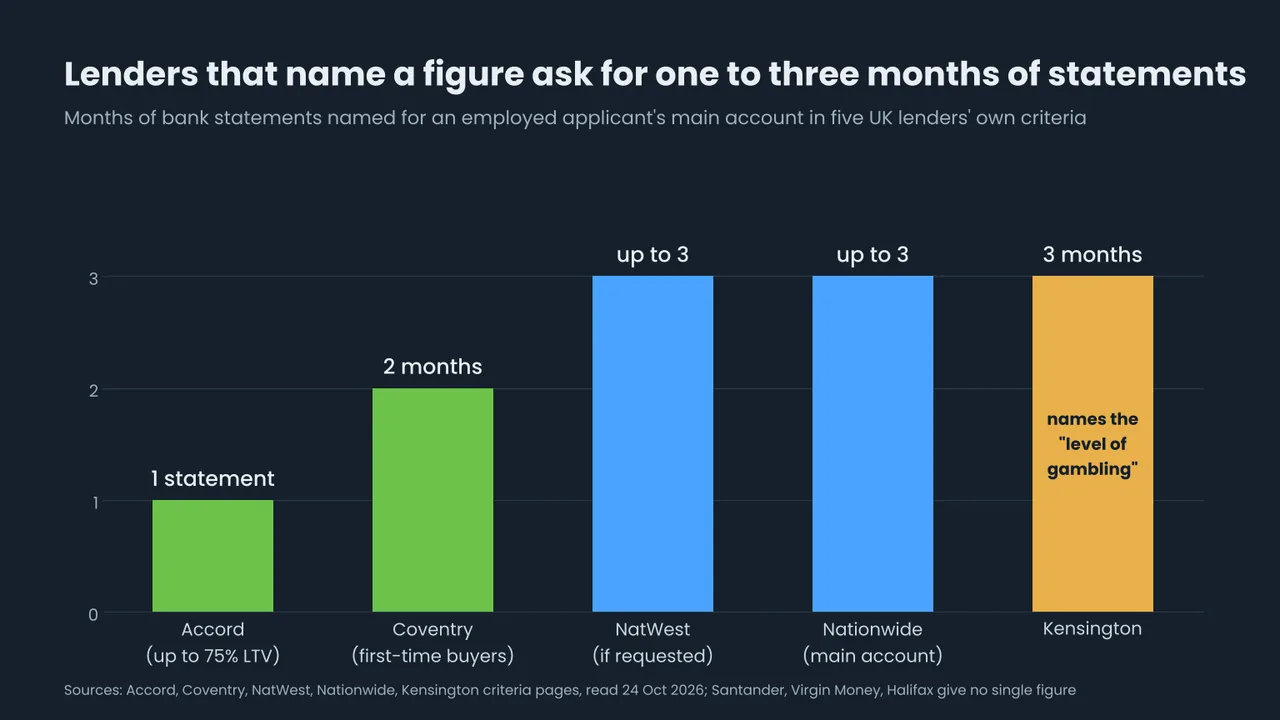
For most employed applicants the window is short, but the number is the lender's call: NatWest says its broker portal confirms if and how many statements it needs for each application. Where lenders describe what they look for, it is how the account is run: salary arriving, regular commitments leaving and, in Nationwide's checks for loans above 90% of the property's value, bounced payments, reliance on an overdraft and signs of financial distress. Payments to a casino are on the same statements, and Kensington asks brokers to look at them specifically.
Paying a casino another way
Paying a casino another way does not take it off the statements. Funding a crypto casino usually starts with a payment to a crypto exchange, which shows on your bank statement and which an underwriter can ask about; our page on crypto casinos explains how that route works. A casino that skips identity checks knows less about you, but the statements an underwriter reads come from your bank. Our page on no-KYC casinos covers what those sites do and do not check.
What the FCA's rules ask a lender to do
Regulated mortgage lending, such as a residential mortgage, is governed by the FCA's MCOB rules, and section 11.6 sets out how affordability must be judged. A lender must not go ahead unless it can show the mortgage is affordable, and it must take full account of your income after tax and National Insurance, your committed expenditure, and your household's basic essential expenditure and basic quality-of-living costs. It may not rely on a general declaration that you can afford it. The section lists examples of quality-of-living costs, from clothing to basic recreation and childcare; gambling is not among the categories, and the word does not appear in the rule text we read.
What brings gambling in is the evidence. The rules name bank statements as evidence of income and as a way to check commitments, and they let a lender rely on what you tell it "unless, taking a common sense view, it has reason to doubt the evidence or information", and they require it to take reasonable steps to find out your actual outstanding commitments. In practice that means three things an underwriter is looking at on the statements:
- Income arriving as declared: Accord and Nationwide both ask for statements that show the salary going in.
- Outgoings that match the application: Santander says the commitments on your statements "must match your application".
- How the account is run: Nationwide's checks for loans above 90% LTV name returned items, reliance on overdraft and signs of financial distress, and Kensington's broker checklist adds the level of gambling.
Winnings are not income
The flow the other way is simpler. Halifax's criteria list gambling as a type of income and mark it not acceptable, so a run of withdrawals from a casino into your account does nothing for the income side of the calculation there. None of the other lenders we read lists gambling income at all. If the worry is the credit side instead, gambling itself is not listed on a credit file; our page on gambling and your credit file covers what the file holds and what a search leaves behind.
When a lender should have noticed
The Financial Ombudsman Service has dealt with the reverse question: what a lender should have done when gambling was plain in a borrower's account. In decision DRN-3173831, the limit on a Barclays mortgage current account reserve, borrowing secured on the couple's home, went up after £47,271 of gambling between September and November 2017, against winnings of £36,678.38 in the same period. The ombudsman wrote that "Mr B had a problem with gambling - the transactions on his current account clearly supported that", and that a lender acting reasonably "would have taken steps to limit the amounts of new debt". The complaint was upheld in part: Barclays was told to refund the interest charged after 1 December 2017 while the reserve balance was over £10,500, to reduce the mortgage by the amount of the reserve above £10,500, about £10,308.56, refunding the interest on it and letting the couple repay it interest free, and to pay £450. One decision is not a rule, and it concerns a bank raising the limit on its own customer's secured borrowing rather than a new application; but it shows that gambling visible in an account can count against a lender that ignores it.
Frequently asked questions
Will online gambling stop me getting a mortgage?
How many months of bank statements do lenders check?
Do gambling winnings count as income for a mortgage?
Do I have to tell the lender that I gamble?
Read next
18+ only. General information, not financial or mortgage advice. Lender criteria change; the eight lenders' pages and MCOB 11.6 were read on 24 Oct 2026, and a mortgage adviser will know the current position. For confidential help with gambling and money worries, call the National Gambling Helpline on 0808 8020 133 at any hour.