
Revolut, Monzo, Starling: casino payments explained
The help pages we read from Monzo, Starling, Revolut and Chase UK describe a gambling block you switch on yourself, working on card payments the bank identifies as gambling. Switching it off is where they differ: Monzo asks you to set a cooldown of 2 days to a year that must run out first, Revolut says it can take up to 48 hours, and Chase UK asks you to speak to customer care, then waits 48 hours. Starling mentions a 48-hour delay. Separately, gambling businesses must not let consumers in Great Britain gamble with a credit card, apart from non-remote lotteries.
Two days, or a whole year. That is the range Monzo gives you when you switch on its gambling block: it asks you to choose a cooldown, and "You'll have to wait out that cooldown before you can switch the block off". The other app banks name a single figure, 48 hours, and Chase UK adds a conversation with its customer care team before the clock starts.
That difference is the heart of it, because none of the pages we read describes a ban on casino payments for adult current-account customers. What the app banks give you is a lock you can put on yourself, and the question each one answers differently is how hard it is to take off again.
Four banks, in their own words
| Bank | Switching it on | What it covers, as the bank puts it | Switching it off |
|---|---|---|---|
| Monzo | In the app; you set a cooldown at the same time | Card payments with "a gambling code"; Monzo can block other payments, like bank transfers, if you ask | Only after the cooldown, from 2 days to a year, has run out |
| Starling | In the app, under the card's gambling controls; each card separately | Card payments "to most gambling merchants - online or in person" | Starling: "if you want to reactivate it, there's a 48-hour delay" |
| Revolut | In the app, under security and privacy; off by default | Payments "to bookmakers, online casinos, and sports betting apps"; active immediately | Up to 48 hours before the block is deactivated |
| Chase UK | In the app, under the card controls | Transactions Chase identifies as gambling; it says the block should work for "things like betting shops, casinos, and online gambling" | Speak to customer care, then a 48-hour delay |
Two notes on sources. The Revolut article we could read does not say which country it is written for, and Revolut's UK-labelled help pages did not load for us, so treat the Revolut row as Revolut's help centre rather than its UK terms. And the Gambling Commission's own page on bank blocks, updated on 16 October 2026, says Monzo customers "will need to talk to the Monzo customer support team" to turn the block off; Monzo's current help page describes the cooldown and does not mention that step. We give Monzo's wording in the table and the Commission's here.
The Commission's page also lists blocks at high-street banks, among them Barclays, HSBC, Lloyds Bank, NatWest and Santander, so an app bank is not the only place to set one.
How long the lock holds
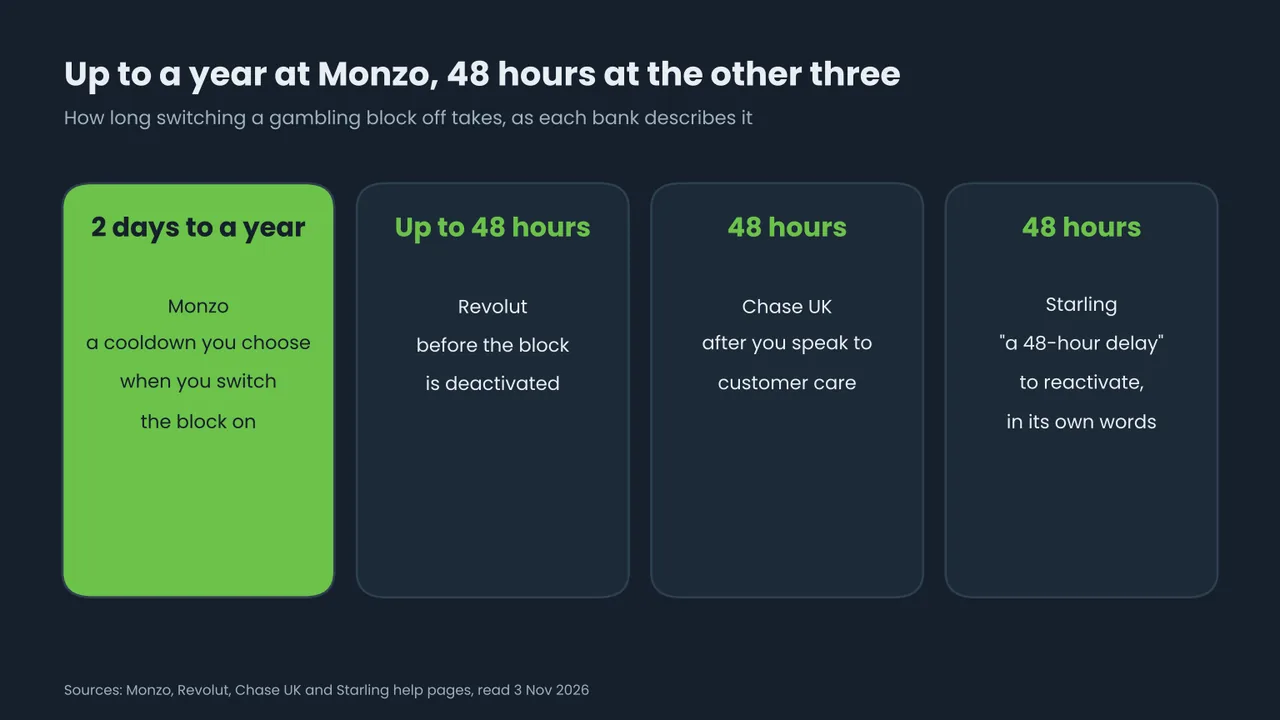
The cooldown is the design choice that separates the four. A gambling block is meant for the moment you decide to stop, and the waiting time is there for the moment you change your mind. Starling says its 48-hour delay is about "making gambling or betting on impulse more difficult". Monzo goes furthest by letting you decide, on a good day, how long a bad day will have to wait: up to a year. Chase UK puts a person in the way first.
A block works at the level of your card, and Monzo and Starling describe what it may miss next to an offer of more help. Monzo says that if a company has no gambling code it can be "tricky for us to stop the payment in time", that you can tell it so it will "block that company from then on", and that you can ask it to block other payments too. Starling reminds customers with more than one account that the block has to be applied to each card. If you want a block to reach further, ask your bank what else it can block.
What goes with a block
A bank block stops payments; it does not stop you opening an account somewhere. That is what Gamstop (Gamstop Online) is for: registering blocks your access to gambling websites and apps licensed in Great Britain, for anything from 6 months to 5 years, and Gamstop says it is free. Gamstop puts the two side by side itself: "Bank blocks stop you from making card payments into online gambling accounts or in-person betting shops."
If the block is part of cutting down or stopping, you do not have to do it alone. GamCare runs the National Gambling Helpline on 0808 8020 133: free and confidential, by phone at any hour or by live chat in England, Scotland and Wales. Starling's gambling help page gives the same number.
The rules that apply whatever your bank
One rule applies whichever bank issued your credit card. Since 14 April 2020 gambling businesses must not let consumers in Great Britain gamble with a credit card, online or offline, apart from non-remote lotteries. The Commission adds that a business taking money from an e-wallet "such as PayPal or Skrill" should make sure it was not loaded from a credit card. Chase UK goes further in its own credit card terms: it will "refuse to authorise a transaction if we have a reason to believe it's for gambling or cryptocurrency". Monzo goes further for younger customers: its terms say 16- and 17-year-olds "won't be able to make payments for things like gambling".
What a mortgage or loan provider can see of your gambling is set out in our guide on whether casino play shows on your credit file. And if a payment you regret went through before a block was in place, the bank's refund route has its own rules, covered in our guide to what the Financial Ombudsman has decided on casino deposits.
Frequently asked questions
How do I turn on the Monzo gambling block?
How long does it take to turn a gambling block off?
Does the Monzo gambling block cover bank transfers?
Can I gamble with a credit card in Great Britain?
Is there one block that covers every bank?
Read next
18+ only. General information, not financial advice. Bank wording is from the Monzo, Starling, Revolut and Chase UK help pages and terms as read on 3 Nov 2026; your app may name the setting differently. National Gambling Helpline (GamCare): 0808 8020 133.