
Pay by mobile and open banking at casinos explained
Pay by mobile adds a casino deposit to your monthly phone bill, or takes it from pay-as-you-go credit, once you confirm a code sent by text. It works in one direction only: winnings are paid out another way. Pay by bank (open banking) moves the money straight from your current account after you approve it in your banking app, and payouts can go back to the same account. Because neither uses a card, closing them takes its own step: several banks say their card-based gambling block does not cover open banking, and phone-bill charges can be barred by your mobile network, with some providers, such as Siru, offering a block of their own.
Ofcom's review of phone-paid services for 2025/26, published on 21 July 2026, asked people who had paid for something by phone in the past year what kinds of service they had bought; among those aged 18 or over, 24% named lotteries, betting or gambling. The biggest route across all these services is operator billing, where the charge lands on your mobile bill: it brought in £385.1 million of the £604.5 million the sector took in the year, just under two-thirds, although the review does not say how much of the gambling spend goes that way. At a casino cashier the same route is called pay by mobile, pay by phone or pay by phone bill. Next to it, a cashier may also offer pay by bank, which is open banking under a friendlier name. The two have one thing in common: neither touches a card.
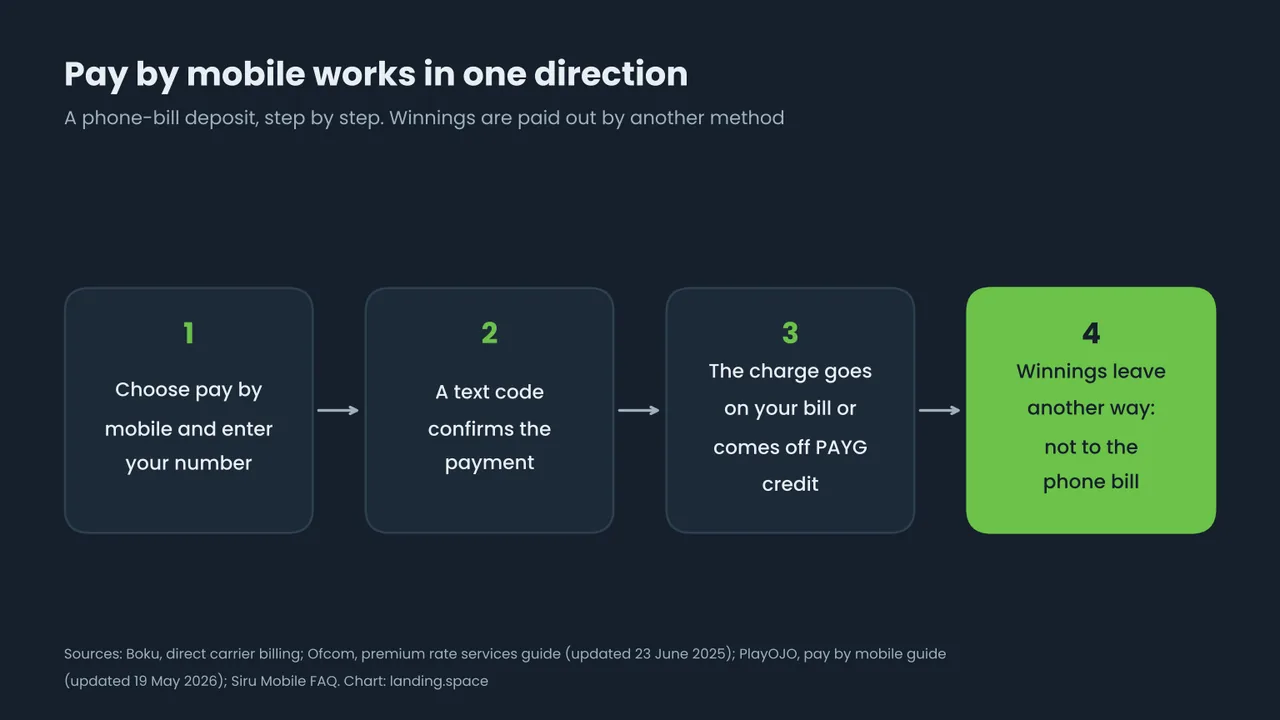
How a phone-bill deposit works
You pick pay by mobile at the cashier, type in your number and receive a text with a one-time code. Once you enter it, the carrier-billing provider adds the charge to your monthly phone bill or deducts it from your prepaid balance; Boku, one of the large providers, describes this flow for carrier billing in general. On a contract you pay it with your next bill, and on the bill itself the line may not name the casino: Ofcom says these charges can appear as "Charge-to-mobile, Operator Billing, Direct Carrier Billing" and that these are just payment mechanisms, not the names of the businesses behind them.
Since 1 February 2025 phone-paid services have been regulated by Ofcom directly, under the Regulation of Premium Rate Services Order 2024, which replaced the Phone-paid Services Authority's code. The Order names "a remote gambling service" among the services with extra rules. Its promotions must say that it must not be used by anyone under 18, that a user who is not the bill-payer needs the bill-payer's permission, and that details of the service may appear on the bill-payer's bill. The merchant has to check age before the service is provided, and must make available a record of your use, including wins and losses, and your latest balance. Whether a particular casino deposit is billed under these rules depends on the provider's route, which the cashier does not usually show.
The limits: £40 and £240, but not everywhere
The figures you will see most often come from the Payment Services Regulations 2017. Payments charged to a phone bill for digital content and voice-based services stay outside the full payment services regime only while a single payment is no more than £40 and a subscriber's total in a month is no more than £240. EE applies exactly that: £40 in a single transaction and £240 in a billing period, combined across all its premium rate services, including charge to bill, and it lists gambling among them. Three and Vodafone quote the same two figures for charges to the bill; Vodafone adds that once you reach the limit you cannot charge anything else to your account that month.
Those figures are not a single national ceiling, though. Siru Mobile, a provider that bills to UK phones (its FAQ does not mention gambling), gives a UK limit of £500 over 30 days and says the most common limit for a phone subscription is £240 a month; it also says its service is limited on Virgin Mobile and the networks that belong to it. The limit that applies to you is the one on your network's help page and in the cashier, and EE's code of practice for these charges says they do not count towards any spend cap on an EE account.
Pay by mobile and pay by bank side by side
| Pay by mobile | Pay by bank (open banking) | |
|---|---|---|
| Where the money comes from | Your phone bill, paid later, or pay-as-you-go credit | Your current account, at the time of payment |
| How you approve it | A one-time code sent by text | In your banking app, with face, fingerprint or passcode |
| Limits | Set by the network and the provider: £40 a payment and £240 a billing period at EE | Your bank's own payment limits |
| Withdrawals | Not to the phone bill; another method is needed | Can be paid back to the account you deposited from |
| How to block it | Ask your network to bar charge-to-mobile purchases | Ask your bank what its block covers: NatWest, Nationwide and HSBC say their card blocks do not cover open banking |
Pay by bank: open banking at the cashier
Pay by bank uses what the Financial Conduct Authority calls a payment initiation service, which lets you pay a company directly from your bank account instead of with a card. At the cashier you choose pay by bank, pick your bank from a list and approve the payment in your banking app. No card number is shared, and Open Banking Limited says you will never be asked to give access to your bank login details or password to anyone other than your own bank. The FCA's advice is to make sure the provider is authorised or registered with it, and, if you see a payment from your account that you did not authorise, to contact your bank as soon as possible and claim a refund.
Winnings are where the two routes part company. Open banking can run in both directions: TrueLayer, one of the providers, describes its gambling payouts as closed-loop and verified, returned to the account that made the deposit, and its payouts page names Faster Payments and SEPA Instant. Trustly adds that the casino decides whether its route is available for a withdrawal and when the request is sent. A phone bill only runs one way. No provider we read explains why, but PlayOJO's guide to the method says withdrawals are not available and another method is needed for cashouts, and Siru says plainly that money cannot be withdrawn from its wallet; a casino paying out after a phone deposit uses a bank transfer or another method you add. Crypto casinos are built differently again, with deposits and withdrawals going through the same wallet, as our page on crypto casinos explains, and the sites described on our no-KYC casinos page sit outside the British licensing system, so the Gambling Commission's protections described here do not cover them.
Is a phone bill credit?
Since 14 April 2020, businesses licensed by the Gambling Commission have been barred from accepting credit card payments for gambling, lottery tickets bought in person aside, and the ban reaches credit card money paid in through an e-wallet. A contract phone bill is paid after the money has been spent, which looks a lot like credit, but the Commission has published no ruling that carrier billing falls under the ban. What it has done is count it as borrowing in its own research: the survey behind its evaluation of the ban asked gamblers which "forms of borrowed money" they had used to fund gambling, and one of the options was a mobile phone account, "adding the cost of gambling to your mobile phone bill to pay at a later date". Among the people who changed how they borrowed after the ban, one reported starting to gamble through a mobile phone account. Pay-as-you-go credit is different, because it has already been paid for.
Closing these routes if you want them closed
The gambling blocks most British banks offer are built around card payments, which a gambling business identifies with a merchant code; our page on casino chargebacks explains how that code decides what a block catches. Payments that are not card payments can pass. The banks say so in their own words:
- NatWest, under "What the gambling card control will not do": stop "non-card gambling payment methods such as bank transfers or open banking payments".
- Nationwide says it cannot block bank transfers or payments made through its internet bank, app or open banking.
- HSBC lists the payments its restriction blocks as in-store and online card transactions, "excluding transactions made via Open Banking".
- Lloyds says its gambling freeze does not apply to direct debits or bank transfers.
- Phone bills are charged by the network, not the bank, and none of the bank pages we read mentions them. O2 can add a bar on "charge to mobile purchases" (some bars show in My O2 only if a support agent adds them), EE will bar premium rate access and online purchases if you call, Vodafone offers a bar to stop all charges, and Ofcom's advice is to ask your network whether it can block premium rate services you do not use. Siru also offers its own block for 3, 6 or 12 months, or permanently.
Rules change, and the Gambling Commission keeps a list of what many banks offer, so ask your own bank exactly which payments its block covers. If you are closing these routes because gambling has become hard to control, the National Gambling Helpline on 0808 8020 133 is free and open 24 hours a day.
Frequently asked questions
Can I withdraw casino winnings to my phone bill?
How much can I deposit by phone bill?
Is pay by mobile the same as paying by credit card?
Will my bank's gambling block stop pay by bank or pay by mobile?
Is pay by bank safe?
Will the casino's name appear on my phone bill?
Read next
18+ only. General information, not financial advice. The network, bank and regulator pages cited were read on 31 Oct 2026; limits and blocks change, so check your own provider's page. Free, confidential support: National Gambling Helpline 0808 8020 133, 24 hours a day.