
Why your card was declined at a legal online casino
Often your card issuer. Licensed casinos must code card deposits as gambling, and the federal rule on internet gambling payments asks banks to block unlawful bets, not the ones a state allows, so refusing a state-legal deposit is the bank's own policy. The other common causes sit on the form: a name, address or security code that does not match the issuer's records, or a credit limit. And if a credit card does go through, Chase, Citi and Amex treat online betting as a cash advance: $10 or 5% of the deposit, whichever is greater.
Three parties handle a casino deposit after you submit it: the casino's payment processor, the card network and the bank that issued your card. The processor sends the request with a merchant category code that tells the network what kind of business is asking, the network passes it on, and the issuing bank decides whether to approve it. A decline message on a licensed New Jersey, Pennsylvania or Michigan site therefore says less about the casino than it seems to.
The order matters for what you can fix. A typo in your billing address is yours to correct in a minute. A bank policy against gambling transactions is not something the casino can change, and nothing in Regulation GG or in the New Jersey, Pennsylvania and Michigan rules cited below obliges your bank to approve the deposit or forbids it to.
What a card deposit costs when it does go through
Start with the case people do not expect: the deposit works. All six issuer agreements we read, from Chase, Citi, American Express, Capital One, Discover and Bank of America, treat gambling on a credit card as a cash advance, not a purchase. Chase's cardmember agreement says "cash-like transactions will be treated as cash advances" and lists "race track wagers, and similar offline and online betting transactions". The fee is "Either $10 or 5% of the amount of each transaction, whichever is greater", and the cash advance APR in that agreement is 28.49%, a variable rate set against a 6.75% prime rate as of June 30, 2026. Citi and American Express use the same $10-or-5% formula. Capital One charges $5 or 5%.
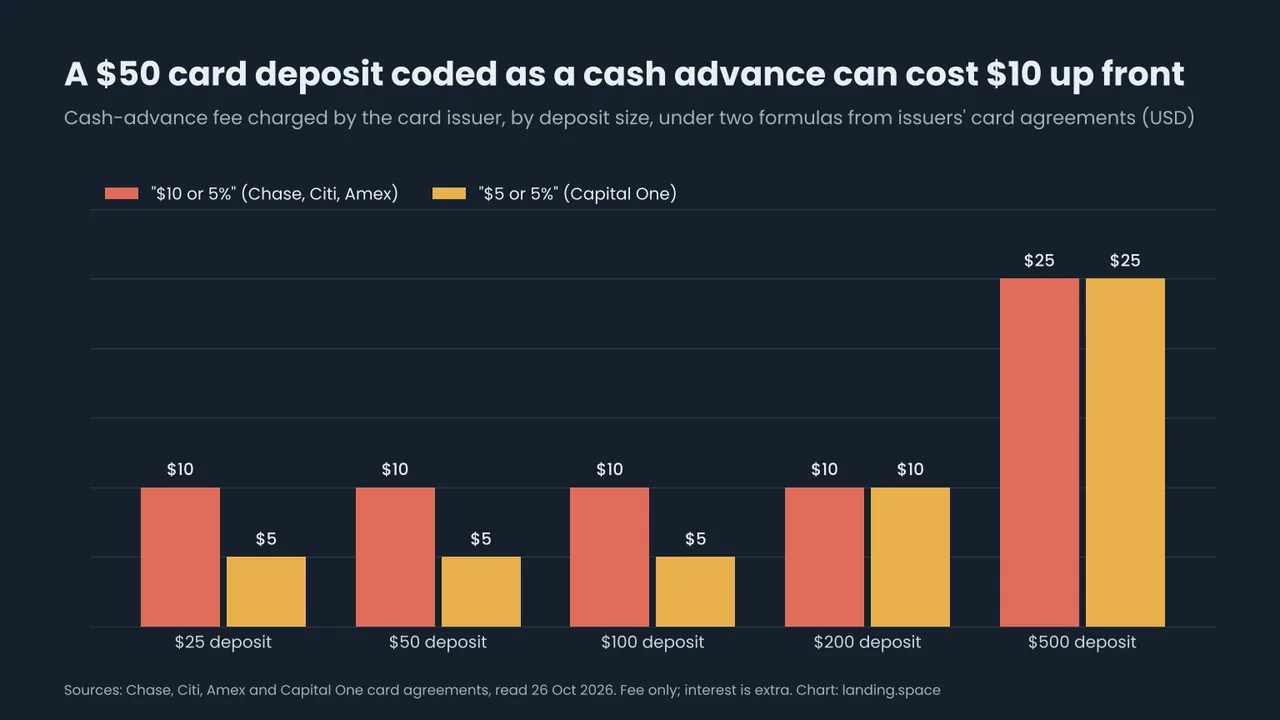
Because the fee has a floor, it takes the largest share of small deposits. Discover's agreement lists "online gambling" among cash equivalents too, and Bank of America's Customized Cash Rewards agreement counts "bets" among them at 5% and says the bank "may deny authorization of any transactions identified as Internet gambling". A debit card draws on your own money, so there is no advance to charge for; whether your bank lets gambling merchants charge it is a separate policy. If the reason you are reaching for a credit card is that the cash has run out, our gambling help page lists free, confidential support in every state.
The code that tells your bank it is gambling
Card networks classify every merchant. Visa's merchant data manual, in its October 2026 edition, says an online gambling merchant "must use MCC 7995 for all transactions, even if gambling is not the Merchant's primary business", and that US lottery and gambling transactions which qualify for the codes 7800, 7801 or 7802 must use those instead. The 7801 code exists for exactly the casinos this page is about.
| Code | Network description | Where it applies |
|---|---|---|
| MCC 7995 | Betting, including Lottery Tickets, Casino Gaming Chips, Off-Track Betting, Wagers at Race Tracks and games of chance to win prizes of monetary value | Gambling merchants in general; all online gambling unless a US code below applies |
| MCC 7801 | Government Licensed On-Line Casinos (On-Line Gambling), US Region only | State-licensed online casinos |
| MCC 7802 | Government-Licensed Horse/Dog Racing, US Region only | Licensed racing wagers |
| MCC 7800 | Government-Owned Lotteries, US Region only | State lotteries |
These codes are how a bank treats a casino deposit differently from a grocery bill without knowing anything about the casino. Separate codes for state-licensed operators would let an issuer treat a licensed New Jersey casino differently from other gambling merchants if it chose to. None of the six agreements we read makes that distinction: they speak of "online betting transactions" and "online gambling" as one category.
Federal law blocks unlawful bets, not legal ones
The federal rule in this area is Regulation GG, which implements the Unlawful Internet Gambling Enforcement Act. It requires payment-system participants to have policies and procedures "reasonably designed to identify and block or otherwise prevent or prohibit restricted transactions". For card systems, one way the rule says to meet that is "a code system, such as transaction codes and merchant/business category codes", so that a transaction can be identified and denied; the other is due diligence on the merchants a bank takes on. Restricted means unlawful: the definition turns on whether the bet is unlawful where it is made, and it leaves out intrastate bets that a state expressly authorizes, with age and location checks.
Then the regulation says something worth knowing when your deposit fails: "Nothing in this part requires or is intended to suggest that designated payment systems or participants therein must or should block" a transaction that falls outside unlawful internet gambling as an intrastate transaction. In plain terms, federal law does not ask your bank to refuse a deposit at a licensed New Jersey casino, and it does not stop the bank from refusing one either. Capital One's agreement puts the bank's side in one line: "We may decline to authorize a transaction for any reason."
New Jersey, Pennsylvania and Michigan allow cards outright. New Jersey's rule lists "a patron's credit or debit card" among the ways to fund an account. Pennsylvania's lists a "credit card or debit card, including prepaid cards", and adds that the operator itself may not extend credit. Michigan's online casino rule allows a "credit or debit card". Massachusetts does ban credit cards, but for sports betting. We could not confirm the card rules in the other states that license online casinos, so this page does not state them.
Read the decline message
- Over the limit. Borgata Online's help page, from a New Jersey operator, lists "You have exceeded your credit limit" first. Check the available credit your issuer shows before trying again.
- Details that do not match. "The name, address and/or telephone number you enter must match the details the credit card company has on its records", and an address that does not match your card statement's billing address is "declined for non-verification of address". Entering an old address after a move is enough to fail.
- The security code. A mistyped CVV2, the three digits on the back, is the third reason Borgata gives.
- Your bank says no to gambling. Borgata's wording is "Your credit card issuing bank does not authorize Internet gaming transactions." BetMGM's help centre says of a declined debit card that it is possible the issuer "has policies that restrict its use in certain industries". Only the bank can change that, if it will.
- A limit set elsewhere. Deposit limits can bite before the bank does, including your own; Borgata's page notes that for BetMGM accounts a limit may have been reached "based on a deposit you made in another state".
- Prepaid and gift cards. New Jersey accepts a reloadable prepaid card only if it "has been verified as being issued to the patron and is non-transferable", and gift cards only under separate conditions in the same rule.
Withdrawals and the card you paid with
A card that accepted the deposit does not always take the money back. New Jersey requires that, before any other withdrawal, the remaining balance up to the amount deposited by card "shall be refunded" to that card, "provided that a credit or debit card issuer permits the return of a withdrawal". The rule does not say how the money is paid when the issuer does not permit it. The identity checks that come before any payout are covered in our guide to cashing out no-deposit winnings.
Other payment methods have their own fees and withdrawal rules, covered on our pages about the Play+ card and PayPal and Venmo withdrawals.
When a site answers a decline with crypto
If a casino responds to a declined card by steering you toward cryptocurrency, check its licence before anything else. The states that allow online casinos license their operators, and our state-by-state guide lists where that applies. A crypto cashier with no state licence behind it is a different arrangement, with no state regulator to complain to.
Frequently asked questions
Why does my card work at stores but not at an online casino?
Is my bank breaking a law by approving a deposit at a licensed casino?
Will a casino deposit on my credit card count as a cash advance?
Can I use a debit card instead?
Why was my deposit declined for address verification?
Do prepaid cards and gift cards work at licensed casinos?
Can my withdrawal go back to the card?
Read next
This is general information about card payments, not financial advice, and online casino play in New Jersey, Pennsylvania and Michigan is for adults 21 and over. Card terms are quoted from the Chase, Citi, American Express, Capital One, Discover and Bank of America agreements read on 26 Oct 2026; your own card agreement decides what you pay. Support for anyone worried about gambling: 1-800-MY-RESET, free and confidential, day or night.