
Cashing Out No-Deposit Winnings: The Four Hurdles
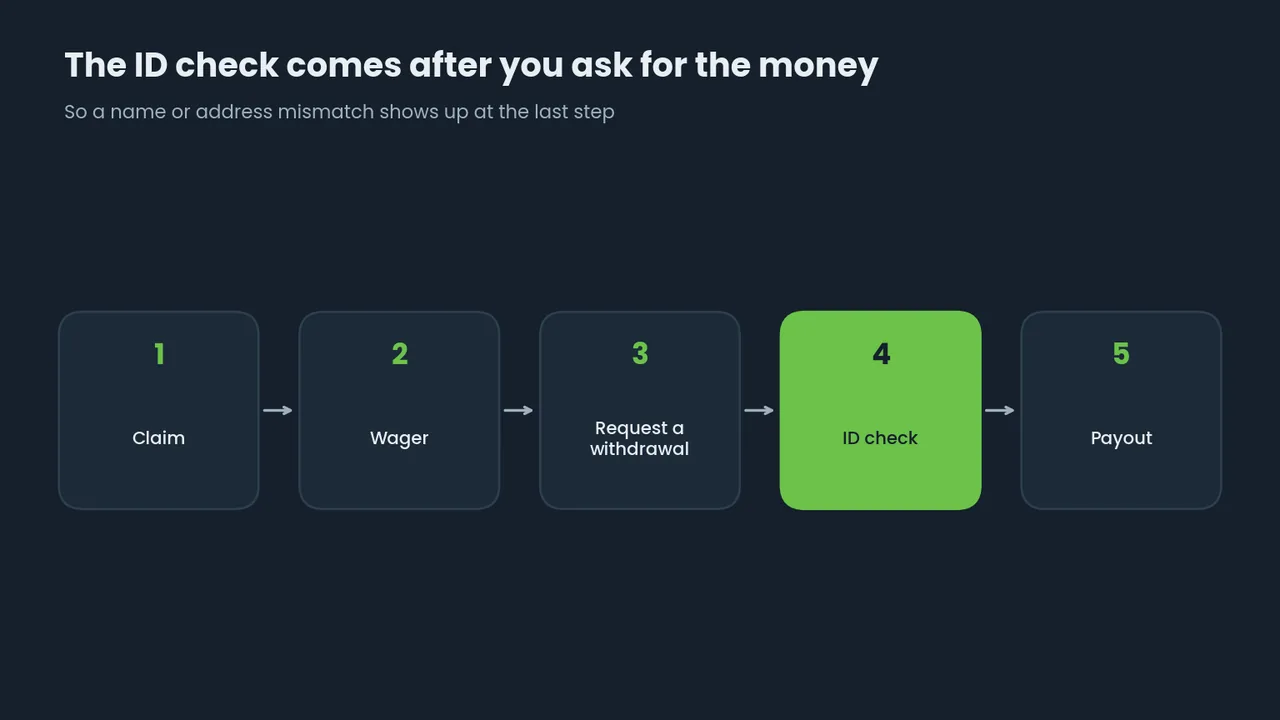
Winnings from a no-deposit bonus only become cash after four hurdles, usually in this order: finish the wagering, accept the max cashout, pass the ID check (KYC), and at some casinos make a deposit before the first withdrawal. The second hurdle is where licensed and offshore offers part ways: Pennsylvania (58 Pa. Code 813a.3) and Michigan (R 432.649) say licensed operators may not cap winnings once the bonus terms are met, so a max cashout that removes winnings you already cleared is an offshore term. If a payout stalls at an offshore site, no US regulator can step in.
Four hurdles, in the order you meet them
- Wagering. The bonus and everything won with it stay locked until you have bet a set multiple of it. A $25 free chip at 40x means $1,000 of bets. Until that counter reaches zero, a withdrawal request normally cancels the bonus and the winnings with it.
- Max cashout. Once the wagering is done, many offshore no-deposit terms cut the balance down to a fixed ceiling, written as a dollar amount or as a multiple of the bonus. Whatever sits above that line is removed when you withdraw.
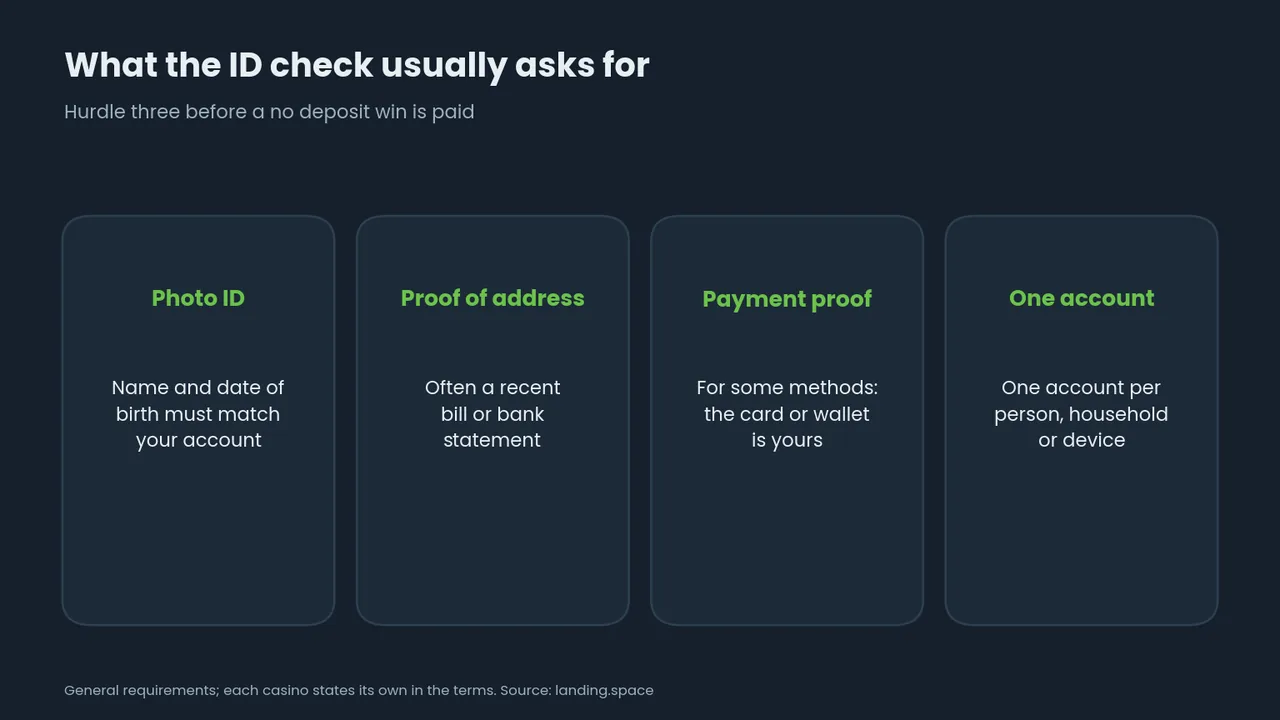
- ID verification (KYC). Before the first payout the casino checks that you are the person on the account: a photo ID, proof of address and sometimes proof that the payment method is yours. The details have to match the account exactly.
- A deposit before the first withdrawal. Some casinos only pay out no-deposit winnings after one real-money deposit, which ties a payment method in your name to the account. Where the rule exists, it sits in the bonus terms or in the general withdrawal terms.
The order matters because each hurdle can end the process after you have already done the work for the ones before it. A player who clears 40x and only then reads about a $50 cap has spent hours on a balance that was never going to be paid in full. The hurdles are also not the same everywhere. Pennsylvania (58 Pa. Code 813a.3) and Michigan (R 432.649) require licensed operators to list withdrawal limits in the bonus terms, and both rules say winnings may not be capped once the terms are met. A max cashout that cuts off winnings you already cleared is exactly what those rules rule out, which is why you meet it at offshore sites rather than in terms filed in those two states. Read all four lines before the first spin.
Why capped winnings are an offshore term
In Pennsylvania every promotion's terms are filed with the Gaming Control Board five days before launch, and they must state the wagering requirements by game, the withdrawal limits, the eligible games and how the offer can be cancelled. Michigan requires bonus terms to be "clear and unambiguous" and to list the expiry, eligibility, withdrawal limits, wagering requirements by game type, the order in which funds are used, eligible games and cancellation, and it lets players cancel a bonus. Both rules add the line that matters for cashing out: winnings may not be capped once the terms are met. Read the withdrawal-limits line, which has to be there, but a cap on winnings already cleared is ruled out.
| Question | Licensed offer in Pennsylvania or Michigan | Offshore no-deposit offer |
|---|---|---|
| Who sees the terms first | PA: filed with the PGCB 5 days before launch | No US regulator |
| Wagering | Must be stated by game or game type | Set by the site, often with game weightings |
| Cap after the terms are met | Winnings may not be capped | A max cashout is common |
| Cancelling the bonus | MI: players may cancel a bonus; both states require cancellation terms | Whatever the site's terms say |
| If a payout is refused | Complaint to the operator, then the state regulator | MGCB: "no meaningful avenue for dispute resolution" |
Most no-deposit offers that Americans see outside the licensed states come from sites no US state licenses, and there the max cashout is set by the site alone. It is the hurdle that decides how much a "no deposit casino real money" offer can ever be worth, whatever the headline says. How the wagering counter moves, and why game weightings matter, is covered step by step in how no-deposit bonuses work. We did not review any specific casino's terms for this page.
Passing the ID check (KYC)
KYC stands for "know your customer". Every casino that pays out has to know who it is paying, and for a no-deposit bonus the check usually happens at the first withdrawal, which is the worst possible moment to discover a problem. The documents asked for vary, but they tend to fall into three groups:
- Photo ID: a driver's license, state ID card or passport, in date, with all four corners visible.
- Proof of address: a recent utility bill or bank statement showing the same address as the account.
- Proof of payment method: for a card, a photo with most digits covered; for an e-wallet or crypto wallet, a screenshot showing the account holder or the address used.
The rule that trips people up is the match. The first and last name, date of birth and address on the casino account have to be the ones on your documents, spelled the same way. A nickname, an old address or a typo at sign-up is enough to hold a payout until support corrects it, and some terms treat a mismatch as a reason to void the bonus. If the casino lets you upload documents before you finish the wagering, doing it early moves this hurdle out of the way while nothing is at stake. In the licensed states players must be 21+.
One account, one name, and the deposit-first rule
One account per person is a standard term, and many offshore sites go further with one bonus per household, IP address, device or payment method. Opening a second account to claim a no-deposit bonus again is a common reason bonus winnings are voided, and a shared computer or address can trigger the same check.
The deposit-first rule is the fourth hurdle and the easiest to miss, because it often lives in the general withdrawal terms rather than on the bonus page. It says that before any no-deposit winnings are paid, you must make one deposit of a stated minimum. Before making it, check two things: whether it has to be wagered, and whether it arrives with a bonus of its own that brings new wagering over the combined balance. This comes up most with free chip no deposit offers.
Withdrawal methods and how long the wait is
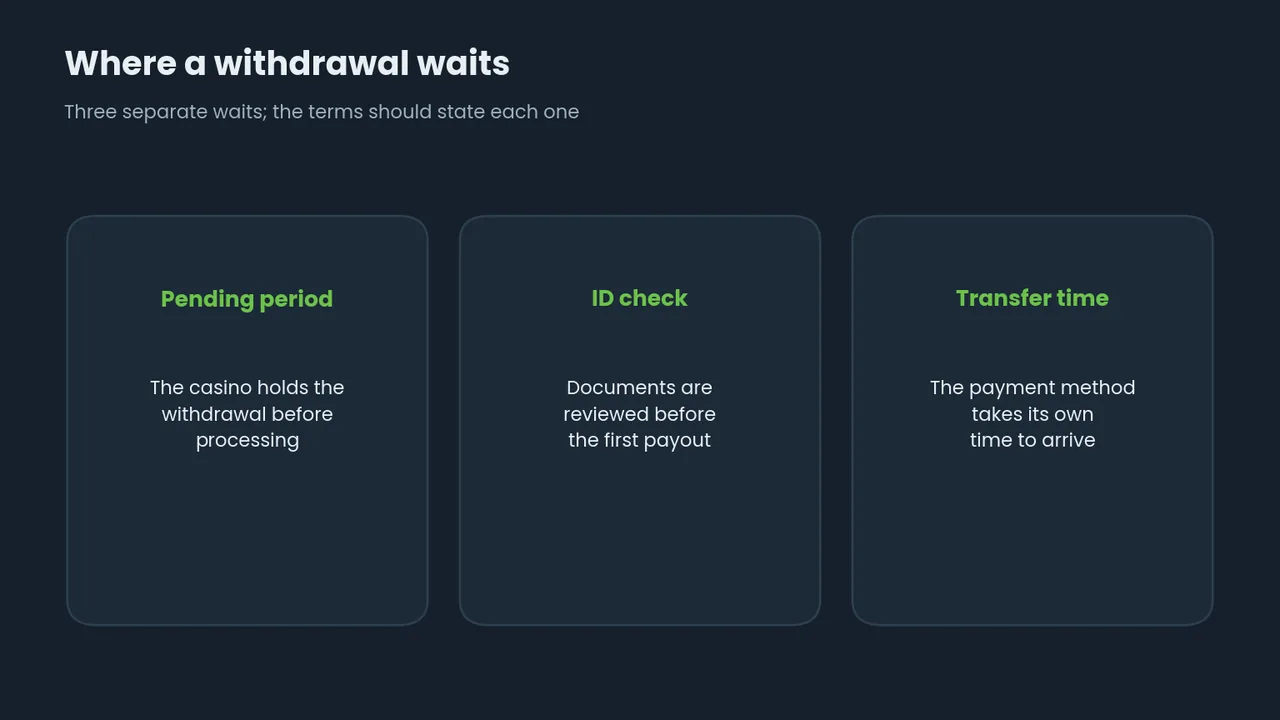
Licensed sites in the seven US states that allow online casino use US payment methods such as bank transfer, cards and e-wallets. Offshore sites that accept Americans often lean more on crypto. Whatever the method, a withdrawal usually waits in three places: a pending period, when the request can still be cancelled; the verification check described above; and the transfer time of the method itself.
Two terms are worth finding before you request anything. The first is the minimum withdrawal: if it is higher than your capped balance, the money cannot leave until the balance grows, which usually means playing on. The second is whether pending withdrawals can be reversed into your balance. If you have decided to cash out, leave the request alone. The same applies to any message asking you to deposit more to release a withdrawal when the terms said nothing about it: ask for the rule in writing first.
What an instant withdrawal can honestly mean
Searches for a "no deposit bonus instant withdrawal casino" or a "free chip no deposit instant withdrawal" are looking for something that does not quite exist. With a no-deposit bonus the wagering and the ID check come first by design. At best, "instant" describes the last step, the transfer, and only after the pending period is over. "Keep what you win" is the same kind of phrase: it usually sits above a max cashout line that says how much of what you win you may keep.
The same goes for "casino games that pay real money with no deposit" and "no deposit slots win real money". The games pay into a bonus balance, not into cash. A slot spin on a free chip can land a big win, but that win belongs to the bonus until all four hurdles are cleared. The game changes how fast the wagering moves, not what the terms let you withdraw.
How much a max cashout cuts: our simulation
To see what the second hurdle does, we ran a $25 free chip at 40x ($1,000 of wagering) through our simulation, with 100,000 players on each of two declared slot models at 96% RTP (method below). We then applied four caps to the same results. The table shows the share of finishers whose balance reached the cap, and the average cash per player, counting busts as $0.
| Max cashout | High volatility: finishers who hit the cap | High volatility: average cash per player | Low volatility: finishers who hit the cap | Low volatility: average cash per player |
|---|---|---|---|---|
| No cap | none | $18.18 | none | $11.09 |
| $200 | 75.6% | $7.82 | 2.4% | $10.99 |
| $100 | 84.2% | $4.19 | 30.2% | $9.37 |
| $50 | 92.4% | $2.19 | 68.2% | $6.03 |
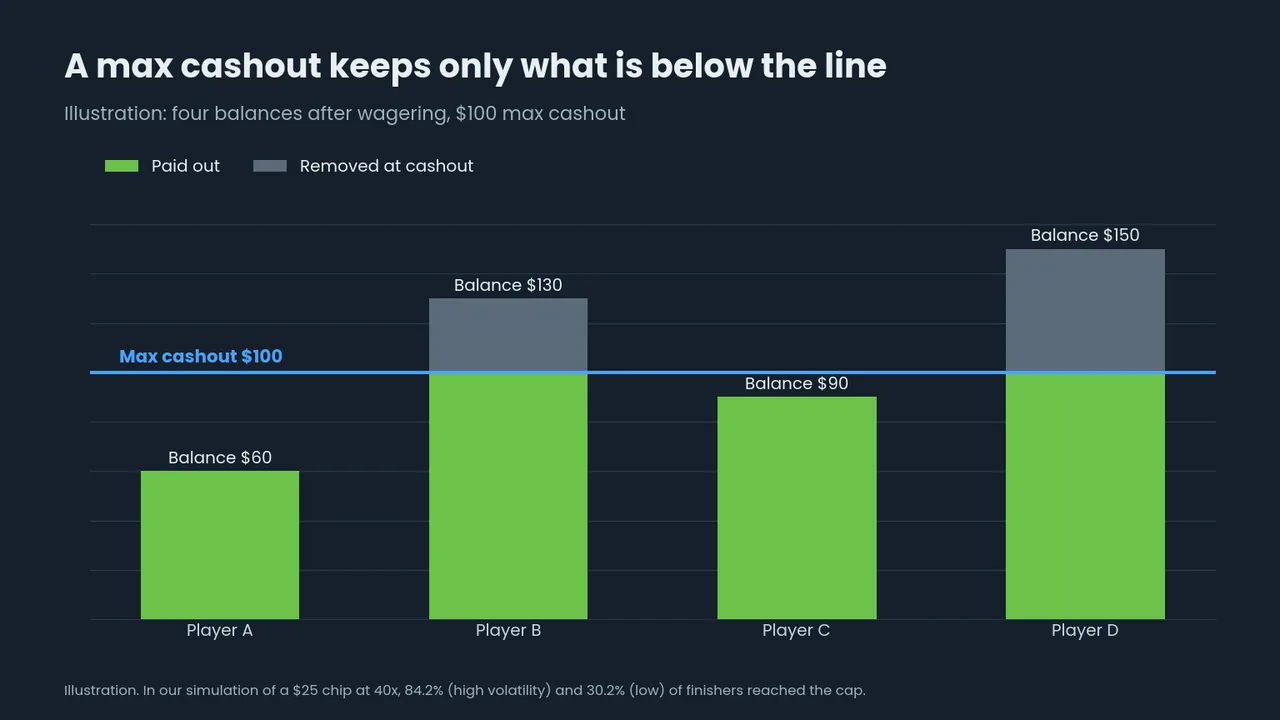
In our simulation the cap barely touches the low-volatility game at $200, but with a high-volatility game a $100 cap takes the average from $18.18 to $4.19 per player. The players it hits are exactly the ones who finished the wagering with a big balance: the only branch in which a no-deposit bonus pays well. That is the practical meaning of the Pennsylvania and Michigan rule. Under those rules, finishing the terms is the end of the process; under an offshore max cashout, it is the point where most of a large win can be removed.
When a withdrawal stalls
- Check the status and your inbox. Often it is a document request that went to spam, or a pending period still running.
- Ask for the reason in writing. Ask support which term the delay or refusal relies on, and keep the reply.
- Keep your evidence. A saved copy of the bonus terms as they stood when you claimed, screenshots of the balance and the wagering counter, and the dates of each message.
- At a licensed casino, escalate to the state. If the operator does not resolve it, take it to the gaming regulator of the state where you played; our guide to online casino legal states names each one.
- At an offshore site, know the limit. The Pennsylvania Gaming Control Board says "Player protections are required only through licensed operators" and that it cannot help with problems at an offshore platform. The Michigan Gaming Control Board, announcing cease-and-desist orders to 45 offshore operators in April 2026, named withheld winnings among the risks and said such sites offer "no meaningful avenue for dispute resolution".
Before you press withdraw
- The wagering counter shows zero, and no bet broke a max-bet rule along the way.
- You know the max cashout, and the minimum withdrawal is below your capped balance.
- Name, date of birth and address on the account match your documents, and you hold only one account.
- You know whether a deposit is required first, and what terms come with it.
Gambling winnings, including cashed-out bonus winnings, are taxable in the US; the rules, and the change to deducting losses from 2026, are explained in our guide to online casino legal states. For offers where these terms are part of our checks, see our no deposit bonus casinos page.
Frequently asked questions
Can I withdraw no-deposit winnings without making a deposit?
Do licensed US casinos put a max cashout on bonus winnings?
What documents do casinos ask for before paying out?
Why was my bonus voided after I finished the wagering?
Who can help if an offshore casino will not pay?
How long does a no-deposit withdrawal take?
Read next
General information only, not legal, tax or financial advice, and 21+ where online casino is licensed. Simulation results use declared slot models, not real games, and real bonus terms vary by casino; check the law in your own state.