
How No Deposit Bonuses Work: Wagering, Caps and Value
A no deposit bonus is casino credit or free spins you get without paying in. Before any of it can be withdrawn you must bet it a set number of times (the wagering requirement), usually within a time limit and on eligible games, and the withdrawal is often capped. More wagering lowers the value step by step, not all at once: in our simulation a $20 chip with a $100 cap was worth $14.51 on average at 10x, $10.86 at 25x and $8.31 at 40x, and only 13% of players finished 40x.
With a deposit bonus there is a handy rule of thumb: the expected loss while wagering is turnover times house edge. On a 96% RTP slot the edge is 4%, so a bonus wagered 25 times loses 25 x 4% = 100% of its value on average. Past 25x, the formula says, the bonus is "eaten". That rule does not carry over to a no deposit bonus, because without a deposit you can never lose more than the bonus itself, and most players run out of balance long before the formula's full turnover. In our simulation there was no cliff at 25x. A $20 chip kept losing value gradually as the multiple rose, and it still had value at 80x, three times past the point where the formula says nothing is left.
No cliff at 25x: what a $20 chip is worth at each multiple
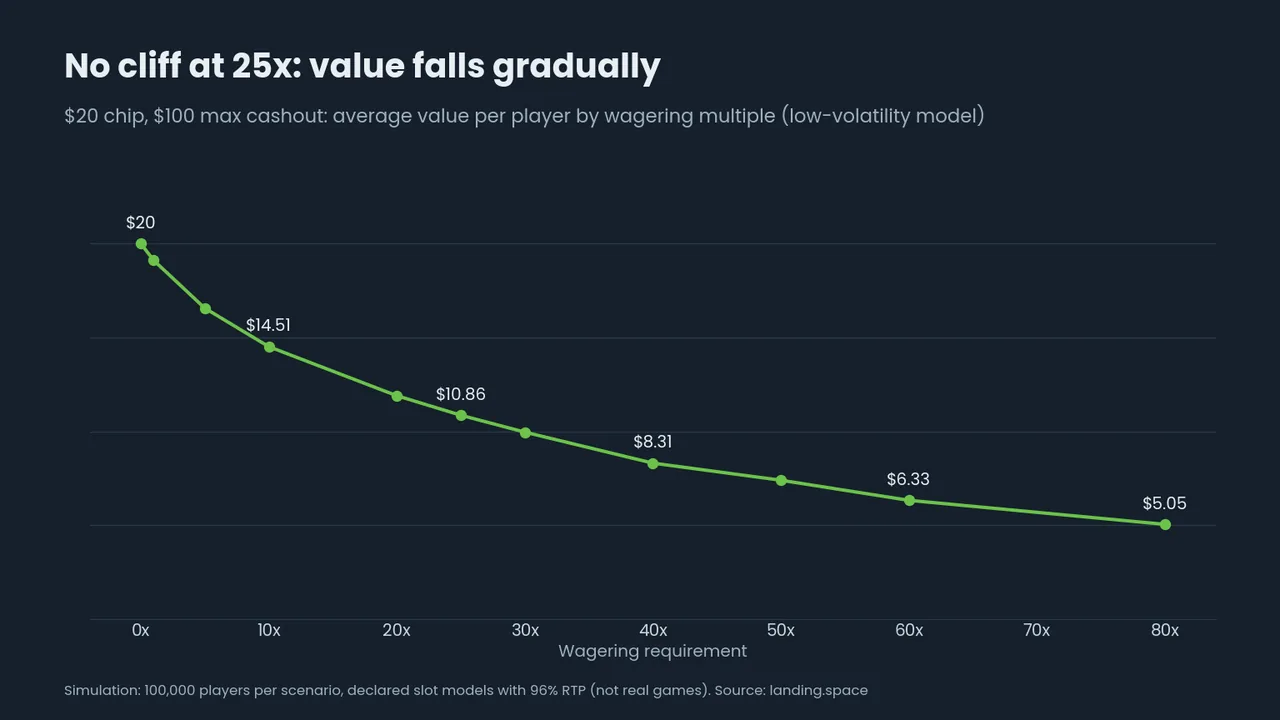
The line bends, but it never drops off an edge. At 25x, where the deposit-bonus rule says the chip is used up, it was still worth $10.86 on average, more than half its face value. The reason is how the value is made. A player who busts has lost the $20 and nothing more, so the formula's expected loss beyond $20 simply never happens. The value that remains comes entirely from the players who reach the end of the wagering, often after an early win, and it is held down by the $100 cap. As the multiple rises, fewer players get there, so the average falls, but slowly.
| Wagering on a $20 chip | Bets needed | Formula: expected loss at 4% | Average value in our simulation | Players who finished |
|---|---|---|---|---|
| 1x | $20 | $0.80 | $19.11 | 100% |
| 5x | $100 | $4 | $16.56 | 57.4% |
| 10x | $200 | $8 | $14.51 | 37.2% |
| 20x | $400 | $16 | $11.90 | 23.1% |
| 25x | $500 | $20 | $10.86 | 19.5% |
| 30x | $600 | $24 | $9.96 | 16.9% |
| 40x | $800 | $32 | $8.31 | 13.0% |
| 50x | $1,000 | $40 | $7.40 | 10.9% |
| 60x | $1,200 | $48 | $6.33 | 9.1% |
| 80x | $1,600 | $64 | $5.05 | 6.8% |
The share who finish drops faster than the value
The average hides the outcome most people actually get. At 40x, 13.0% of simulated players finished the wagering and 87% ended with $0. The average of $8.31 is real, but it is made of a few players leaving with up to $100 and most leaving with nothing. The chance of finishing falls steeply over the first few multiples and then flattens: from 100% at 1x to 57.4% at 5x, 37.2% at 10x and 19.5% at 25x, then only slowly down to 6.8% at 80x.
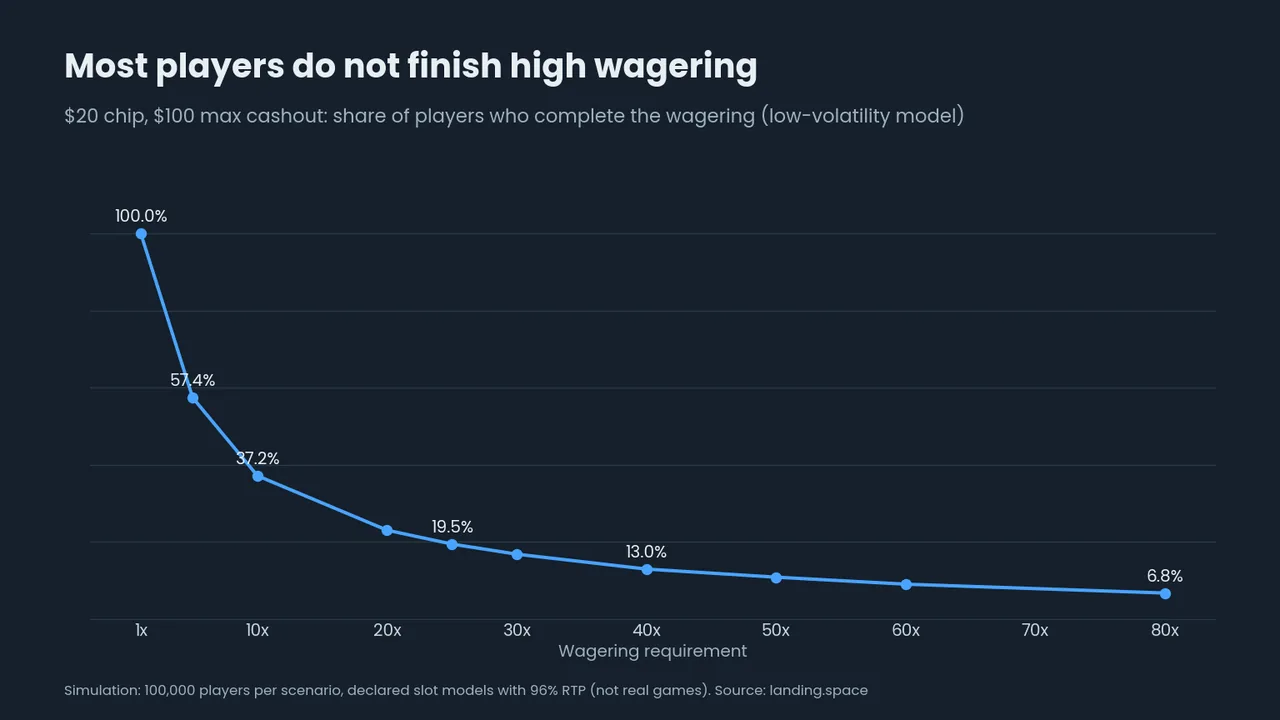
So a low wagering requirement helps you mainly by making it more likely that you finish at all. Going from 40x to 10x almost triples the share who get through, while the average value rises by about $6. If you want the best chance of withdrawing something, the multiple is the number to compare. If you are happy with a long shot at the cap, a higher multiple costs less than the deposit-bonus rule suggests.
Method: in our simulation, 100,000 players per scenario, seed 20260926. Two declared slot models with 96% RTP, one high and one low volatility; they are models, not real games. Bets of $0.50 on chips up to $25, $0.20 when wagering free-spin winnings. Each player bets until the wagering is done or the balance is below one bet, and the cashout is capped at the stated max cashout.
Wagering the bonus or wagering the winnings
A wagering requirement is always a multiple of something, and the something matters as much as the multiple. On a free chip it is usually the bonus: $25 at 40x means $1,000 of bets. On free spins it is usually the winnings from the spins: 50 spins at $0.10 produced average winnings of $4.81 in our simulation, so 30x on those winnings means about $144 of bets. The headline "40x" and "30x" look similar; the dollar targets are seven times apart.
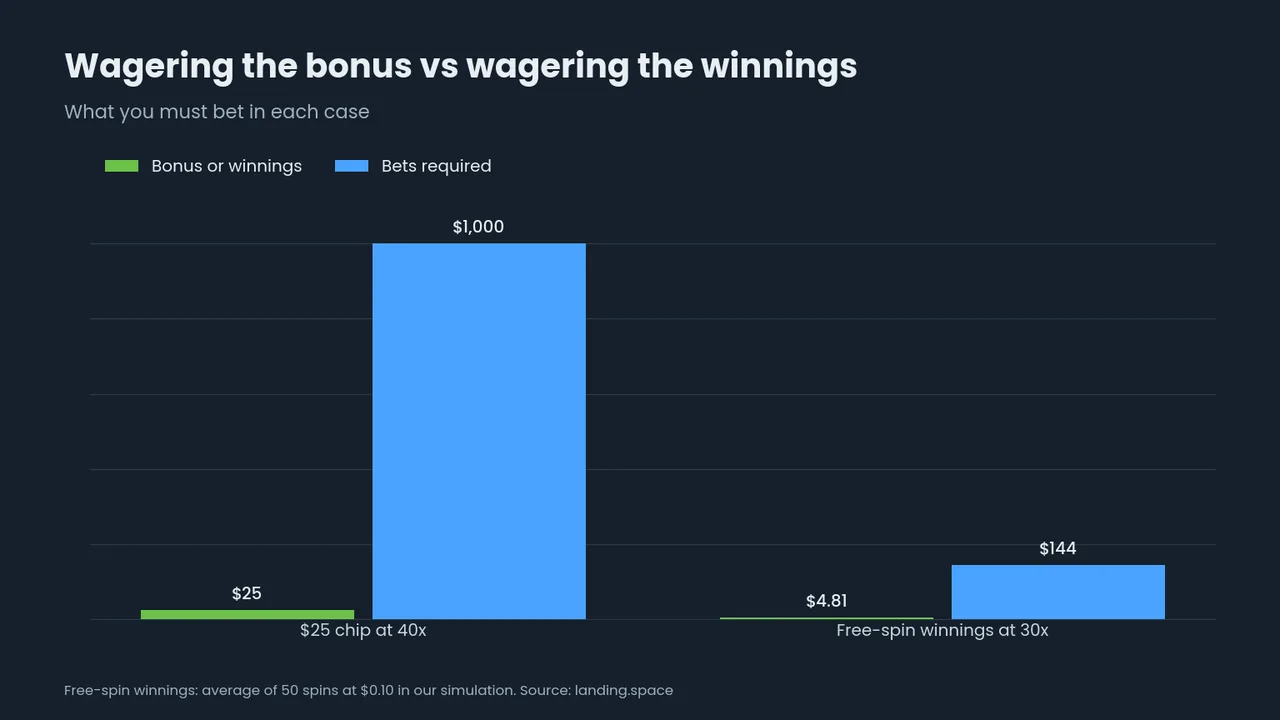
The finishing odds end up closer than the targets suggest, because the free-spin balance is smaller too. In our simulation the $25 chip at 40x with a $100 cap was finished by 4.5% of players on the high-volatility model and 13.9% on the low-volatility model, and 30x on the spin winnings paid something to 4.3% and 13.5%. Watch for two variants in the terms: wagering on "bonus plus winnings", which grows as you win, and wagering on bonus plus deposit, which should not apply to a true no deposit offer at all.
How often the cashout cap actually bites
The max cashout is the most you can withdraw from a no deposit bonus, whatever your balance says. Whether it matters depends on the kind of game. We ran a $25 chip at 40x with caps of $50, $100 and $200 and counted how many players ended the wagering above the cap.
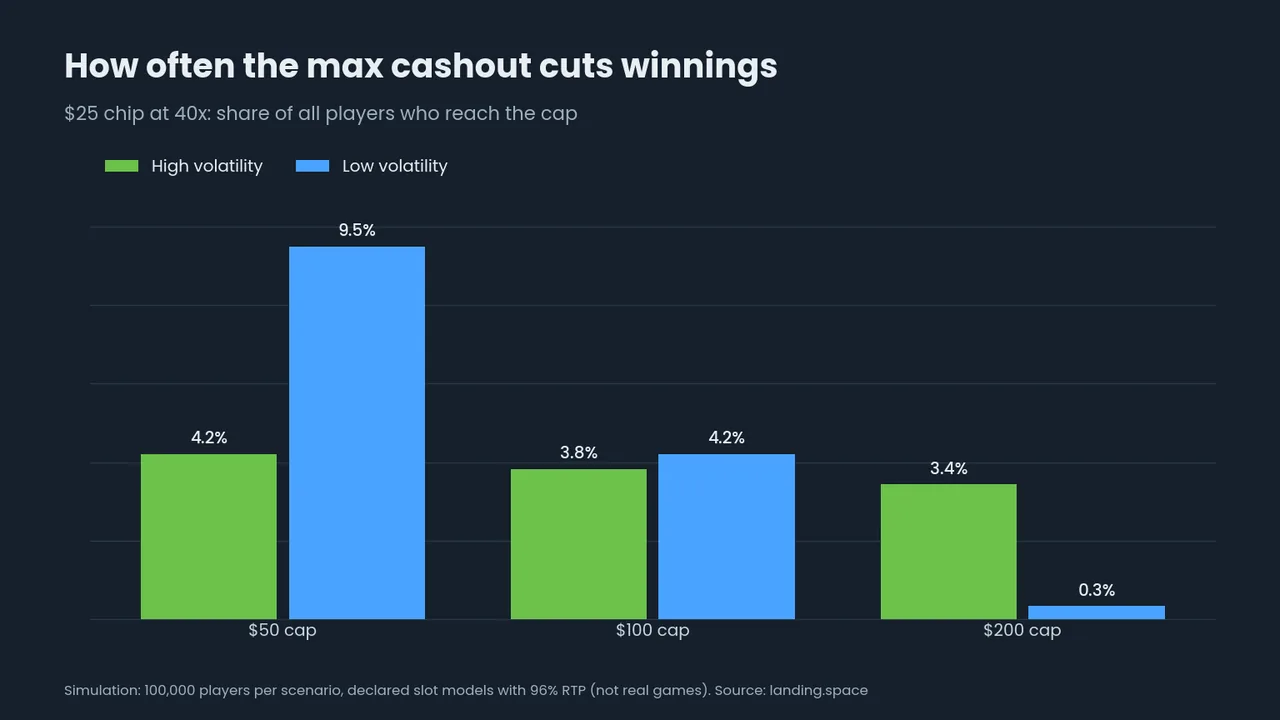
On the high-volatility model, 4.5% finished and three in four of them were over even a $200 cap: if you get through on that kind of slot, it is usually because of one big win, and the cap takes the rest. The average value was $4.19 with a $100 cap against $18.18 with no cap at all. On the low-volatility model the picture flips. A $50 cap binds for 9.5% of players, but a $200 cap for only 0.3%, and the average value barely moves between a $200 cap ($10.99) and no cap ($11.09). A higher cap is worth most on high-volatility games, which are exactly the games where the fewest players finish.
Game contribution, max bet and time limits
- Game contribution. Each game counts a percentage of every bet towards the wagering. Slots usually count 100%; table and live games often count far less or nothing. At 10%, $1,000 of wagering becomes $10,000 of bets.
- Eligible games. Free spins are tied to one slot, and chips often exclude some games. Betting on an excluded game can cancel the bonus.
- Max bet. Most terms cap the stake while a bonus is active. A bigger bet finishes faster but can void the winnings.
- Time limits. There is usually one deadline to claim and another to finish wagering. $1,000 at $0.50 is 2,000 bets, and anything left when the clock runs out is removed.
- Order of funds. If you deposit while a bonus is active, the terms say whether your cash or the bonus is used first. That decides what you can withdraw if you stop early.
We did not review any specific operator's terms for this page; these are the general forms the terms take. Each casino words them differently, so read the actual text before you play.
No wagering and low wagering no deposit offers
A no deposit bonus with no wagering requirements pays winnings as cash straight away, so the limits move elsewhere: the value per spin, the cap and the expiry. They are small but reliable. In our simulation, 50 no-wager spins at $0.10 with a $100 cap were worth $4.74 on the high-volatility model and $4.80 on the low-volatility one, and almost every player kept something. The same spins with 30x on the winnings were worth $1.98 and $2.79. A no deposit bonus with low wagering requirements sits between the two: at 5x, the $20 chip above was finished by 57.4% of players and worth $16.56 on average.
So can you win with casino free play? Yes, some players do, and occasionally up to the cap. But the odds are set by the terms, not by luck alone: the lower the multiple and the higher the cap, the better your chance. Our pages on free spins no deposit and free chip no deposit bonuses compare current offers on exactly these lines.
How licensed states set the rules for bonus terms
Real-money online casino is licensed and live in seven states: New Jersey, Delaware, Pennsylvania, West Virginia, Michigan, Connecticut and Rhode Island. In those states, bonus terms are not just the casino's choice. Pennsylvania's rule requires operators to file each promotion's terms with the Gaming Control Board five days before launch, and the terms must state wagering requirements by game, withdrawal limits, eligible games and how the promotion can be cancelled. The operator is responsible for promotions run by its marketing affiliates, and it may not cap winnings once the terms are met.
Michigan's rule says bonus terms must be "clear and unambiguous" and must list the expiry, eligibility, withdrawal limits, wagering requirements by game type, the order in which funds are used, eligible games and cancellation. Players may cancel a bonus, and winnings may not be capped once the terms are met. In New Jersey, the Division of Gaming Enforcement's advertising standards rule out unrealistic wagering requirements; its own example is $150,000 of play to redeem a $1,000 bonus, which is 150x.
Finding and claiming a no deposit offer
People often ask what online casinos have a no deposit bonus. The honest answer is that offers change every week, so any fixed list goes stale; our no deposit bonus casinos page lists current offers with the date we last read the terms. Getting free spins or a chip with no deposit usually works the same way:
- Read the terms first. Multiple, what it applies to, cap, eligible games, max bet and expiry.
- Register with your real details. The name and address must match your ID later.
- Enter a code if one is required, usually at sign-up; some offers are credited automatically.
- Wager on eligible games only, below the max bet, before the deadline.
- Verify and withdraw. Expect an ID check before the first payout; the steps are in our guide to cashing out no deposit winnings.
Do casinos give free money? Not in the sense the phrase suggests. A no deposit bonus costs you nothing to claim, but it is credit with conditions, and in our simulation the typical outcome at 40x was $0. Treat it as a free look at a casino with a small chance of a payout, and check your own state's law on online casinos before you sign up.
Frequently asked questions
What does 40x wagering mean on a no deposit bonus?
Is a bigger chip always better than a smaller one?
Do winnings from free spins have wagering too?
What happens if I do not finish the wagering in time?
Can I cancel a no deposit bonus?
Why is my withdrawal capped even though my balance is higher?
Read next
18+ or 21+ depending on where you play; 21+ in the licensed US states. General information, not legal, tax or financial advice. Simulation results use declared slot models, not real games, and real bonus terms vary by casino.