
Gambling Help in the US: Helpline and Self-Exclusion
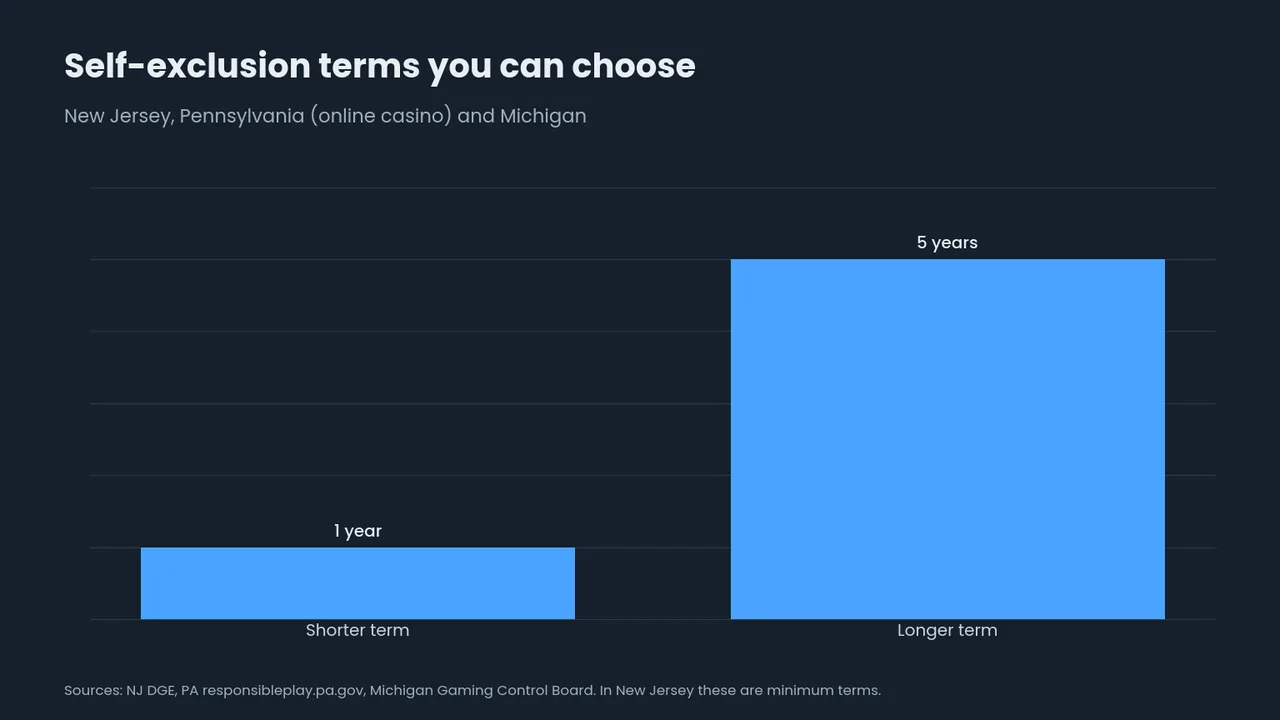
The national problem gambling helpline in the US is now 1-800-MY-RESET (1-800-697-3738). You can call or text it, or chat at 1800myreset.org, 24 hours a day, 7 days a week. The National Council on Problem Gambling has run it since 29 September 2025. The older number, 1-800-GAMBLER, is now run by the Council on Compulsive Gambling of New Jersey. If you live in New Jersey, Pennsylvania or Michigan, you can also put yourself on the state's self-exclusion list for 1 or 5 years.
If you have landed here, you are probably not looking for a bonus. Maybe the betting has crept up, money has gone missing, or you keep promising yourself that this is the last time. Maybe it is not your gambling at all, but a partner's, a parent's or a friend's. You do not need to be sure it is a "gambling addiction" to ask for help, and you do not need to have hit bottom first. The most useful thing to know is that the national number changed in 2025, so a number you remember from an old ad may not be the national one any more. This page gives you the current number, the self-exclusion lists in the states that license online gambling, and practical first steps for money and for family.
The national helpline changed on 29 September 2025
- The number: 1-800-MY-RESET, which spells out 1-800-697-3738 on a phone keypad.
- Three ways in: call it, text it, or open a chat at 1800myreset.org, whichever feels easiest.
- When: 24 hours a day, 7 days a week.
- Who runs it: the National Council on Problem Gambling, since 29 September 2025.
- What happened to 1-800-GAMBLER: it is now run by the Council on Compulsive Gambling of New Jersey. New Jersey and Pennsylvania rules still cite it in gambling ads, so you may see both numbers.
Reaching out for the first time
There is no script. A first sentence such as "I think my gambling is getting out of hand" or "I am worried about my husband's betting" is enough to start. You do not have to add up every loss before you get in touch, and you do not have to decide on the spot what you want to change. If saying it out loud feels like too much, the text and chat options exist for exactly that moment: typing a few words late at night can be easier than making a call. It can help to jot down beforehand what worries you most, whether that is money, sleep, secrecy or the way arguments start at home, so you have something to point to when the conversation begins. And if the first attempt does not feel right, you can try again another day, by another route.
Support around one person
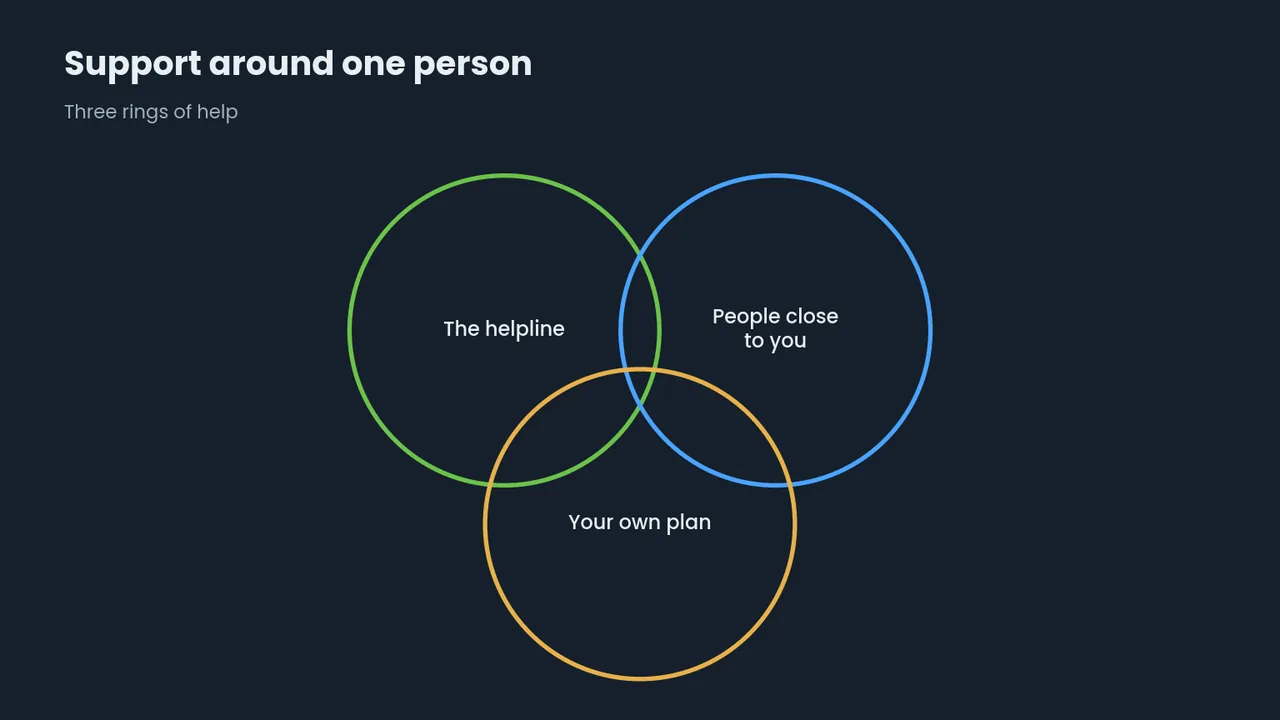
A helpline is one ring of support, not the only one. The people around you are the second: one person you trust who knows what is going on makes the next steps far easier, because you are no longer keeping a secret and fighting the urge at the same time. A doctor or counselor you already see is another person worth telling, since gambling often travels with stress, low mood or poor sleep. The third ring is your own plan: the practical barriers and routines you put in place so that the hard moments meet an obstacle instead of an open door. None of these has to be perfect. Together they make it harder for one bad evening to undo a good week.
How to stop gambling: small steps that add up
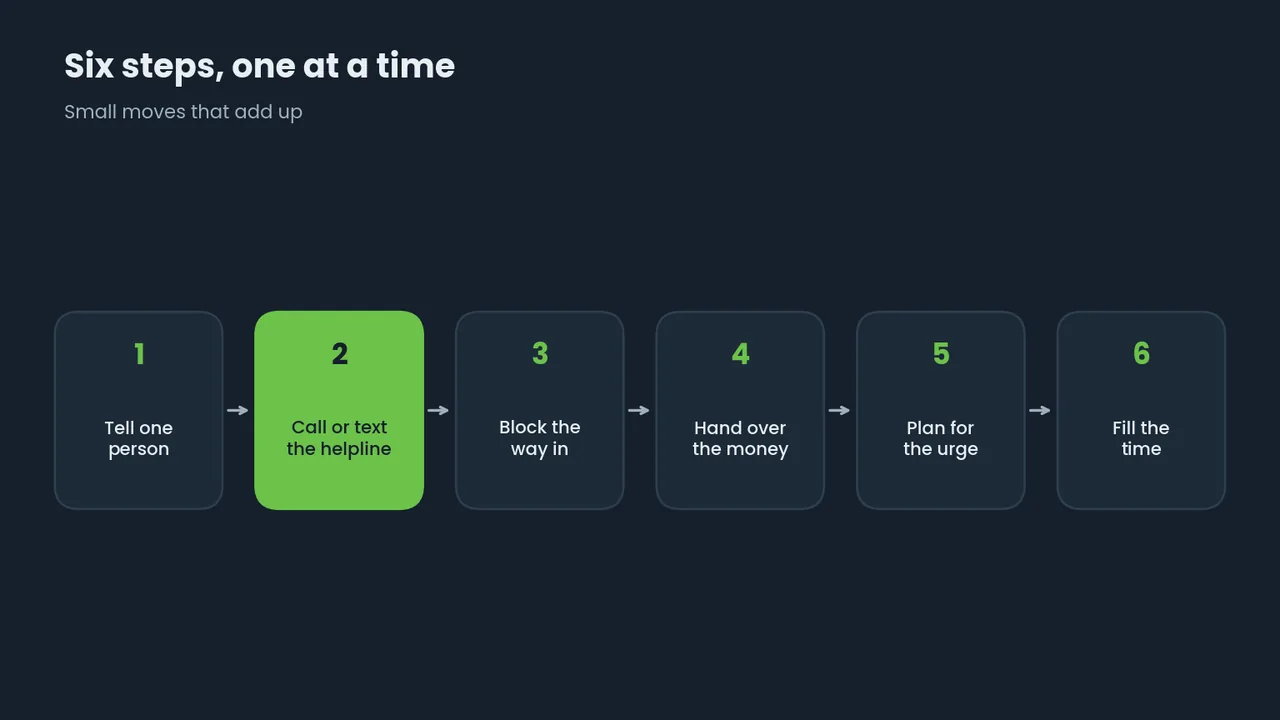
People rarely stop in one move. What tends to work is a series of small steps, each one making the next a little easier:
- Tell one person. Choose someone you trust and say it plainly. The secret is often heavier than the conversation.
- Reach the helpline. Call, text or chat 1-800-MY-RESET and talk through what is happening and what might help next.
- Block the way in. Delete gambling apps, unsubscribe from casino emails and texts, remove saved cards from any gambling account, and consider your state's self-exclusion list (below).
- Hand over the money for a while. Let someone you trust hold the card you gamble with, or set up your accounts so that bills are paid before you see the balance.
- Plan for the urge. Urges tend to rise and fall. Decide in advance what you will do instead: wait, walk, call someone, or leave the room where you usually play.
- Fill the time. Gambling takes hours as well as money. Put something back in those hours, even something small, so the gap does not pull you back.
Self-exclusion in New Jersey, Pennsylvania and Michigan
Self-exclusion means asking the state to put you on a list that licensed gambling operators must apply to you. Each state runs its own list, and the details differ:
| State | List | What it covers | Terms | How to sign up |
|---|---|---|---|---|
| New Jersey | Division of Gaming Enforcement self-exclusion list | Casinos, online casino, sports betting and racetracks | Minimum 1 year or 5 years | Online or by video call |
| Pennsylvania | Separate lists for each product | The online casino list covers online casino; other products have their own lists | 1 year or 5 years (online casino) | Through the state's responsible play site |
| Michigan | Responsible Gaming Database | See the Gaming Control Board's questions and answers | 1 year or 5 years | Through the Gaming Control Board |
Two points are easy to miss. In Pennsylvania the lists are separate, so joining the online casino list does not by itself cover the other products; read which list you are joining. In New Jersey a single list covers casinos, online casino, sports betting and racetracks. Whatever state you are in, read on the official page how the term ends and what happens when it does before you sign, so the end date does not arrive as a surprise. Choosing the longer term is a decision worth talking through with someone you trust or on the helpline.
What a state list does not reach
A self-exclusion list is applied by the operators a state licenses. Sites that no US state licenses are outside those lists, so signing up in New Jersey, Pennsylvania or Michigan does not block them, and there is no state regulator to ask for help there. If you have played on such sites, add other layers: blocking software on your phone and computer, closing or emptying the accounts you used, removing saved card details, and asking your bank whether it can block gambling payments on your card. Unsubscribe from their emails too, since a bonus offer landing in your inbox is exactly the kind of trigger a self-exclusion is meant to keep away.
Money: first moves when gambling has hit the budget
Debt is often the part that keeps people awake, and it is also the part where a few early decisions help most:
- Write it all down. List what you owe, to whom and when it is due. Seeing it on one page is hard, but it replaces a vague dread with something you can act on.
- Stop borrowing to cover losses. New credit to pay old gambling debt usually makes the hole deeper.
- Protect the essentials first. Rent or mortgage, utilities and food come before any other payment.
- Separate the money. Keep bill money in an account you do not gamble from, or hand control of it to someone you trust for a while.
- Do not try to win it back. Chasing losses is one of the clearest signs gambling has taken over, and no bonus or free offer changes that.
- Raise money on the helpline too. It is part of the picture, and saying the numbers out loud is often the first step to dealing with them.
When it is someone you love
Living with someone else's gambling is exhausting, and it often comes with its own secrecy and shame. A few things tend to help. Pick a calm moment to talk, not the middle of an argument or right after a loss. Describe what you have noticed, such as missing money, late nights or changes in mood, rather than putting a label on the person. Protect your own finances, for example by separating accounts and keeping your own card and passwords to yourself. You cannot make someone else stop, but you can decide what you will and will not pay for. And look after yourself: sleep, the people who support you, and a way to talk about it. Reaching out yourself, by call, text or chat, is a reasonable first step even if the person gambling is not ready to.
Frequently asked questions
Is 1-800-GAMBLER still the national gambling helpline?
Can I text the gambling helpline instead of calling?
How do I self-exclude in New Jersey?
How long does self-exclusion last in Pennsylvania and Michigan?
Does self-exclusion block offshore casino sites?
What if the person gambling will not admit there is a problem?
General information, not legal, medical or financial advice. The national problem gambling helpline is 1-800-MY-RESET (1-800-697-3738), call or text 24/7; in an emergency call 911.