
Geolocation failed? How casinos check you are in-state
A state-licensed online casino has to confirm you are inside the state before it takes a bet, and it reads your device's Wi-Fi, GPS and cell signals, not just your IP address. A failed check usually comes down to one of three things: too few signals (Wi-Fi off, location access denied), software the check is built to catch (VPNs, proxies, remote desktop, mock-location apps, rooted phones), or a spot close to a state line, where Pennsylvania re-checks every 5 minutes instead of every 20. A VPN never fixes it.
The message differs from app to app, but it always means the same thing: the casino could not prove where you are, so it will not accept a wager. A failed check blocks betting; it does not by itself close your account. Work through the steps below in order, from the quickest change to the slowest.
Fix it in this order
- Turn Wi-Fi on, even if you are on cellular data or plugged in by cable. A cable connection and Wi-Fi can be on at the same time, and the check works better with both. Caesars Sportsbook & Casino's help page puts it simply: "The more network signals you have within range of your device, the more accurately we can locate you."
- Give the app location access. On an iPhone that is Settings, then Privacy, then Location Services; on Android, Settings, then Location. A check that is refused location access has only weaker signals to work with.
- Quit, do not just pause, any VPN, proxy or remote-desktop program, and clear proxy settings in your browser. The same help page says that with any of them running "you will not be able to access real money gaming."
- On Android, open Developer options and clear "Allow mock locations" and USB debugging. A rooted or jailbroken phone will not pass at all: real-money play needs "a device with its original manufacturer settings."
- On a computer, restart the location plugin. Browser play needs a small program, Player Location Check, running in the background. If the site still cannot find it, uninstall and reinstall it. Mobile apps have the check built in.
- Change networks. Caesars warns that public Wi-Fi, such as a coffee shop's or a hotel's, and especially networks run by larger businesses, "may be associated with a location outside of allowed state." It recommends a private, password-protected network.
- Move away from the state line. Caesars warns that within half a mile of a border "you may be blocked from play." The next sections explain why.
What the check actually reads
It is not an IP lookup. Pennsylvania's technical standard for online casinos, § 809b.7 of the Gaming Control Board's rules, tells operators to "utilize pinpoint accurate location data sources". On a mobile connection the system must disregard IP location data entirely, and on any other connection IP data "shall not be used as the primary location data source." That is why a home broadband address that looks right is not enough on its own.
Caesars' help page names the company behind its check: GeoComply. GeoComply describes collecting "GPS, GSM, WiFi, plus IP addresses" from the device and lists VPNs, proxies, remote desktop, emulators and fake location apps among the tricks it identifies. The volume is large: the company counted 81.4 million geolocation checks on Super Bowl day 2026 alone.
As for your privacy, GeoComply says the location data it collects is "depersonalized" and that it receives no names or email addresses during a check. For any request about your own data, it sends you to the casino where you hold the account.
Near a state line: the 5-minute rule
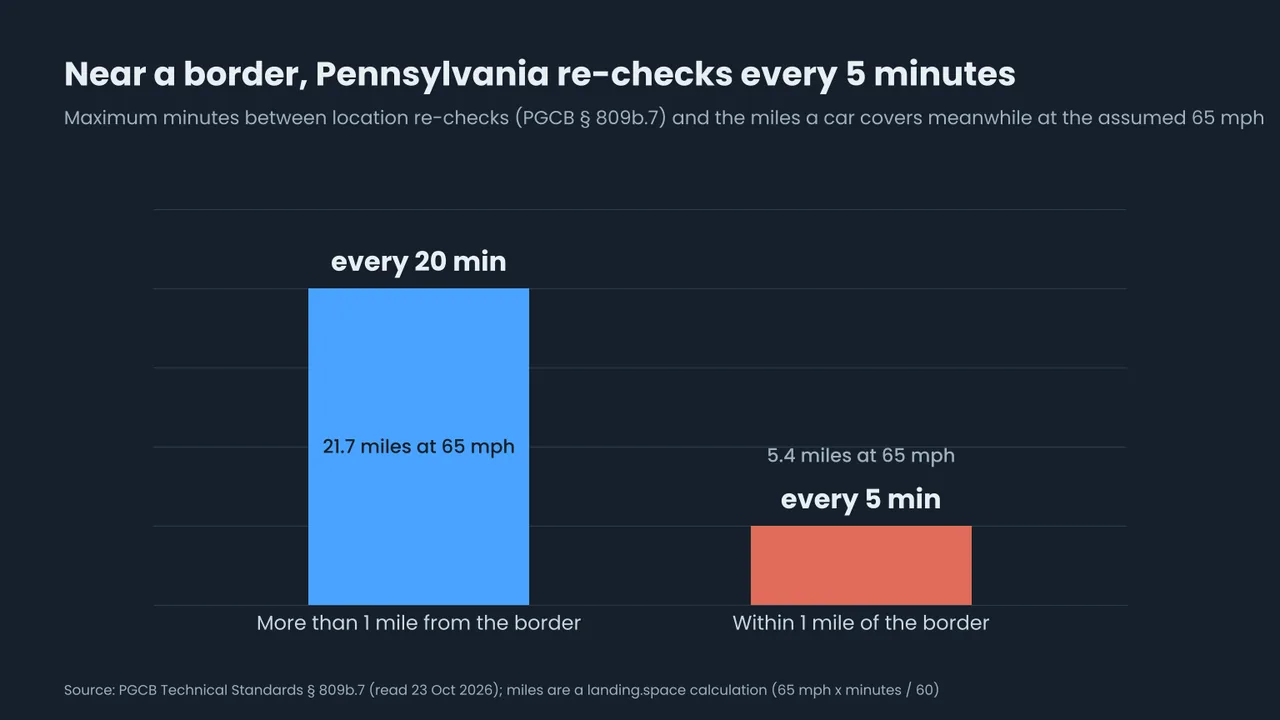
The first check runs when you log in or place your first wager. After that, Pennsylvania's standard requires "a geolocation re-check" every 20 minutes, or every 5 minutes if you are within 1 mile of the Commonwealth's border. For phones on the move it adds a second rule: re-checks are timed on "an assumed travel velocity of 65 miles-per-hour". At that speed a car covers 21.7 miles in 20 minutes but only 5.4 miles in 5, which is why the system checks four times as often where a short drive could take you out of the state.
A border spot can also fail when you are clearly inside the state. Every location fix comes with an accuracy radius, a circle in which the system is confident you are. The standard requires that this radius "cannot be within boundary buffer zones or over the boundary line." If your signals are weak, the circle grows, and once it touches the buffer the check fails. More Wi-Fi networks in range shrink the circle, which is why step 1 helps most near a border.
Crossing into a neighboring legal state does not help either. Each state's site checks for its own state, so a Pennsylvania casino account will not take a bet placed from New Jersey, even though both states license online casinos.
When the check fails mid-session
If a re-check places you outside the state, Pennsylvania's rule gives you "limited access to the interactive gaming account functions" but no betting until a later check confirms you are back inside. Caesars says the same in plainer words: leave the state during a session and "you will no longer be eligible to continue playing." A failed check stops bets, not the account. Getting money out has checks of its own, starting with your identity; the guide to cashing out no-deposit winnings takes them in the order you meet them.
The rules we read make no exception for bonus play, so expect the same check before free spins with no deposit will run at a licensed casino.
Why a VPN makes it worse
| Running on your device | What the rules or the software say | Result |
|---|---|---|
| VPN or proxy | Pennsylvania requires operators to "detect and block location data fraud, including but not limited to Proxy"; GeoComply lists VPNs, proxies and data centers among what it detects | Check fails until you quit it |
| Remote desktop | Named in the same Pennsylvania list ("Remote Desktop Programs") | No real-money play while it runs |
| Fake location app, mock locations | "Fake Location Apps" in the Pennsylvania list; Caesars asks Android users to clear "Allow mock locations" | Check fails |
| Virtual machine or emulator | "Virtual Machines" in the Pennsylvania list; GeoComply lists emulators | Check fails |
| Rooted or jailbroken phone | Operators must block devices showing "system-level tampering (i.e. rooting, jailbreaking)" | Device refused |
A VPN changes only the address your internet traffic appears to come from. It does not change the Wi-Fi networks or cell towers your phone can see, and the Pennsylvania standard already tells operators not to rely on IP data. So a VPN does not move you; it adds a mismatch the system is required to look for. The Pennsylvania standard also asks operators to "detect and block players that make repeated unauthorized attempts", so the practical advice is the dull one: switch the tool off, then try again.
Which states run these checks
The three rule texts we read for this page all tie the wager to the state's own territory, with differences in detail:
| State | Rule | What it says about location |
|---|---|---|
| New Jersey | N.J.A.C. 13:69O-1.2(e) | Location detected at login and "as frequently as specified" in each operator's approved submission; no wagers until the player is in an authorized location; "Internet gaming shall only occur within the State of New Jersey" |
| Pennsylvania | PGCB § 809b.7 | Check at login or first wager; re-check every 20 minutes, every 5 within 1 mile of the border; IP data never the main source; blocks proxies, fake location apps, virtual machines, remote desktop, rooted and jailbroken devices |
| Michigan | R 432.631 | A geofencing system must "dynamically monitor" the player's location "throughout the duration" of the session; the Gaming Control Board approves the technical specifications |
Two caveats. The New Jersey text we could read is an older copy of chapter 13:69O, so the current wording may differ in detail; and we did not read the rules of West Virginia, Connecticut, Delaware or Rhode Island for this page. Licenses are granted state by state, and in the three states we read the bet has to be placed inside the state that licensed it; Michigan's rule makes room only for players covered by a multi-state agreement.
That also means there is no fix outside those states. In a state without licensed online casinos, a licensed app will refuse you however good your signal is; which seven states have them, and which regulator oversees each, is set out on our online casino legal states page.
Frequently asked questions
Why does geolocation fail when I am at home?
Can I use a VPN to play from another state?
How close to a state line is too close?
Why does the app check my location again while I play?
Does the geolocation company know who I am?
Read next
General information, not legal advice; online casino play is 21+ in the licensed states. The steps follow the Pennsylvania standard, the Michigan and New Jersey rules and an operator help page as read on 23 Oct 2026; your own app's help page has the final word on its settings.