
Quaddie, First 4 and flexi percentages explained
A Quaddie costs the number of runners you pick in each leg multiplied together: 3 x 3 x 3 x 3 is 81 combinations, or A$81 for the full dividend. With flexi you choose the outlay and TAB pays that share: A$20 on 81 combinations is a 24.69% bet. A First 4 box of five runners is 120 combinations. TAB's flexi floor is 1%, and the two bets treat a scratching differently: a Quaddie gets a substitute, a First 4 gets a refund.
Three runners in each leg of a Quaddie sounds modest. It is 81 combinations, A$81 to take the whole dividend, and a A$20 ticket on it is a 24.69% bet. Add a fourth runner to every leg and the same A$20 buys 7.81%. Almost everything that confuses people about exotic bets comes down to that multiplication, and to the percentage TAB prints on the ticket instead of a stake.
Legs multiply, they do not add
TAB describes the Quaddie as "selecting 4 winners from 4 races at a race meeting selected by TAB", with "at least one runner in each race/leg". Every runner you pick in one leg is paired with every runner in the others, so the combinations are the four leg counts multiplied together. One extra runner in a leg where you had a single pick doubles the cost of the whole ticket, and one more in every leg of a 3-3-3-3 takes it from 81 combinations to 256.
| Runners per leg | Combinations | Cost for 100% | A$20 buys | A$50 buys |
|---|---|---|---|---|
| 2-2-2-2 | 16 | A$16 | 125% | 312.5% |
| 3-2-2-2 | 24 | A$24 | 83.33% | 208.33% |
| 4-3-3-2 | 72 | A$72 | 27.77% | 69.44% |
| 3-3-3-3 | 81 | A$81 | 24.69% | 61.72% |
| 4-4-4-4 | 256 | A$256 | 7.81% | 19.53% |
| 5-5-5-5 | 625 | A$625 | 3.2% | 8% |
| 8-6-6-6 | 1,728 | A$1,728 | 1.15% | 2.89% |
| 10-8-8-8 | 5,120 | A$5,120 | Not accepted (0.39%) | Not accepted (0.97%) |
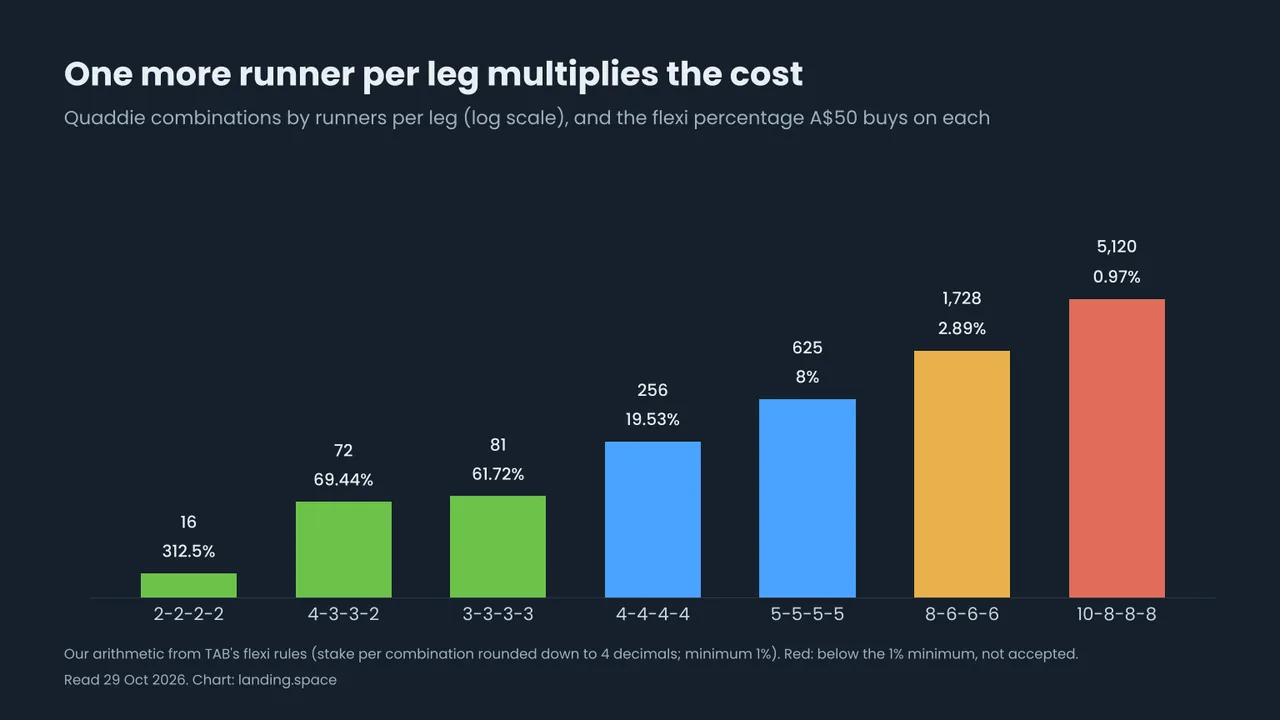
TAB's minimum for a Quaddie is "$0.50, though most people bet at least $1". The real constraint on a wide ticket is the flexi floor further down: on 5,120 combinations even A$50 falls short of it.
What a flexi percentage pays
TAB shows dividends for a A$1 unit. A flexi bet lets you pay less (or more) than the full unit cost, and you are paid the same share of the dividend. TAB's own worked example uses a Trifecta: five runners boxed cost A$60 at A$1, so a A$15 bet is 25%, and if the dividend is A$200.00 "You will collect: 25% of $200 = $50". The rules behind it are short:
- The percentage is your outlay divided by the combinations. The Victorian rules, which set dividends for ONE POOL, divide the total bet by the number of combinations and round the result down to four decimal places. A$20 on 81 combinations is A$0.2469 a combination, shown as 24.69%.
- The floor is 1%. TAB's flexi page sets a "Minimum Investment of $0.50", "Increments must be a multiple of 50 cents" and a bet percentage of "1.00% or greater".
- Flexi changes your share, not your chance. A 24.69% ticket wins in exactly the same races as a 100% ticket on the same runners; it just collects a quarter of the money.
A worked Quaddie, with an invented dividend: 4-3-3-2 is 72 combinations. A$36 on it is A$0.50 a combination, a 50% bet. If the Quaddie pays A$1,840.60, the ticket returns 50% of that, A$920.30. The same runners at A$72 would have collected the full A$1,840.60, and at A$20 (27.77%) A$511.13.
First 4: box, standout and roving banker
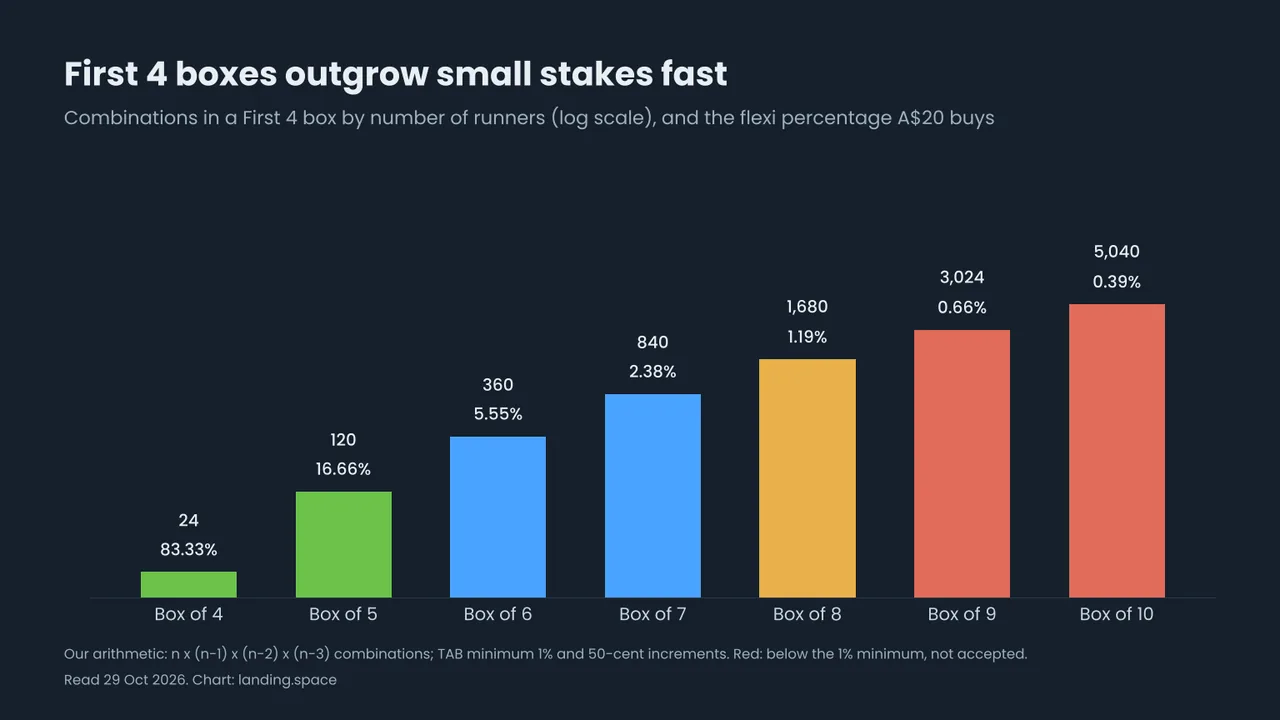
A First 4 means "selecting the runners that will place 1st, 2nd, 3rd, and 4th in a race in the correct order". Boxing covers every order of the runners you choose, which is why the count climbs so fast: four places filled from n runners is n x (n-1) x (n-2) x (n-3). A standout fixes one runner in first and boxes the rest behind it; a roving banker lets your banker finish in any of the four places.
| First 4 bet | Combinations | Cost for 100% | A$20 buys | Outlay for 1% |
|---|---|---|---|---|
| Box of 4 | 24 | A$24 | 83.33% | A$0.50 |
| Box of 5 | 120 | A$120 | 16.66% | A$1.50 |
| Box of 6 | 360 | A$360 | 5.55% | A$4 |
| Box of 8 | 1,680 | A$1,680 | 1.19% | A$17 |
| Box of 10 | 5,040 | A$5,040 | Not accepted (0.39%) | A$50.50 |
| Standout: 1 runner first, 6 behind | 120 | A$120 | 16.66% | A$1.50 |
| Roving banker: 1 runner anywhere, 5 others | 240 | A$240 | 8.33% | A$2.50 |
Read the last column before you build a wide box. A box of ten needs A$50.50 just to reach the 1% floor, and at 1% a A$10,000 dividend returns A$100. A standout with one horse on top and six behind is 120 combinations, the same as a box of five, against 840 for boxing all seven, so it is the cheaper way to cover a field when you trust one horse for first.
Scratchings and dead heats
| What happens | Quaddie | First 4 |
|---|---|---|
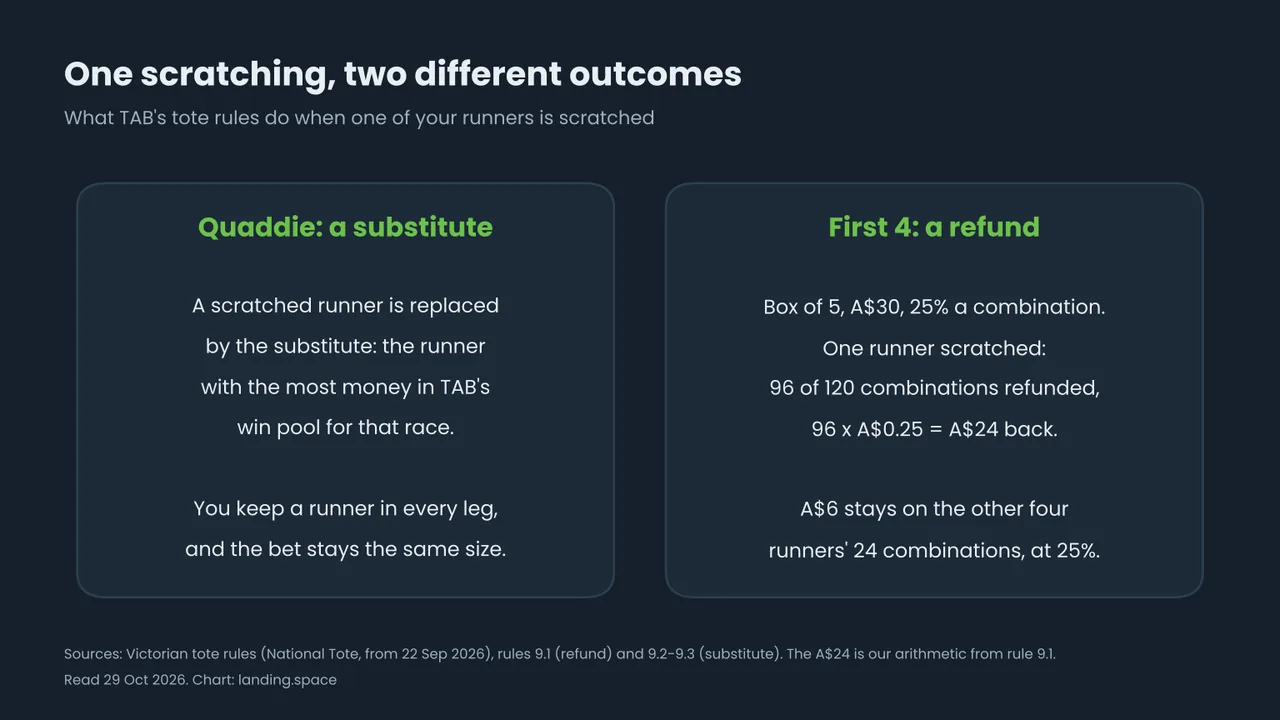
| One of your runners is scratched | Your bet moves to a substitute: the runner with the most money on it in TAB's win pool for that race (rules 9.2 and 9.3) | The money on that runner's combinations is refunded (rule 9.1) |
| Two runners dead-heat | The pool is split into as many equal parts as there are winning combinations (rule 12.6) | The pool is split across the winning combinations in the dead heat (rule 12.10) |
| Smallest dividend paid | A$1.04 per A$1 on domestic ONE POOL races, now the same for TAB customers in NSW, VIC, ACT, QLD, SA, TAS and NT | |
The two bets part ways here. In a Quaddie you are never left with an empty leg: the substitute is fixed once betting on that leg closes, and in practice it is the race's tote favourite by money. In a First 4 the scratched runner simply drops out. Take a A$30 box of five, 25% a combination: 96 of the 120 combinations include any one runner, so a scratching should hand back 96 x A$0.25, A$24, on our reading of rule 9.1, leaving A$6 on the 24 combinations of the other four, still at 25%.
Cup Day: where your exotic goes
TAB listed Melbourne Cup day 2026, Tuesday 3 November, as a World Pool meeting, with the races still to be confirmed when we read it. Only Win, Place, Quinella, Duet and Trifecta join World Pool, so Quaddie and First 4 bets stay in ONE POOL, the combined NSW, Victorian and Queensland tote that TAB has run since 22 September 2026; our tote versus fixed odds guide explains what ONE POOL changed. For the 2026 Cup itself, the final field was declared at 4.30pm on Saturday 31 October under the VRC's race conditions, and our Melbourne Cup betting guide covers what that means for every type of bet.
Everything above is TAB's tote. Other licensed bookmakers offer Quaddie and First 4 products under their own rules, including minimums and scratching terms, so read theirs before you build a ticket; our comparison of Australian betting sites covers the ones we review. Whoever takes the bet, a flexi percentage is a share of a pool: it tells you what you will collect if you win, never how likely that is.
Frequently asked questions
How much does a Quaddie cost?
What does a flexi percentage mean?
What is the minimum flexi percentage at TAB?
What happens to my Quaddie if a horse is scratched?
What happens to my First 4 if a horse is scratched?
Read next
18+ only. General information, not betting or financial advice. Rules are TAB's published tote rules and help pages as read on 29 Oct 2026; percentages and returns are our arithmetic, and example dividends are invented. Other bookmakers set their own terms. Free help: 1800 858 858.