
Same Game and Same Race Multis: the hidden margin
A Same Game Multi (SGM) or Same Race Multi (SRM) is not priced by multiplying the legs. Because legs in one game or race are related, the bookmaker prices the combined outcome with its own model, so the margin built into the single price cannot be worked out from the slip. In a standard multi the margin compounds with every leg: at a 5% margin per leg, six legs return about 75 cents per dollar on average. Void rules also differ: Sportsbet cancels the whole SGM if one leg is void, while a standard multi just drops the leg.
In November 2023 the Northern Territory Racing Commission decided a punter's complaint against Sportsbet over $34,772.50 in Same Game Multi winnings that the bookmaker had voided after a software error in its pricing. The Commission sided with Sportsbet, but the most useful part of its decision is a plain description of how these bets are priced. "Because the relationship between the various different elements of a Same Game Multi is not independent," it wrote, "the odds are not simply determined by multiplying the odds for each element of the bet. Instead, the odds are calculated by a computer software pricing scheme, which takes into account each selection made by a punter." That passage is why an SGM's margin is so hard to see.
How a normal multi's margin builds up
Every bookmaker market carries a margin, also called the overround. Turn each price into an implied probability by dividing 1 by the decimal odds, add them up across the market, and anything above 100% is the bookmaker's cut: two teams both at $1.91, for example, add up to about 105%. In a standard multi each leg brings its own margin with it, and because the prices are multiplied, so are the margins. With a 105% book on every leg, a single bet returns about 95 cents per dollar on average; a six-leg multi returns about 75.
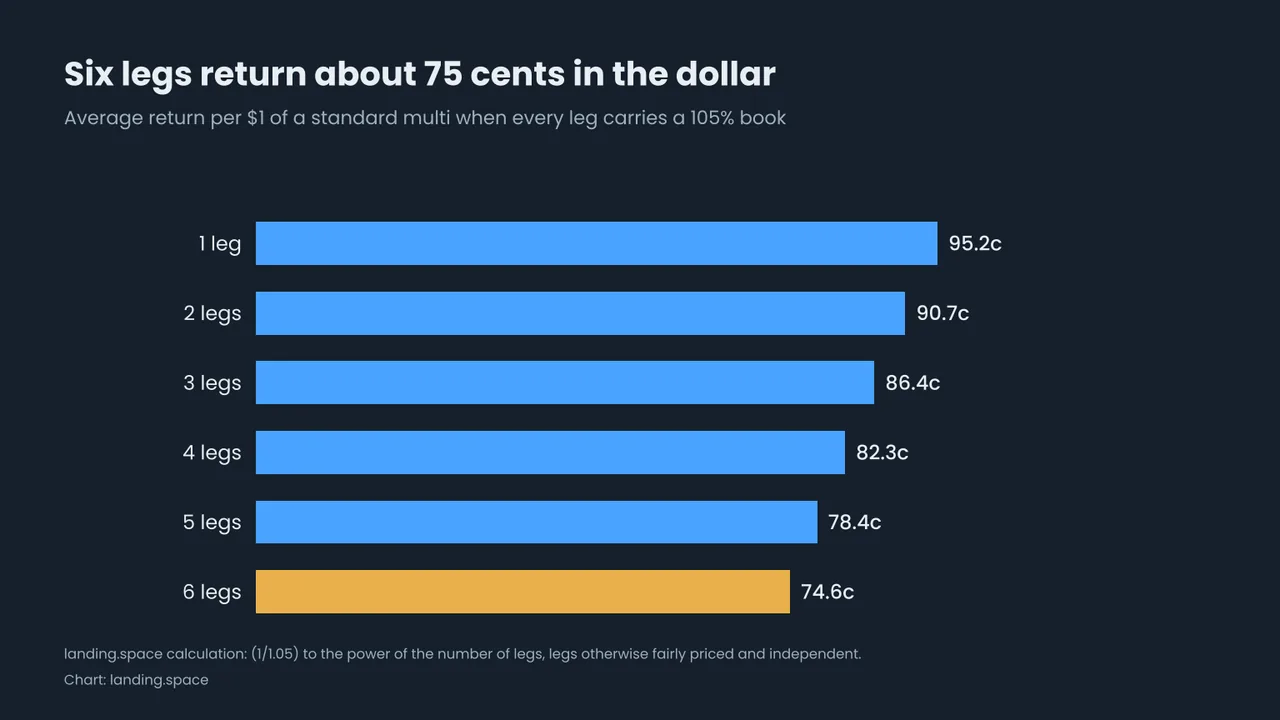
The economist Karl Whelan sets out the same compounding in a 2026 post on multi-leg bets: "So the more legs you add, the more you lose." Victoria's gambling regulator is blunter. "You're more likely to lose with a multi bet," its guide to betting says, and "Betting companies also make more money from multi bets than single bets, so they often promote them to get you to bet more."
Why a Same Game Multi is priced differently
Multiplying works only when the legs have nothing to do with each other. In one game they usually do. TAB says SGM odds "are calculated differently due to the selections within the same game or event", and that SRM odds "are calculated differently due to selections within the race relating to each other". A team winning big and its star forward kicking a bag go together. When legs move together, the chance of both coming in is higher than the two chances multiplied, and a price built by multiplication would be too generous. The analyst Tony Corke made this point in 2020 with a Sydney example: a forward kicking seven or more goals "is far more likely to be associated with a Swans' win than with a Swans' loss".
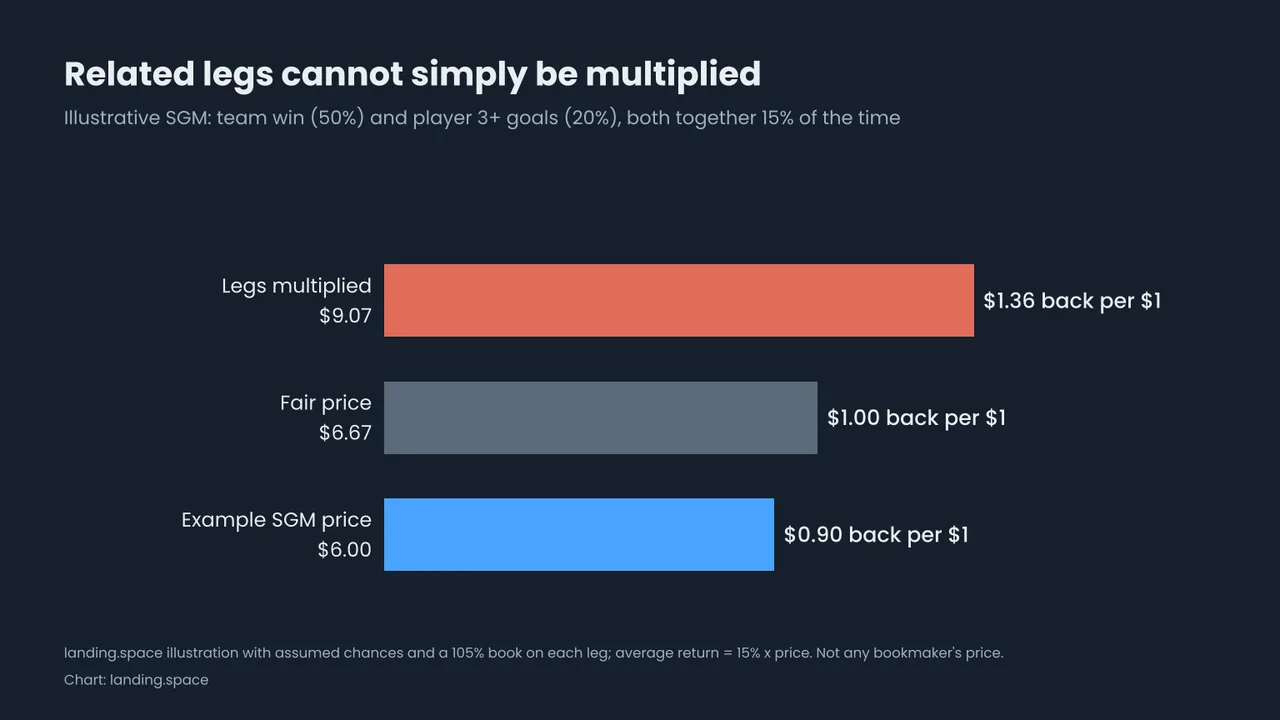
The chart uses made-up but plausible numbers. Say a team has a 50% chance of winning and a player a 20% chance of kicking three or more, and the two together come in 15% of the time rather than the 10% you would get if they were unrelated. With a normal margin on each leg the prices are $1.905 and $4.76, and multiplied they give $9.07: at a 15% chance, that would hand the punter about $1.36 back for every dollar on average. The fair price for a 15% chance is $6.67, so a bookmaker offering, say, $6.00 keeps about 10% of what is staked on it. You see only the $6.00. You do not see the 15%, so you cannot tell how much of the gap below $9.07 is correlation and how much is margin.
The only published measurements we found are from the UK, where the same product is called a bet builder. A January 2024 analysis by Propus Partners for SBC News of Premier League bet builders put average margins at 20% to 35% across the bookmakers sampled; three-selection bets averaged about 25% and four-selection bets about 40%, and bets with a single market type ran close to 20%. We found no equivalent figure for Australian SGMs.
A model can also get it wrong, and when it does the price can be taken back. In 2025 three punters backed Same Game Multis on Manly against St George Illawarra that combined "Time of First Try" markets; bet365 paid them, then resettled the bets at lower odds after finding a pricing fault. According to a report in The Straight in September 2026, the NT Racing and Wagering Commission found the odds of 26.00 and 34.00 "materially overstated the true likelihood of the combined outcome" and called the resettlement "a reasonable and proportionate response to an obvious pricing error". The test it applied was whether the error would have been apparent "to a reasonable person exercising ordinary wagering judgement". The 2023 Sportsbet decision also went the bookmaker's way, though those bets were voided rather than resettled. In both cases the regulator accepted that an obvious pricing error could be corrected under the bookmaker's published terms.
What the operators' own numbers show
Bookmakers do not publish SGM margins for Australia, but their results show where the product sits. Tabcorp's 2024 annual report lists "Same Game Multi turnover +23%" in a year when its total turnover fell 3%. Flutter, which owns Sportsbet, told investors in May 2025 that its US structural revenue margin rose 0.7 points to 14.1%, with "Same Game parlay penetration" up 2.6 points, and that the margin in its International division rose 1.1 points to 16.9%, "driven by continued growth in Same Game Parlay products". Neither figure is Australia-only: Flutter's International division includes Sportsbet alongside other markets. Entain's Australian results do not break the product out. Flutter credits part of its margin growth to same-game products; Tabcorp reports SGM turnover growth but no margin.
When a leg is void, the rules differ
| What happens | TAB | Sportsbet | PointsBet |
|---|---|---|---|
| One SGM leg is void, or a player does not play | The stake is refunded if a selection is voided | The whole SGM is cancelled and the stake refunded | The whole SGM is void |
| A leg is void in a standard multi | Not covered on the pages we read | That leg is voided and the odds recalculated | That leg alone is voided |
| A runner in a Same Race Multi is scratched | The bet is refunded | Deductions apply if a runner is scratched after you bet | Not covered on the pages we read |
| Cash out on an SGM or SRM | No | Not covered on the pages we read | Not covered on the pages we read |
The void rule is the one place an SGM can be kinder than it looks. Sportsbet's own example is a five-leg SGM where three legs lose, one wins and one is void: the stake comes back "even though you had losing legs". The reverse case costs you: a winning SGM can be refunded at stake if one player is a late withdrawal. Sportsbet's AFL rules add that a player who is injured during the game still counts, while bets on a team's named substitute are void, and TAB's SRM page pays dead heats at the relevant percentage, half for a two-way dead heat in a Top 1 selection. TAB also caps an SGM at 20 legs and an SRM at four runners, and offers an SRM only on races with at least six starters. Ladbrokes, Neds and bet365 publish their own rules, which we could not read; our guide to Australian betting sites compares the licensed bookmakers that offer these bets.
Reading an SGM price
- Multiply the leg prices yourself. If the SGM pays less than the product, the gap is some mix of correlation and extra margin, and the slip does not show which; a lower price is not proof of a worse bet, and a price close to the product is not proof of a better one.
- Count the legs. Each leg adds margin in a standard multi, and the UK bet-builder data suggests that more selections and market types usually mean more margin in same-game bets too, though less strictly.
- Check the void rule before you bet. A late withdrawal voids the whole SGM and refunds the stake at Sportsbet and PointsBet; TAB refunds the stake whenever an SGM selection is voided.
- Compare with singles. If you only want one outcome, a single bet carries one margin; a multi of several carries several.
Frequently asked questions
How are Same Game Multi odds calculated?
Why is my Same Game Multi price lower than the legs multiplied?
What is the margin on a Same Game Multi in Australia?
What happens if a player in my Same Game Multi does not play?
What is a Same Race Multi?
Are multis a worse bet than singles?
Read next
18+ only. General information, not betting advice. Product rules come from TAB, Sportsbet and PointsBet pages read on 1 Nov 2026, and the worked examples are our own calculations with assumed probabilities; each bookmaker's rules apply to your bet. Free, confidential help: 1800 858 858.