
Gambling ad rules in 2026: Australia's new law, UK bonus caps and Ireland's watershed



Australia's Parliament passed the Interactive Gambling Amendment (Gambling Reform) Bill 2026 on 19 August 2026, and its main wagering advertising restrictions are due to start on 1 January 2027. On 19 October the regulator, the ACMA, published its first guidance on the part that bans "notable people" from wagering ads, and it reads the rule broadly. This is the biggest gambling advertising change of the year, but it is not the only one. The UK capped bonus wagering requirements in January 2026. Ireland has a 5:30am to 9pm broadcast watershed written into law, but it has not started yet. Below we set out which rules are in force, which are coming, and which are still undecided.
Gambling ad rules change piecemeal, so this piece sticks to rules we could check in primary or reputable sources, with dates. Where reports disagree, we say so.
Update, 26 October: who counts as a "notable person" in Australia
On 19 October the Australian Communications and Media Authority published initial guidance on one part of the new law: from 1 January 2027, wagering advertising "must not feature a notable person", on any platform from broadcast TV and radio to news websites, online games and social media, and licensed wagering providers may not sign up a notable person to promote it. The guidance says the Act was enacted on 26 August 2026 and places the rule in a new Part 7C of the Interactive Gambling Act, at section 62W.
The definition is wide on purpose. It covers any current or former professional sports player or athlete, celebrity, social media influencer or prominent individual, plus any class the minister adds, and the ACMA calls it "purposefully broad". There is "no prescribed number of followers" for an influencer: someone paid by a wagering company to appear in its advertising is likely to count, and the guidance's own example is an esports commentator with fewer than 10,000 followers who may still qualify because of standing in that community. Former players stay in scope years after retiring if they remain in the public eye, and prominent individuals can include politicians, academics, business leaders and advocates, down to a former local mayor voicing local radio ads.
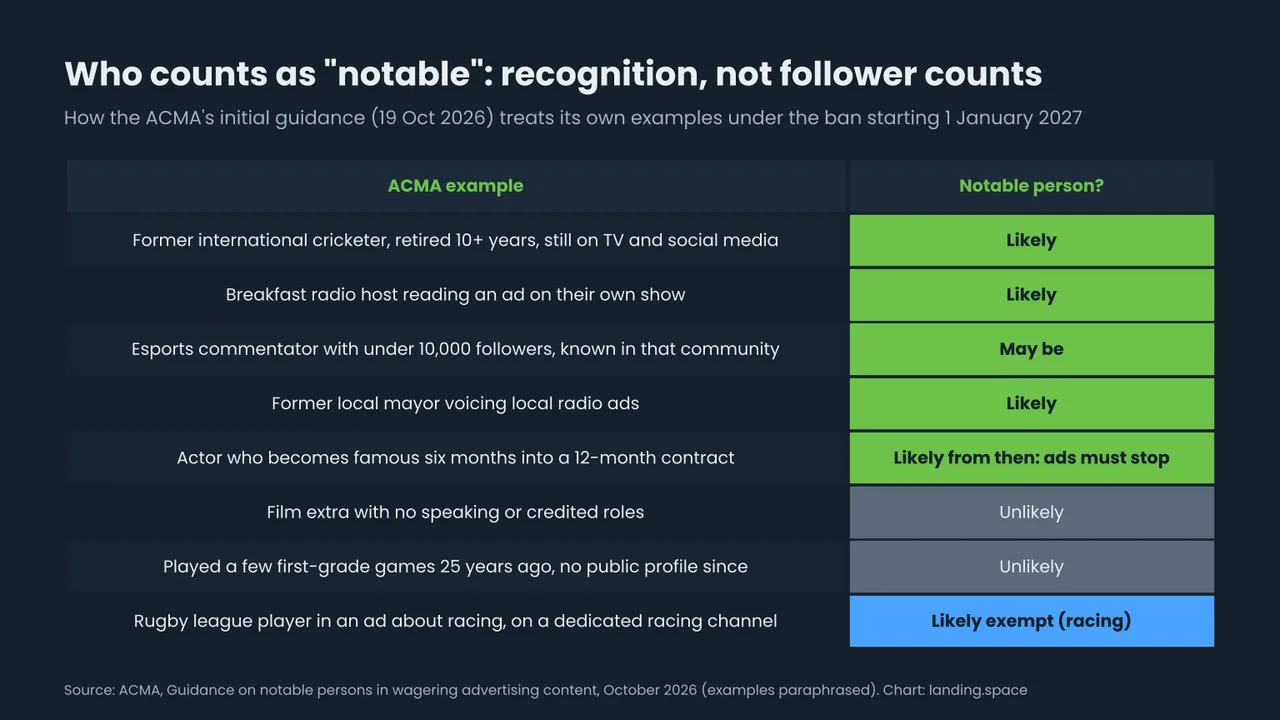
Two parts of the guidance change how campaigns are planned. The obligation, and any penalty, sits with the wagering provider, "not the notable person", and each broadcast or online showing counts as a separate contravention. Notability can also arrive mid-contract: in the ACMA's example, an unknown actor who lands a leading role six months into a 12-month campaign becomes notable, and the provider "must stop further advertising content from being shown". The main specific exception is racing content that relates "solely or principally" to racing and runs on a dedicated racing channel, program or online service; the Act's general exceptions, for conduct required by law, accidental conduct and journalism, also apply. The ACMA gives racing.com and the Melbourne Cup coverage as examples, and says a program that mixes racing with NRL or AFL is unlikely to qualify.
Ads on uniforms and at venues fall under a separate rule, section 62V, which the guidance says reaches every level of sport, grassroots included. Deals signed before the bill was introduced on 2 July 2026 are grandfathered until 31 December 2031, so a notable athlete may still be seen wearing a sponsor's logo; the ACMA says it is scoping a public list of those arrangements.
Australia: the biggest change of 2026
The Australian Government announced its package on 2 April 2026, including a ban on wagering advertising during live sport and in sports venues, with the reforms set to begin from 1 January 2027. Johnson Winter Slattery and Senet both date its passage through Parliament to 19 August 2026, and the Act received Royal Assent on 26 August 2026.
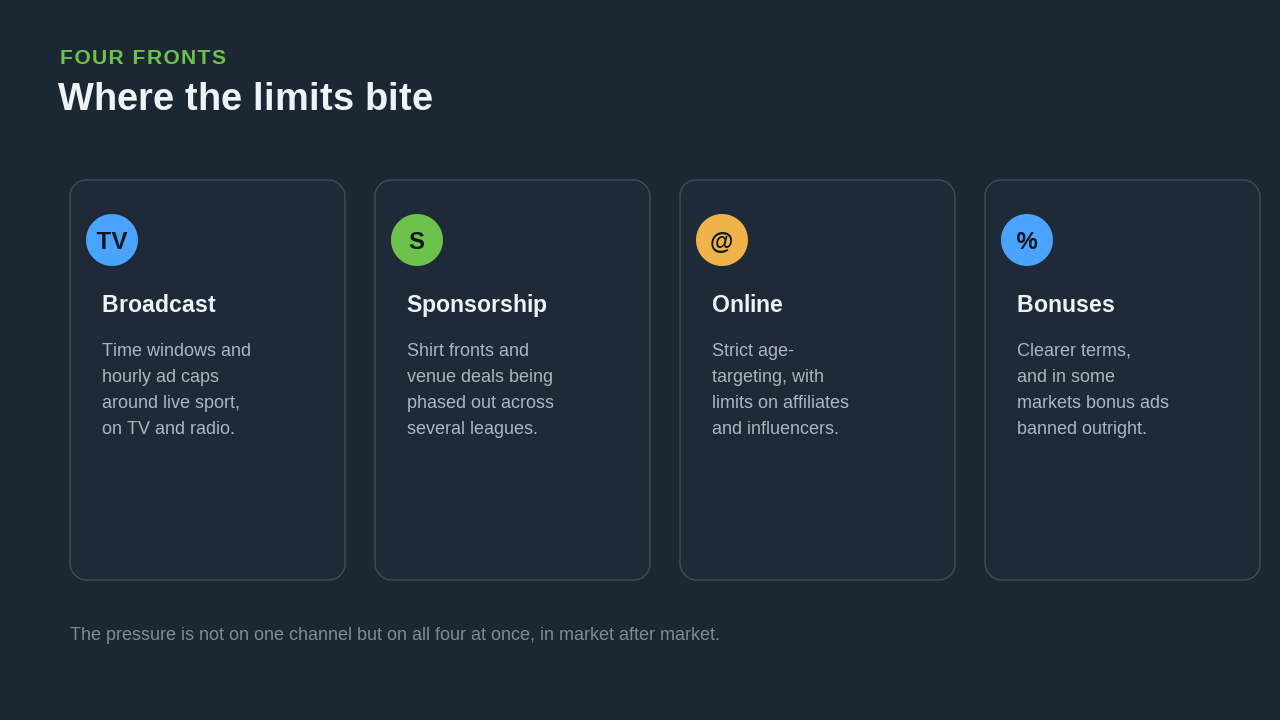
A legal summary by Johnson Winter Slattery sets out the main broadcast rules. Between 5:00am and 8:30pm, TV broadcasters are limited to three wagering ads per 60 minutes. No wagering ads may run from 15 minutes before to 5 minutes after live sport. Radio wagering ads are banned from 8:00am to 9:00am and from 3:00pm to 4:00pm, around school drop-off and pick-up. Online content services must stop minors, and people who have opted out, from seeing wagering ads, and must check a national opt-out register every 14 days.
Gaming Intelligence reported that the law also bans wagering ads in sports venues and on uniforms, and bans athletes, celebrities and influencers from promoting wagering. Senet's summary adds three more changes. Wagering staff and third parties can no longer be paid commissions linked to a customer's gambling. The live sport blackout will start 15 minutes before play instead of 5. The opt-out register will start later, on a date set by proclamation.
For comparison, ACMA's current rule for live sport on TV and radio bans gambling ads from 5 minutes before the scheduled start until 5 minutes after play, between 5:00am and 8:30pm. SCCG noted that the new law does not include the full advertising ban recommended in the parliamentary report known as the Murphy report. These rules cover wagering (sports and race betting), which is the licensed online gambling product in Australia. Our Australia hub covers the local market.
United Kingdom: appeal, bonuses and marketing consent
In the UK, the content of ads is governed by the CAP and BCAP codes, which the ASA enforces. Since 2022 the test has been whether an ad has "strong" appeal to under-18s, a stricter standard than the old "particular" appeal test. On 14 October 2025, CAP and BCAP updated their guidance. It now says that at least 100,000 social media followers registered as under-18, counted across platforms, indicates strong appeal. The update also gives more detail on adult-centric and non-adult-centric sports.
The Gambling Commission has changed how offers can be built. From 19 January 2026, bonus wagering requirements are capped at 10 times. Promotions that require customers to take part in two or more types of gambling, such as betting and slots, are banned. Separately, from 1 May 2025, operators have had to let customers opt in to direct marketing by product type and channel. Our wagering requirements analysis covers the bonus cap in detail.
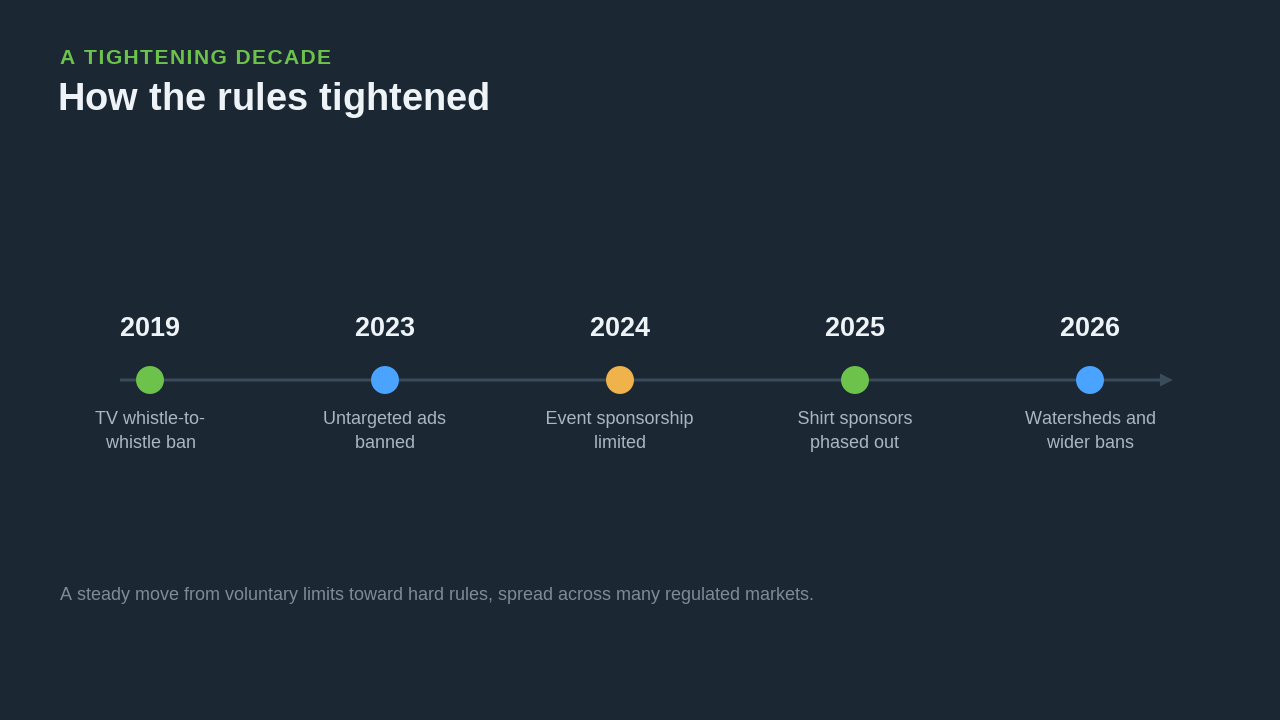
The best-known UK rule is still voluntary. The whistle-to-whistle ban, agreed by the Industry Group for Responsible Gambling and in place since summer 2019, stops TV betting ads from five minutes before to five minutes after live sport shown before the watershed. Horse and greyhound racing are exempt.
Ireland: a watershed in law that has not yet started
The Gambling Regulatory Authority of Ireland (GRAI) was established on 5 March 2025 under the Gambling Regulation Act 2024. The Act includes a statutory watershed that bans gambling advertising on television, radio and on-demand audiovisual media between 5:30am and 9:00pm.
A ministerial order took effect on 5 February 2026, allowing the GRAI to license remote operators from 1 July 2026 and in-person operators from 1 December 2026. Online casino licences are not expected before 2027. Some reports at the time, including one from Gambling Insider, described the watershed as taking effect with that order. The GRAI said something different in June 2026: it told the Racing Post that the advertising regulations must be commenced by the minister before they take effect, and that the timing is a matter for the department. We found no commencement order for the advertising rules as of 24 September 2026. See our Ireland hub for local context.
The Netherlands: from untargeted ads to sponsorship
The Netherlands moved in stages. A ban on untargeted advertising for online gambling began on 1 July 2023. It covers television, radio, newspapers, magazines, billboards, bus shelters and publicly accessible buildings. The sponsorship ban came next: programme and event sponsorship ended on 1 July 2024, and shirt sponsorship and deals with teams, competitions and individual athletes ended on 1 July 2025. iGaming Business reported that the Kansspelautoriteit said it would take immediate enforcement action against breaches.
Germany and Italy: rules that are already established
Some markets tightened years ago. Under Germany's 2021 State Treaty on Gambling, ads for virtual slot machines, online poker and online casino games are banned on broadcast media and the internet every day between 6:00 and 21:00. Italy's Decreto Dignità (Law 96/2018) banned most gambling advertising from 14 July 2018 and extended the ban to sponsorship from 1 January 2019.
How the markets compare
| Market | Main rule | Status |
|---|---|---|
| Australia | Wagering ads: 3 per hour on TV 5am to 8:30pm, live sport blackout from 15 min before, no venue, uniform or celebrity ads | Passed 19 Aug 2026, from 1 Jan 2027 |
| UK | Strong appeal to under-18s test; bonus wagering capped at 10x; no mixed-product offers | Cap in force from 19 Jan 2026 |
| UK | Whistle-to-whistle TV ban around pre-watershed live sport | Voluntary industry code since 2019 |
| Ireland | No TV, radio or on-demand gambling ads 5:30am to 9pm | In the 2024 Act, not yet commenced |
| Netherlands | No untargeted ads; no sports sponsorship | From 1 Jul 2023 and 1 Jul 2025 |
| Germany | No broadcast or internet ads for online casino, slots and poker 6:00 to 21:00 | In force since 2021 treaty |
| Italy | Broad ban on gambling ads and sponsorship | Since 2018 and 2019 |
What is confirmed and what is not yet known
Confirmed: Australia's law has passed and its main advertising rules are due to start on 1 January 2027. The ACMA's 19 October guidance confirms that the notable-persons ban starts on the same day, applies on every platform and binds the wagering provider, not the person in the ad. The Act sets the TV daytime window at 5:00am to 8:30pm, with no more than three wagering ads on a channel in any 60 minutes (section 62M). The UK's 10x bonus cap and mixed-product ban have applied since 19 January 2026. The Dutch sponsorship ban has been fully in force since 1 July 2025.
Not yet known: when Ireland's watershed will start, and when Australia's national advertising opt-out register will launch, since it depends on a proclamation. The ACMA has not yet issued formal guidance on the notable-persons provision, which it says it may do later, or the list of grandfathered sponsorship deals it is scoping.
What it means for players
In these markets you will see fewer gambling ads around live sport and in family viewing hours, and from 2027 Australian wagering ads should no longer feature athletes, celebrities or influencers on any platform, apart from narrow exceptions such as racing-only content on dedicated racing channels; athletes may still wear sponsors' logos under deals grandfathered until the end of 2031. In the UK, a bonus can no longer require more than 10 times wagering, so check the terms of any offer. Our responsible gambling guide explains the tools that let you cut marketing and set limits.
Frequently asked questions
When do Australia's new wagering ad limits start?
The main advertising restrictions in the Interactive Gambling Amendment (Gambling Reform) Act are due to start on 1 January 2027. The bill passed Parliament on 19 August 2026. The national advertising opt-out register will start later, on a date set by proclamation.
Who counts as a notable person under Australia's gambling ad ban?
Any current or former professional athlete, celebrity, social media influencer or prominent individual, or a person in a class the minister determines, under the Interactive Gambling Act. The ACMA's guidance of 19 October 2026 sets no follower threshold and says a person paid by a wagering company to appear in its ads is likely to count.
How many betting ads per hour will Australian TV allow?
Under section 62M of the amended Interactive Gambling Act, from 1 January 2027 a TV channel may show no more than three wagering ads in any 60 minutes between 5:00am and 8:30pm. The Johnson Winter Slattery summary adds that none may run from 15 minutes before to 5 minutes after live sport.
Is Ireland's 5:30am to 9pm gambling ad ban in force?
Not as of late September 2026, as far as we could confirm. The watershed is in the Gambling Regulation Act 2024, but in June 2026 the GRAI said the advertising regulations still needed to be commenced by the minister.
Is the UK whistle-to-whistle ban a law?
No. It is a voluntary industry code agreed by the Industry Group for Responsible Gambling and in place since summer 2019. It covers TV betting ads from five minutes before to five minutes after live sport shown before the watershed.
What is the 10x cap on UK casino bonuses?
Since 19 January 2026, the Gambling Commission has capped bonus wagering requirements at 10 times the bonus. It has also banned offers that require customers to play more than one type of gambling product.
Can gambling brands still sponsor Dutch football clubs?
Online gambling operators cannot. The Netherlands ended programme and event sponsorship on 1 July 2024 and shirt, team, competition and athlete sponsorship on 1 July 2025.
Sources
- ACMA - initial industry guidance on notable people in gambling advertising (19 Oct 2026)
- ACMA - Guidance on notable persons in wagering advertising content (October 2026)
- Interactive Gambling Amendment (Gambling Reform) Act 2026 (No. 72, 2026), as made
- Department of Infrastructure (Australia) - Gambling Reforms 2026
- Johnson Winter Slattery - Changes to Australian gambling advertising laws
- Gaming Intelligence - Australian Parliament passes Interactive Gambling Amendment Bill
- Senet - Australia's gambling advertising reforms: the current state of play
- ACMA - Gambling ads during live sport on broadcast TV and radio
- SCCG Management - Australia passes Interactive Gambling Amendment Bill 2026
- ASA and CAP - CAP and BCAP update guidance on protecting under-18s
- Gambling Commission - Gambling promotions to be safer and simpler
- Gambling Commission - New rules boosting safety and consumer choice
- Gambling Insider - Whistle-to-whistle UK gambling ad ban confirmed
- SBC News - GRAI begins duties as Gambling Authority of Ireland
- Citizens Information - Gambling Regulatory Authority of Ireland
- gov.ie - Minister signs order to allow the GRAI to begin issuing licences
- Gambling Insider - Ireland gambling regulator opens licensing
- Racing Post - New era of gambling regulation in Ireland set to commence next week
- iGaming Business - Game over for gambling sponsorship in Dutch sport
- LFK - Glücksspielstaatsvertrag FAQ
- Withers - The implications of Italy's ban on gambling advertisements
Go deeper
UK financial risk assessments will start at GBP 5,000 a day. How deposit limits, stake caps and credit bans compare in the Netherlands, Sweden and Finland.
Read article →
With fewer ads to go on, knowing how to check a licence matters more than ever.
Read guide →
The tools and habits that keep gambling safe, whatever the marketing around it.
Read guide →This article is independent editorial coverage and is not sponsored; no operator or supplier paid for inclusion. The facts were checked against the sources listed above on 24 September 2026 (the 26 October update against the ACMA's notable-persons article and guidance and the Act as made), and rules, programmes and offers can change after that date. Nothing here is legal or betting advice. 18+ only (21+ for online casino in the US states that license it); if you gamble, set your limits in advance.